What a Home Service Marketing Agency Costs (Real 2026 Pricing)
A home service marketing agency usually costs $2,500 to $10,000 per month for the retainer before ad spend, software, content, and performance fees. Larger programs often run $12,000 to $25,000 per month all in before any revenue-share fee, because paid media, local search, landing pages, call tracking, reporting, and follow-up work all need labor and budget.
You need total monthly cash out, not the retainer alone. Get five lines before you sign: agency retainer, media budget, software and tracking, content production, and any fee tied to collected cash.
The short answer on 2026 pricing
Most home service businesses pay $2,500 to $10,000 per month for an agency retainer in 2026, according to a home-service pricing guide from Hook Agency [1]. Broader agency data shows a wide market, from about $3,000 per month for one service to $75,000 per month for a full-stack partnership [2].
Agencies pack different labor under the same label. One $3,500 retainer might cover Google Ads and a monthly report. A $10,000 retainer might cover local SEO, paid search, landing pages, call tracking, CRM handoff, and weekly revenue review.
For a $3M to $10M company, set spend as a share of revenue. One 2026 home-service budget guide places established companies at 5% to 12% of gross revenue, with growth mode at 8% to 12% [3]. A $5M company then spends $250,000 to $600,000 per year, or about $20,833 to $50,000 per month, across agency fees, media, tools, and content.
Pricing models you will see
Home-service owners usually see three models. General pricing models match common agency patterns [4].
-
Monthly retainer. A fixed fee covers recurring work: labor, meetings, reporting, management, and planning. This fits search, reviews, ads, landing pages, and call tracking that need weekly work.
-
Media management fee. The agency prices ad account work as a flat fee, a percent of spend, or a tier. Hook Agency lists Google Ads management at $500 to $2,500 per month for home service, with ad spend often $1,000 to $5,000 or more in competitive markets [1].
-
Hybrid performance. A base retainer plus a fee tied to results. Scale Your Offers uses a retainer plus 5% of collected cash from agency-sourced jobs.
Retainer bands and what each one buys
Use this table to filter proposals. Exact price depends on market, trade, tracking, ad history, locations, and owned scope.
| Monthly retainer band | Typical buyer | Work usually included | Cash planning note |
|---|---|---|---|
| $2,500 to $4,000 | Owner needs one main channel managed | Google Ads setup, local landing page edits, monthly reporting, basic call tracking review | Plan separate ad spend and tool fees |
| $5,000 to $10,000 | Owner wants steady demand across paid search and local search | Google Ads, Local Service Ads, local SEO, landing pages, review plan, lead source reporting | Plan $5,000 to $20,000 in media for many markets |
| $10,000 to $15,000 | Owner has crews to fill and sales tracking in place | Paid search, paid social, funnel work, call review, offer testing, CRM handoff, weekly pipeline review | Plan content, software, and sales follow-up labor |
| $15,000 to $25,000+ | Owner wants a full acquisition engine | Multi-channel paid media, testing, funnel builds, local SEO, tracking, sales process review, revenue reporting | Plan larger media budgets and clear capacity limits |
| Retainer plus performance fee | Owner wants the agency paid partly on collected cash | Base operating work plus agreed fee on collected revenue from sourced jobs | Define attribution, collection timing, and exclusions in writing |
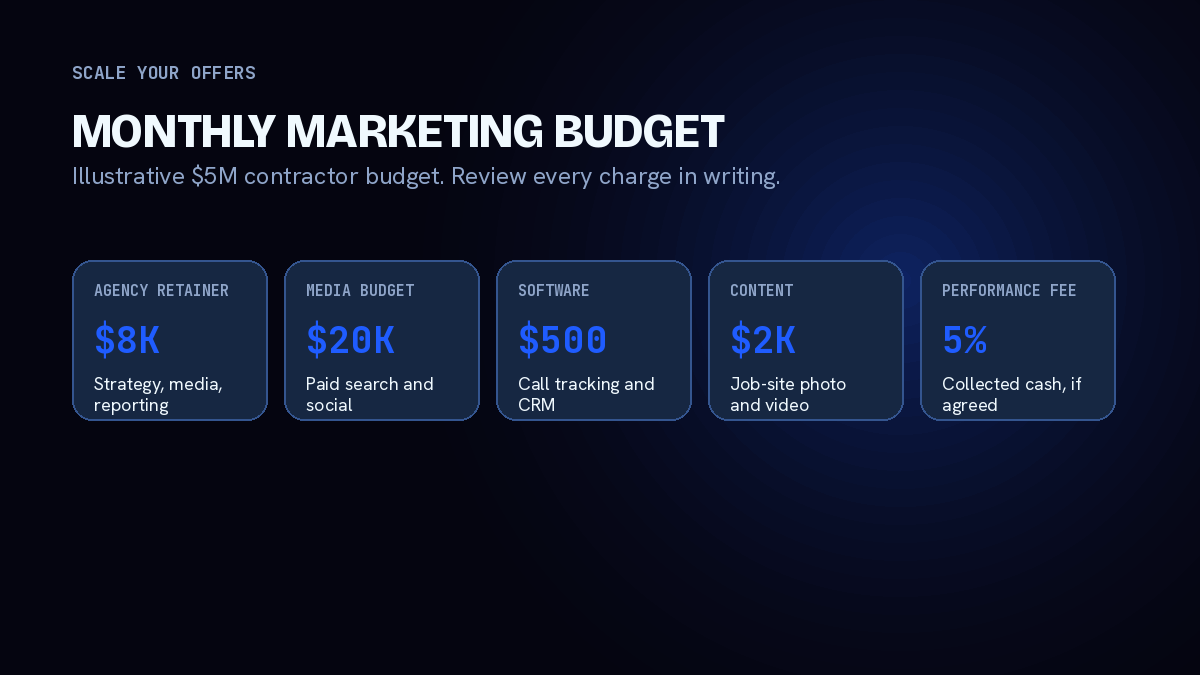
A low retainer can still produce a high bill. A $4,000 retainer with $18,000 in ad spend, $600 in tools, and $2,000 in content totals $24,600 before any performance fee. A higher retainer can still fail when the media plan starves demand. The fee tells you what the agency charges. The lead plan tells you whether the spend can create enough booked work.
Charges outside the retainer
-
Ad spend. Agencies manage Google Ads, Local Service Ads, Meta, YouTube, or retargeting. You pay platforms directly. You should see platform spend, campaign names, lead sources, and booked-job output.
-
Software. Hook Agency lists tool charges at $200 to $600 per month for call tracking, CRM links, and review platforms [1]. Multi-location tracking, call scoring, AI answering, or advanced reporting can raise this line.
-
Content. Truck wrap photos, jobsite sets, technician shoots, offer-page copy, video ads, or city-page sets often sit outside the base retainer. Ask what the fee covers.
-
Website. Many retainers exclude builds. A template site costs several thousand dollars. A custom, tracked site with routing and CRM links costs more. Confirm who owns site files, landing pages, and analytics after the contract.
Media budget changes the total cost
Paid demand needs both management and spend.
A $7,500 retainer with $3,000 in ad spend often gives too little fuel in a competitive market. A $7,500 retainer with $25,000 in ad spend can drive enough volume for useful testing when tracking and follow-up work.
Start with your revenue target. If you need $150,000 in new monthly sold work and your average job equals $5,000, you need 30 sold jobs. If your close rate from qualified booked appointments equals 40%, you need 75 qualified booked appointments. If 60% of paid leads become qualified booked appointments, you need 125 paid leads.
Then set budget by cost per lead. At $150 per paid lead, 125 leads need $18,750 in media. At $250 per paid lead, 125 leads need $31,250. The retainer sits on top of media.
The agency must connect spend to leads, leads to appointments, appointments to sold jobs, sold jobs to collected cash, and collected cash to margin.
Performance-fee math
A performance fee can align incentives when both sides define the math. Scale Your Offers uses a retainer plus 5% of collected cash. Collected cash matters because the fee ties to money received, not signed contracts alone.
Read that fee this way. If agency-sourced jobs produce $100,000 in collected cash during the billing period, a 5% fee equals $5,000. If collected cash equals $250,000, the fee equals $12,500. If a job cancels before collection, the agreement states how that job enters the fee calculation.
This fee works when the company tracks lead source, appointment set date, estimate date, sold date, install date, invoice amount, and collected amount. Without that data, both sides argue over credit.
Separate agency-sourced revenue from house-file revenue. If a prior customer clicks an ad and books again, the contract needs a rule. If a referral clicks a branded search ad, the contract needs a rule. If a customer books through a database campaign, the contract needs a rule.
Labeled worked example: $5M home-service company
Use your CRM, accounting, and call-tracking data to replace each input.
Annual revenue equals $5,000,000. The owner targets a 10% annual marketing budget. That sets $500,000 per year, or $41,667 per month.
The average ticket equals $2,500. The sales team closes 40% of qualified booked appointments. The owner wants 70 new jobs per month from the marketing program.
Required qualified booked appointments equal 70 divided by 0.40. The result equals 175 appointments.
The expected cost per qualified lead equals $200. Media spend for 175 qualified leads equals 175 times $200. The result equals $35,000.
Agency retainer equals $12,000 per month. Software and tracking equal $500 per month. Content and jobsite media equal $2,000 per month. Media spend equals $35,000 per month.
Before the performance fee, monthly marketing cash out equals $49,500.
Now apply a 5% fee to collected cash from agency-sourced jobs. If 70 jobs close at a $2,500 average ticket, sold work equals $175,000. If the company collects the full $175,000 in that period, the 5% fee equals $8,750.
Total monthly cash out equals $49,500 plus $8,750. The result equals $58,250.
That number equals 13.98% of monthly revenue if the company runs at $416,667 per month. The owner can run that level for a short push when capacity and gross margin hold. For a steady 10% budget, the owner must trim media, retainer scope, content, or performance-fee exposure.
The budget test before you sign
Start with required booked work and capacity.
Write down five numbers:
1) Monthly revenue capacity. If crews can install $600,000 per month, that sets the ceiling for new sold work.
2) Required added revenue. If you sell $450,000 per month and capacity equals $600,000, your gap equals $150,000.
3) Average job size. If your average job equals $7,500, you need 20 added jobs to close a $150,000 gap.
4) Close rate by source. Paid search, Local Service Ads, referrals, organic, and database campaigns close at different rates. Use CRM data.
5) Gross margin. A $500 acquisition cost on a $2,500 job differs from a $1,500 acquisition cost on a $15,000 job. Margin sets room for marketing.
For the operating pattern behind ads, funnel, tracking, and follow-up, read The Booked-Out Contractor, a $2.95 book that explains the paid-ads machine in plain terms from the page copy.
A.C.E. cost check for agency pricing
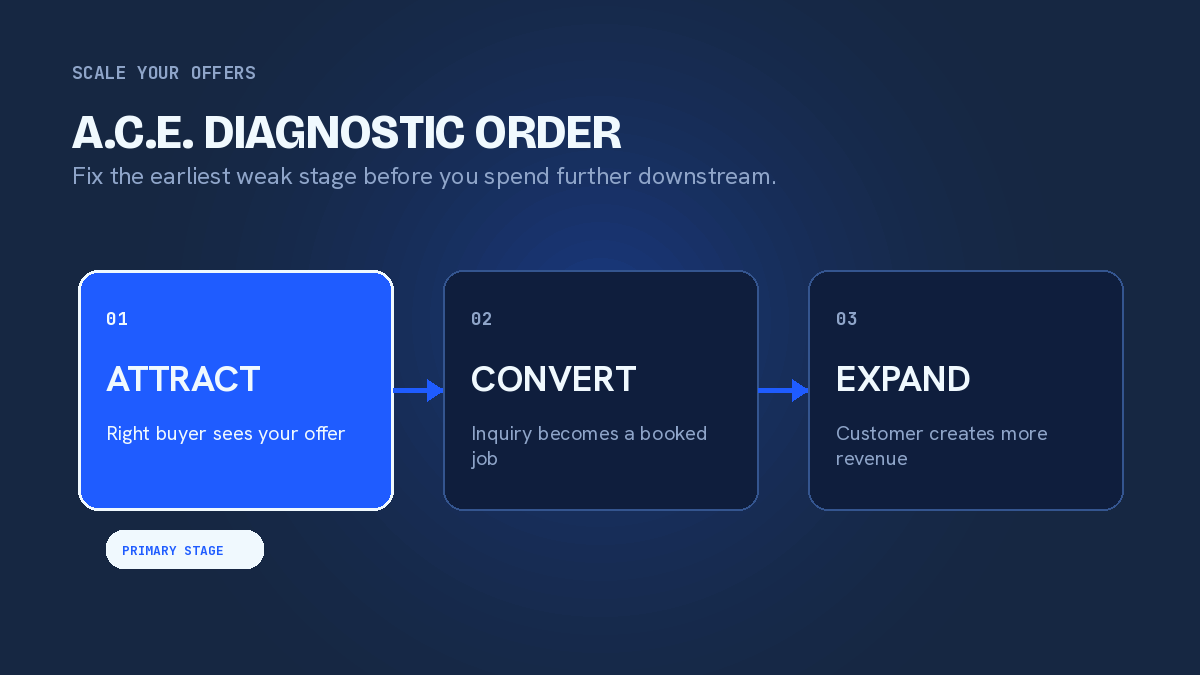
The first weak A.C.E. stage tells you where to start. A.C.E. means Attract, Convert, and Expand.
-
Attract brings the right buyers into your pipeline. For pricing, this line includes paid search, Local Service Ads, local SEO, landing pages, offers, targeting, and media spend. Start here when crews need more qualified demand and your market presence falls short of the revenue target.
-
Convert turns inquiries into booked and sold work. This line includes speed to lead, call handling, forms, texts, booking rules, estimate follow-up, and sales pipeline review. A higher ad budget wastes money when calls ring through, forms sit, or estimates lack follow-up.
-
Expand increases revenue per customer. This line includes memberships, repair-to-replacement paths, add-on products, return visits, and database campaigns. Expand after you build enough demand and your conversion process captures the demand you already paid for.
For this topic, the primary stage is Attract because agency retainers and media budgets buy demand creation first. Review Convert before you raise media spend. If your company misses calls or loses estimates, a higher agency fee exposes a sales-process leak faster.
Use the Lead Flow Score page for a quick A.C.E. read. The page lists 12 questions, a 90-second path, no cost, and an instant result.
What a fair proposal should show
A fair proposal shows all costs and what each dollar funds.
-
One monthly view of retainer, media budget, tool fees, content costs, and any performance fee.
-
A channel list with separate line items when labor differs: Google Ads, Local Service Ads, SEO, Meta, retargeting, email, database campaigns, landing pages, and call tracking.
-
Planning math: target lead count, target cost per lead, target appointment count, expected close rate, expected sold revenue, and collection timing. Treat these as planning inputs, not guarantees.
-
Reporting, ownership, and the first 90 days. Define metrics back to jobs and cash. Define account, asset, and data ownership. Define a first-quarter plan for tracking cleanup, offers, builds, tests, call review, reporting, and budget pacing.
When a higher agency fee makes sense
Pay a higher fee when the agency owns more revenue work and your company can monetize it. A $15,000 retainer can fit a $7M contractor that needs multiple channels, jobsite content, sales follow-up reporting, and weekly revenue review.
Pay a higher fee when your internal team lacks time for details. Campaign structure, search terms, landing pages, call tracking, forms, reviews, CRM source data, and tests need attention.
Pay a higher fee when the agency cuts waste. Waste includes irrelevant search terms, weak offer pages, slow callbacks, duplicate leads, poor source tracking, and media spend during dead capacity windows.
Set a ceiling tied to contribution margin. If the program produces $200,000 in collected cash at a 45% gross margin, gross profit equals $90,000. If total marketing cost equals $55,000, the program leaves $35,000 before overhead.
FAQ
How much does a home service marketing agency cost in 2026?
A typical home service agency retainer runs $2,500 to $10,000 per month before ad spend. Larger programs often run higher when the agency manages paid media, SEO, landing pages, call tracking, content, and reporting.
Does the retainer include ad spend?
Many agency retainers exclude ad spend. Plan media as a separate budget line that you pay to platforms like Google, Meta, or Local Service Ads.
How does a 5% collected-cash performance fee work?
A 5% collected-cash fee means you pay 5% of cash received from agreed agency-sourced jobs. If collected cash equals $100,000, the fee equals $5,000.
What should I ask for before signing an agency contract?
Ask for a full monthly budget, channel list, tracking rules, reporting format, 90-day plan, ownership terms, and performance-fee terms. You also need the math that connects spend to leads, appointments, sold jobs, and collected cash.
If you want Scale Your Offers to review your agency spend, channel mix, tracking, and A.C.E. bottleneck, book an A.C.E. Audit. We will look at the first weak stage, then tie the fix to numbers your team can verify.
References and definitions
[1] Hook Agency, “Digital Marketing Costs For Home Service Businesses In 2026,” retrieved from https://hookagency.com/blog/digital-marketing-costs-for-home-service-businesses-in-2026/.
[2] Darkroom, “Marketing Agency Cost 2026: Pricing by Service,” retrieved from https://www.darkroomagency.com/observatory/marketing-agency-cost-2026-pricing-by-service.
[3] Bringing Home Bacon, “How Much Should Home Service Businesses Spend on Marketing in 2026,” retrieved from https://bringinghomebacon.com/how-much-should-home-service-businesses-spend-on-marketing-in-2026-a-practical-budget-breakdown/.
[4] Taskip, “Digital Marketing Agency Pricing Models,” retrieved from https://taskip.net/digital-marketing-agency-pricing-models/.
Attract: Attract covers paid and owned demand that brings the right buyers into the service area pipeline.
Convert: Convert covers speed, booking, qualification, sales follow-up, and the close process that turn inquiries into revenue.
Expand: Expand covers added revenue from current customers through memberships, replacement paths, add-ons, return visits, and database campaigns.