
How to Build an HVAC Referral Program That Produces Replacement Leads
An HVAC referral program should produce more than casual names. It should create replacement conversations with homeowners who already trust the person making the introduction.
The program works best when your team asks after high-satisfaction service events, tracks every referral in the CRM, and pays rewards only after completed paid work. That operating rule protects margin, keeps the customer relationship clean, and turns your installed base into a repeatable source of replacement demand.
Many HVAC companies ask for referrals at random. A technician may mention it at the end of a tune-up. A comfort advisor may mention it after a sale. A dispatcher may add it to an email. That loose method creates loose numbers.
A replacement-focused referral system needs tighter control. The ask must happen when the homeowner feels the result. The reward must match the job type. The follow-up must move fast enough to book the referred homeowner before the need cools.
ACCA guidance connects customer trust with installation work and preventive maintenance contact, which gives HVAC owners a practical place to start the referral ask [1]. ENERGY STAR states that heating and cooling equipment older than 10 to 15 years can be a candidate for replacement, which gives your team a clear filter for referral fit [2].
Start With the Replacement Lead You Want
Define the referral before you announce the program to customers or technicians. A referral for a $129 inspection does not carry the same economics as a referral for a 14-year-old system replacement consultation.
Your program should separate three referral types:
- A repair referral for a homeowner with an active comfort issue.
- A maintenance agreement referral for a homeowner who wants routine care.
- A replacement referral for a homeowner with older equipment, repair history, comfort complaints, or efficiency concerns.
The third category deserves the strongest reward because it can create the largest gross profit pool. It also needs the most careful screening because weak qualification burns sales capacity.
Use one written definition across the company. A replacement referral means the referred homeowner has an HVAC system near the 10 to 15 year range, a failing or unreliable system, a comfort problem that repair may fail to solve, or interest in a full system estimate [2].
That definition gives your CSR, dispatcher, technician, and comfort advisor the same target.
Set the Ask at High-Satisfaction Moments
The referral ask should happen after proof of service, not during pressure. A homeowner who just received a clean install, a tidy walkthrough, and a comfort follow-up has a better reason to introduce your company to a neighbor.
Use two primary moments.
The first moment is the 72-hour post-install follow-up. The customer has heard the new system run. The home feels different. The noise level, thermostat performance, and comfort pattern are fresh. The call should check satisfaction first and ask for referrals second.
The second moment is the first annual maintenance visit after an installation. The homeowner has experienced a full heating and cooling cycle with your company. The technician can ask after completing the tune-up, cleaning the area, and confirming that the customer feels good about the work.
Do not let the team ask for replacement referrals during a stressful breakdown unless the customer gives praise first. The ask should follow relief, trust, and confirmed satisfaction.
Use a Referral Moment Table
The table below gives your team a practical referral plan. Put this into your field service software, CSR scripts, and technician meeting rhythm.
| Customer moment | Owner of the ask | Replacement referral script | CRM action | Reward trigger |
|---|---|---|---|---|
| 72 hours after completed install | Install coordinator or CSR | “Your new system has had a few days to run. If someone you know has an older unit or keeps dealing with repairs, we can give them a replacement consultation.” | Tag customer as post-install referral source | Paid after referred replacement job receives final payment |
| First annual maintenance after install | Technician | “Your system looks good today. Many neighbors wait until a breakdown. If you know someone with a 10 to 15 year old unit, I can send them a referral link.” | Add referral source name and referred homeowner name | Paid after completed paid work |
| Positive review or praise call | CSR | “Thank you for saying that. If a friend needs help with an older system, I can send you a referral link.” | Log praise moment and referral ask | Paid after completed paid work |
| Repair with aging system in the customer’s network | Technician | “If someone you know keeps putting money into an older system, we can inspect it and give options.” | Mark as repair-to-replacement referral | Paid after replacement close |
| Maintenance agreement renewal | CSR | “Your agreement keeps your system on schedule. If a family member wants the same care or has an older unit, I can send the referral page.” | Add renewal referral ask | Paid after completed paid work |
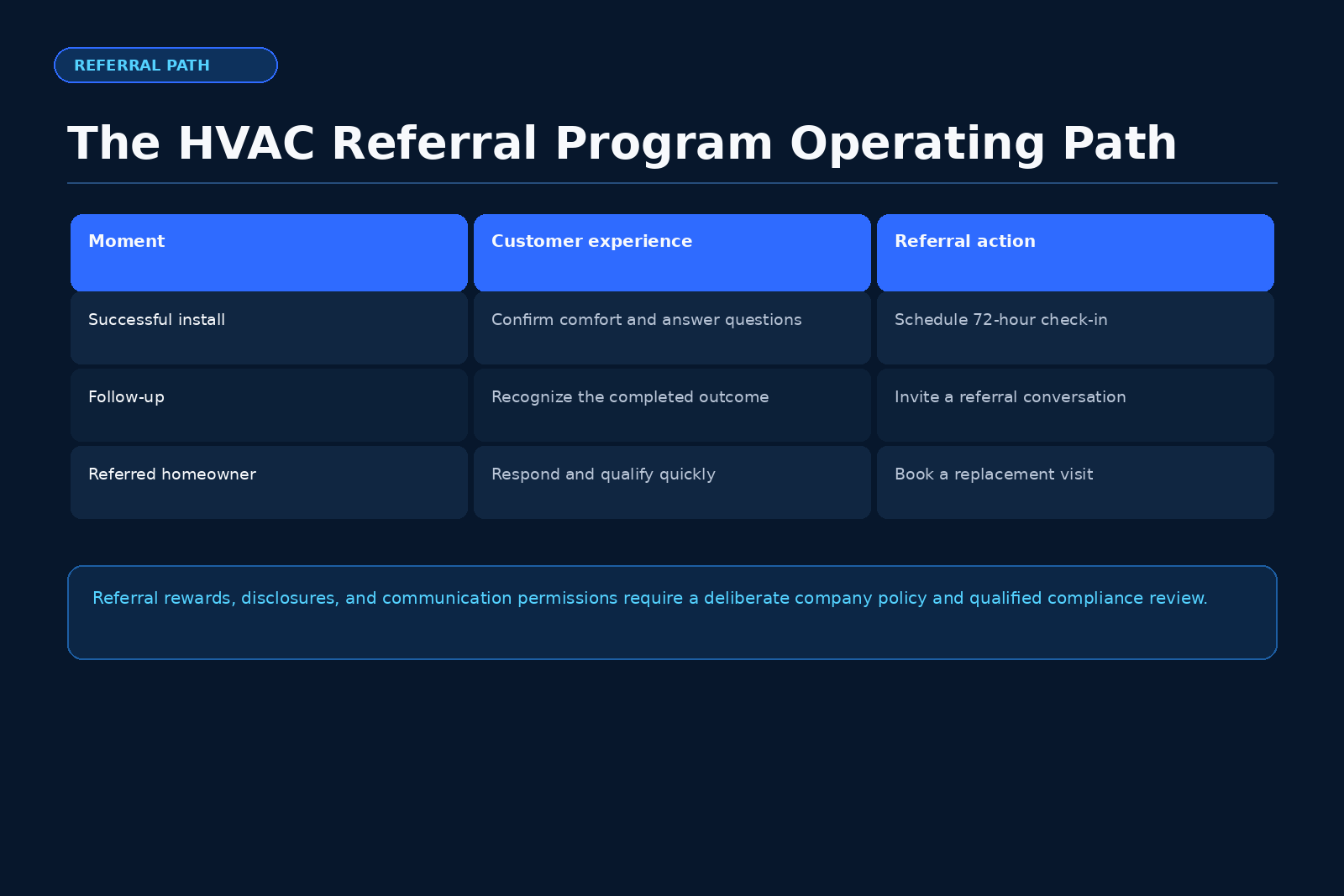
The customer should never need to remember your phone number or explain your process. Send a referral link by text or email after the verbal ask when channel consent exists. The page should ask for the referred homeowner’s name, phone, email, address, system age if known, comfort issue, and preferred contact window.
Protect Margin With Reward Tiers
A single reward for every referral creates margin problems. A $250 payout may make sense on a completed replacement. The same payout can wipe out a small repair ticket.
Use tiers tied to completed paid work.
A practical tier model can look like this:
- Maintenance agreement referral: account credit after the agreement payment clears.
- Repair referral: smaller account credit after the repair invoice receives payment.
- Replacement referral: larger gift card or account credit after final payment on the installed system.
- IAQ add-on referral: moderate account credit after completed paid work.
Account credits can keep future service inside your company. Gift cards can work for full replacements because the sale size gives more room. Keep the payout tied to collected revenue, not booked appointments.
Your terms should state that the referred homeowner must complete paid work before any reward goes out. Your team should also explain that rewards may require disclosure when customers mention an incentive. The FTC endorsement guides address material connections, and the FTC states that incentives connected to endorsements or reviews require clear disclosure [3][4].
Worked Illustrative Calculation: Reward Size Against Gross Profit
Use your own average tickets, close rates, and gross margins. The numbers below show the math pattern only.
Assume a referred replacement job has these inputs:
- Average replacement sale: $12,000
- Gross margin target: 45%
- Gross profit before referral reward: $12,000 × 45% = $5,400
- Replacement referral reward: $250
- Card and admin cost: $25
- Total reward cost: $250 + $25 = $275
- Reward cost as share of gross profit: $275 ÷ $5,400 = 5.1%
That referral reward leaves $5,125 of gross profit before overhead allocation.
Now compare the same reward to a repair:
- Average repair sale: $450
- Gross margin target: 50%
- Gross profit before referral reward: $450 × 50% = $225
- Same reward cost: $275
- Reward cost as share of gross profit: $275 ÷ $225 = 122.2%
The repair cannot carry that payout. This is why replacement referrals need a separate tier.
If your average replacement sale is $15,000 and your gross margin target is 42%, the gross profit before reward equals $6,300. A $300 reward plus $30 admin cost equals $330. The reward cost equals 5.2% of gross profit. The owner can then decide whether the acquisition cost fits the plan.
Build the CSR and Technician Script
Your script should feel plain and specific. It should mention the type of homeowner you want to help.
A technician can say this after a strong maintenance visit:
“Your system is in good shape today. If you have a neighbor or family member with an older unit, repeated repairs, uneven rooms, or rising comfort complaints, I can send you a referral link. We only send the reward after completed paid work, so the process stays clear.”
A CSR can say this after a post-install follow-up:
“I am glad the system is running well. If someone you know has an older furnace, AC, or heat pump and wants replacement options, I can text you a referral link. The program pays after completed work, and we explain the referral reward in the process.”
The language does four things. It confirms satisfaction. It names replacement fit. It removes confusion about the reward. It lets the customer decide without pressure.
Automate the Ask Without Losing Control
A referral program breaks down when every ask depends on memory. Use automation to trigger the right message after the right event.
Create these triggers in your CRM or field service system:
- Completed replacement install plus paid invoice creates a 72-hour satisfaction call task.
- Satisfaction marked positive creates a referral link text or email.
- First annual maintenance after install creates a technician prompt.
- Referral form submission creates an immediate CSR call task.
- Referred lead status changes from booked, to quoted, to sold, to paid.
- Paid status creates reward approval task for the office manager.
Email programs need opt-out discipline. The FTC’s CAN-SPAM guide states that commercial email must give recipients a clear opt-out method, keep the opt-out mechanism available for at least 30 days after sending, and honor opt-out requests within 10 business days [5]. SMS programs require channel-specific legal review before launch because consent duties differ by channel and location.
The program should also log reward disclosures. If a customer receives a reward for referring a friend, your forms and follow-up messages should make that material connection visible [3][4].
Use Fast Follow-Up on Referred Replacement Leads
A referred lead has trust at entry, but speed still matters. The referred homeowner may have an old system, active discomfort, or another contractor in the mix.
A Workato study in a B2B setting cited earlier lead-response research showing that lead qualification odds fell sharply as response time moved from five to ten minutes. Workato’s own 2026 sample found that more than 99% of sampled companies did not send a personalized email within five minutes, and none called within five minutes [6]. This evidence comes from B2B, so use it as directional evidence for response discipline, not as an HVAC guarantee.
Set your referred-lead standard at five minutes during business hours.
The CSR should call first, text second, and email third when consent permits. The first call should confirm the referral source, equipment age, system type, urgency, homeowner ownership status, and appointment window. The CSR should book the consultation during the call if the fit matches your replacement criteria.
If the referred homeowner asks for price by text, move to a call. The CSR can say, “Replacement pricing depends on the system, comfort needs, home layout, and options. I can book a consultation and make sure we prepare the right choices.”
For replacement-estimate follow-up and database reactivation, Scale Your Offers describes the fastest revenue path as work inside the existing customer list. Its HVAC page frames A.C.E. order and gives an illustrative unsold-estimate model that owners should replace with their own figures [7]. Use that same discipline for referrals: measure source, speed, booking rate, quote rate, close rate, and collected revenue.
A.C.E. Section: Fit the Referral Program Into the Growth System
A referral program sits in Expand, but A.C.E. still starts at the earliest constraint. Fix the first weak stage before you scale the next one.
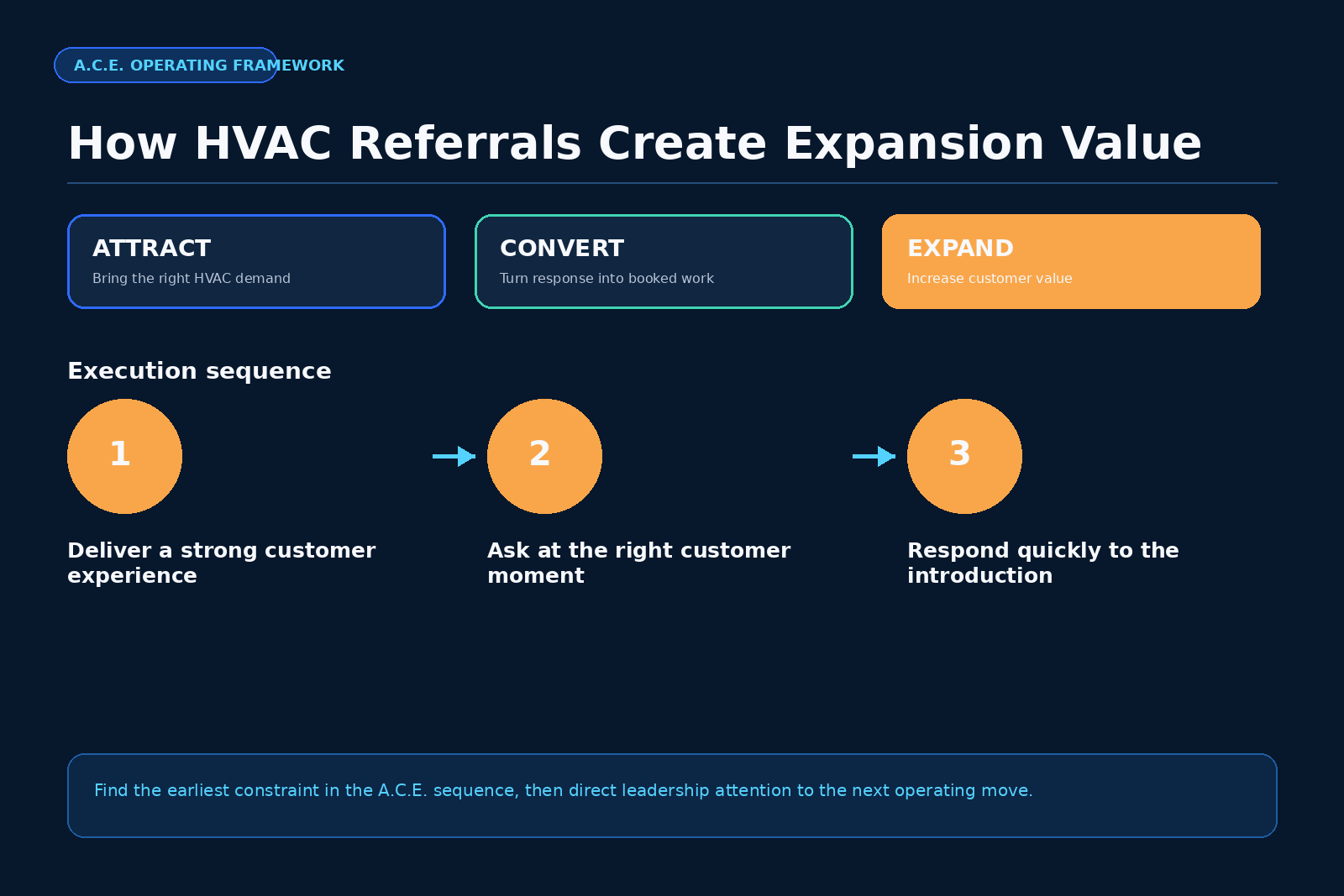
Attract: Attract brings HVAC maintenance and replacement buyers from the service area. If your company lacks enough total demand, referrals alone will not fill the board. Paid traffic, local search demand, seasonal campaigns, and maintenance promotions feed the top of the system. For owners who want a paid-ads machine covering ads, funnel, tracking, and follow-up, The Booked-Out Contractor, a $2.95 book describes that system on the Scale Your Offers page [8].
Convert: Convert covers response speed, qualification, booking, presentations, and estimate follow-up. If your CSRs miss referred leads or your comfort advisors fail to follow up on estimates, a larger referral program will leak trust. Fix call speed, booking scripts, sales handoff, and follow-up status rules before you increase asks.
Expand: Expand covers maintenance agreements, referrals, indoor air quality, repair-to-replacement, and database reactivation. Once Attract and Convert have a stable base, a referral program can raise lifetime customer revenue by turning happy customers into warm introductions. This stage works because the existing customer already knows your workmanship, scheduling, cleanup, and follow-through.
If you do not know which A.C.E. stage has the earliest constraint, the ACE Assessment page says its Lead Flow Score uses 12 questions, takes 90 seconds, has no cost, and gives an instant result [9]. Owners who want a deeper operating review can request an ACE Audit.
Track the Program Like a Sales Channel
Treat referrals like a channel with numbers, owners, and weekly review. Do not bury them inside generic call tracking.
Use these fields in your CRM:
- Referring customer name.
- Referred homeowner name.
- Referral date.
- Referral channel.
- System age or age range.
- Lead type.
- First response time.
- Appointment booked.
- Estimate given.
- Sold status.
- Paid status.
- Reward approved.
- Reward sent.
- Reward disclosure logged.
Review the numbers weekly. Count referral asks, referral submissions, booked appointments, estimates, sold jobs, collected revenue, gross profit estimate, reward cost, and net gross profit after reward.
A comfort advisor should see every referred replacement lead source before the appointment. The source gives context and helps the advisor protect trust. The referred homeowner should hear that the company appreciates the introduction and will give clear options.
Keep Customer Trust Ahead of Reward Hype
The referral program should never sound like a cash grab. HVAC replacement carries a large household decision. Customers will only refer friends if they believe your team will treat them well.
Use plain reward terms. Pay after completed paid work. Disclose incentives. Keep outreach compliant. Train the team to ask after satisfaction, not pressure.
The best referral programs protect the customer’s name. If your company damages that trust, the referral source stops sending people. If your company handles the referred homeowner with care, the original customer gains confidence in sending the next one.
FAQ
How much should an HVAC referral reward be for a replacement lead?
Set the reward from gross profit math. A $250 to $300 reward may fit a full replacement in many illustrative models, but your company should use its own average ticket, margin target, and admin cost before finalizing the number.
Should technicians ask for replacement referrals?
Technicians can ask when the timing fits. The best moments come after a clean maintenance visit, a successful post-install check, or a clear praise moment. The script should name older systems, repeated repairs, and comfort issues.
Should the reward go out when the appointment books?
Pay after completed paid work. A booked appointment can cancel, fail qualification, or turn into a small repair. Paid-work triggers protect margin and reduce confusion.
How should an HVAC company handle referral disclosures?
Tell customers when a reward exists and include the disclosure in referral pages, emails, and follow-up language. FTC guidance addresses material connections tied to endorsements and reviews, so get legal review before launch.
If you want to find the first leak before adding more referral asks, take the ACE Assessment. It will help you see whether Attract, Convert, or Expand needs attention first, then you can build the referral program on a cleaner operating base.
References
- ACCA, “10 Strategies for Building Your HVAC Customer Base”
- ENERGY STAR, “Heating and Cooling: Replace”
- eCFR, “16 CFR Part 255: Guides Concerning Use of Endorsements and Testimonials in Advertising”
- FTC, “Consumer Reviews and Testimonials Rule: Questions and Answers”
- FTC, “CAN-SPAM Act: A Compliance Guide for Business”
- Workato, “Lead Response Time Study”
- Scale Your Offers, “The Fastest Money”
- Scale Your Offers, “The Booked-Out Contractor”
- Scale Your Offers, “ACE Assessment”