The Best HVAC Marketing Agencies in 2026 (Honest Comparison)
The best HVAC marketing agency in 2026 turns your local demand gap into booked and sold jobs you can track. A $3M to $10M HVAC company needs verifiable math, reporting tied to revenue, and a plan that keeps techs and installers busy with the right calls.
Start with a scorecard before you name agencies. One company needs more replacement leads. Another needs faster response on current inquiries. Another needs better follow-up on unsold estimates.
Scale Your Offers belongs in this review with a direct caveat. The contractor vertical remains newer for Scale Your Offers, while the company’s aggregate proof spans more than $12 million in tracked revenue and more than 50,000 leads across accounts the company has touched. Those figures cover company-wide work and make no HVAC-only result claim.
A scorecard should come before the agency shortlist
Score agencies against booked revenue, not deck polish. The right partner shows how it creates qualified demand, tracks booked jobs, and works with your CSR team, sales process, CRM, and dispatch reality.
Third-party lists use different yardsticks. First Page Sage says its ranking formula assigns 40% to client roster, 30% to leader track record, 20% to average online reviews, and 10% to company size and founding year.[2] Built-Right Digital says it evaluates HVAC marketing companies by qualified lead generation, transparent reporting, and HVAC industry knowledge.[3] LettrLabs lists selection criteria that include industry experience, reputation, references, service range, and communication.[4]
Those inputs help. A $5M HVAC company still needs an operating scorecard that ties channel plans to booked jobs and revenue.
| Evaluation factor | Weight | What the agency must show | Owner check |
|---|---|---|---|
| HVAC buyer fit | 20% | Campaigns match replacement, service, tune-up, maintenance, and emergency intent | Ask for channel plan by job type |
| Local market fit | 15% | Budget matches your service area, seasonality, and install capacity | Compare plan to crew calendar |
| Lead-to-booked-job tracking | 20% | Reports connect spend, lead source, booked appointment, estimate, sale, and revenue | Audit CRM fields before signing |
| Conversion process | 15% | Plan includes speed to lead, qualification, booking, and follow-up | Test response workflow with sample leads |
| Reporting clarity | 10% | Dashboard shows cost per lead, cost per booked job, cost per sale, and revenue | Require weekly number review |
| Channel skill | 10% | Agency explains PPC, SEO, Local Services Ads, retargeting, email, and landing pages in plain math | Match channels to current gap |
| Operating fit | 10% | Meeting cadence, decision rights, and CRM access match your team | Name owners for every task |
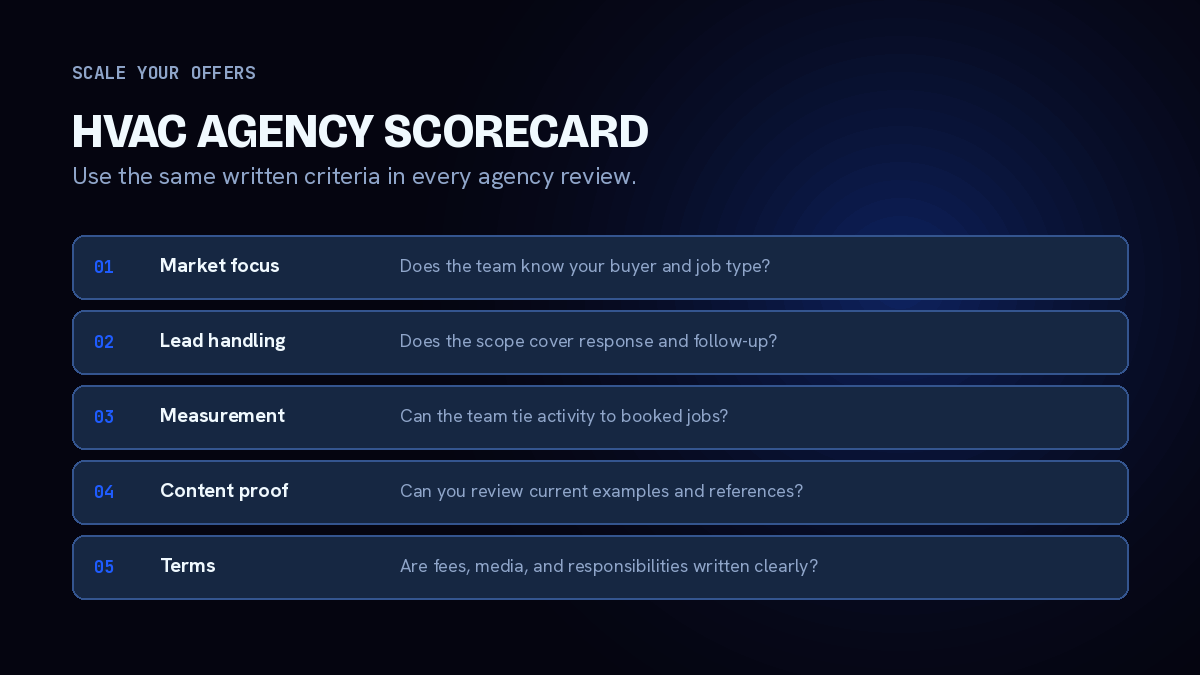
Use this table to compare agencies. If you lack lead volume, focus on HVAC buyer fit, local market fit, and channel skill. If you carry many leads and book too few, focus on lead-to-booked-job tracking and conversion process.
The best agency profile depends on your current constraint
Start with your constraint. Add traffic when crews have open capacity and the call board lacks qualified inquiries. Fix conversion when lead volume looks healthy and booked appointments lag. Work your customer base when you sit on old estimates, aging systems, and service customers who rarely hear from you.
A public list can point you to firms with visibility. Your P&L needs a partner that shows how many additional booked jobs you need, which channels create them, and which internal process catches them.
Score in three passes. First, score Attract across paid search, local SEO, Local Services Ads, social ads, landing pages, offers, tracking, and job-type targeting. Second, score Convert across call handling, form speed, SMS follow-up, estimate follow-up, qualification, and booking discipline. Third, score Expand across maintenance agreements, repair-to-replacement paths, indoor air quality, and database reactivation.
Fix the earliest weak stage first. Extra ad spend wastes money when the call process misses inquiries. Better call handling tops out when demand runs too low. Customer-base reactivation improves cash flow when your call team can book and sell the work.
Agency comparison for 2026
The supplied source set permits factual discussion of Thrive Internet Marketing Agency, First Page Sage, Built-Right Digital, and Scale Your Offers. This article makes no claims about private results, private client wins, or unavailable data.
Thrive Internet Marketing Agency
Thrive appears in current HVAC agency research and publishes 2026 HVAC marketing company content. Thrive reported a 5,556% increase in traffic from AI platforms, a 1,078% increase in ChatGPT presence, and 404% growth from Gemini from January to October 2025.[1]
Treat those numbers as a prompt to ask for booked-job math. AI-platform traffic matters only when reports show which visits turn into calls, forms, appointments, estimates, and sold work.
Use direct questions. How does Thrive separate replacement leads from service calls? How does it report revenue by source? How does it plan for shoulder months? How does it work in markets where Google Local Services Ads, PPC, organic search, and review volume all affect lead cost?
Thrive may fit owners who want a broad digital agency with public AI-search reporting. Confirm local HVAC execution, booked-job reporting, and CRM connection before you choose.
First Page Sage
First Page Sage earns mention because the supplied research gives a clear ranking formula. Its HVAC agency ranking algorithm uses 40% client roster, 30% leader track record, 20% average online reviews, and 10% company size and founding year.[2]
That formula weights public proof signals, leadership, reviews, and tenure. It can help you screen agencies.
Use it as one input. A high score in a published ranking still needs an operating fit check. You may need replacement demand in a specific radius, multilingual CSR coverage, weekend lead response, or financing follow-up. A ranking formula cannot confirm those needs for your shop.
First Page Sage may fit owners who favor SEO-led thinking and public proof signals. Ask for reporting that ties search traffic to booked and sold jobs.
Built-Right Digital
Built-Right Digital appears in the supplied research through its HVAC franchise marketing content. Built-Right says it evaluates marketing companies by qualified lead generation, transparent reporting, and HVAC industry knowledge.[3]
That approach aligns with the scorecard here. Qualified leads matter because dispatch capacity has a cost. Transparent reporting matters because a $5M owner cannot run marketing by call volume alone. HVAC knowledge matters because replacement demand, maintenance demand, emergency demand, and franchise territory rules require different campaigns.
Ask Built-Right, or any franchise-focused firm, how it handles location-level reporting. Multi-location HVAC operations need spend, lead, booking, and revenue data by branch or territory. A blended report can hide one market that works and another that burns budget.
Built-Right may fit owners who want franchise-aware evaluation criteria and a heavy focus on qualified leads and reporting. Ask how the agency maps those criteria into job-type campaigns, local budgets, and booked revenue.
Scale Your Offers
Scale Your Offers has a newer contractor vertical, and that fact belongs in the open. The company’s aggregate proof spans more than $12 million in tracked revenue and more than 50,000 leads across accounts the company has touched. Those figures cover company-wide work and make no contractor-only case claim.
Scale Your Offers brings the A.C.E. Method to agency selection. Attract brings the right buyers. Convert turns inquiries into booked revenue. Expand increases revenue per customer. Address the earliest weak stage first.
For an HVAC owner, the process starts with diagnosis. A company that lacks qualified replacement opportunities needs Attract work. A company with call volume and low booking needs Convert work. A company with a large CRM and low reactivation activity needs Expand work.
Scale Your Offers also publishes HVAC-specific thinking on existing customer lists and fast response. The HVAC page on The Fastest Money frames database reactivation as an early operating priority for $3M to $10M owners with install crews, sales process, and CRM history. That page uses illustrative models and tells owners to replace sample inputs with their own numbers.
Scale Your Offers may fit owners who want a diagnostic model, paid-demand execution, follow-up discipline, and a scorecard tied to booked revenue. Owners who want a long contractor-only public case library should weigh the newer vertical candidly as part of the decision.
A worked example shows the agency math
Use round numbers here and swap in your CRM, call center, and P&L data before you sign any agency contract.
Assume an HVAC company does $5,000,000 in annual revenue. The owner wants a 20% increase in booked revenue over the next 12 months. The target increase equals $1,000,000.
Assume the average sold job tied to the campaign equals $10,000. The company needs 100 additional sold jobs because $1,000,000 divided by $10,000 equals 100 jobs.
Assume 50% of booked sales appointments receive an estimate and 40% of those estimates close. The booked-appointment-to-sale rate equals 20% because 50% multiplied by 40% equals 20%.
The company needs 500 additional booked sales appointments because 100 sold jobs divided by 20% equals 500 booked appointments.
Assume the inquiry-to-booked-appointment rate equals 50%. The company needs 1,000 additional qualified inquiries because 500 booked appointments divided by 50% equals 1,000 inquiries.
This math gives you a clear agency test. The agency must show how it will create 1,000 qualified inquiries, how it will track 500 booked appointments, and how it will report 100 sold jobs. The plan also must show where it can fail.
If you raise the inquiry-to-booked rate from 50% to 60%, the required inquiry count changes. You still need 500 booked appointments. At 60%, you need 834 qualified inquiries because 500 divided by 60% equals 833.3. That conversion gain reduces the Attract load by 166 inquiries.
This arithmetic shows why agency selection depends on operating fit. A pure lead-generation firm can help when you truly need 1,000 more inquiries. A conversion-heavy partner can deliver better economics when you already have enough demand and lose too many leads before booking.
The A.C.E. Method gives the owner a cleaner choice
A.C.E. sets the order for agency selection. Find the earliest weak stage before you compare proposals.
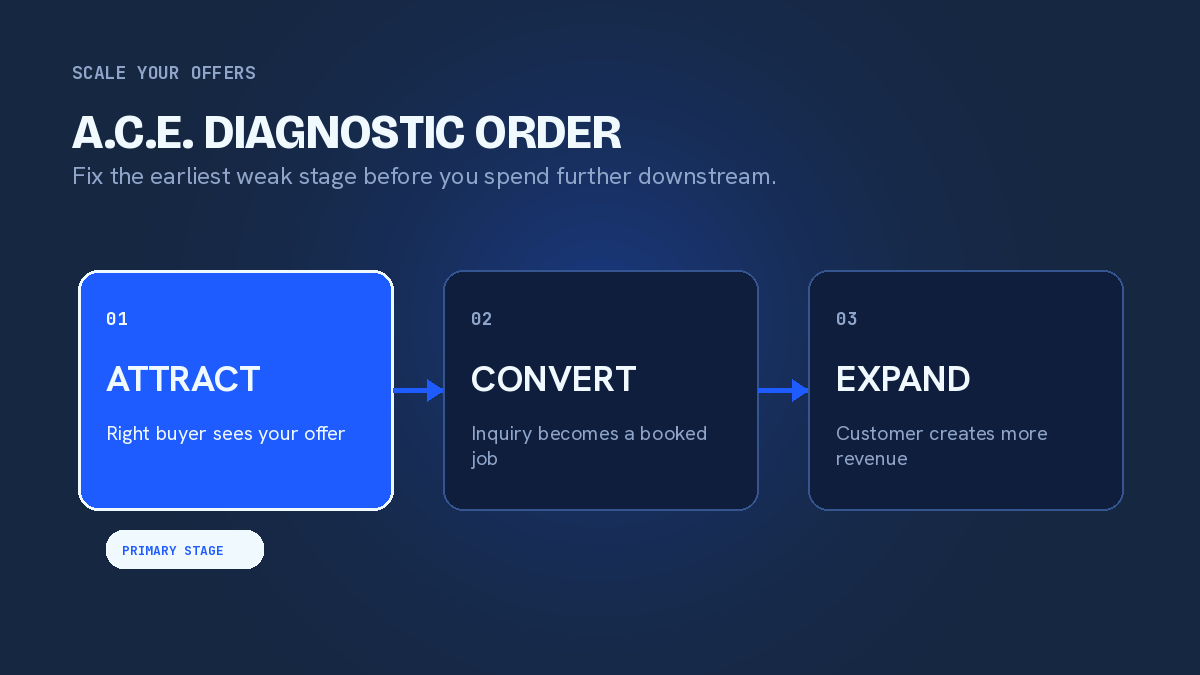
- Attract: You need qualified demand from the right HVAC buyers in your service area. This stage covers paid search, Local Services Ads, local SEO, social ads, landing pages, offers, and audience targeting.
- Convert: You need fast response, qualification, booking, estimate follow-up, and sold-job tracking. Directional B2B research from Workato cites earlier research showing lower lead-qualification odds as response time moved from five minutes to ten minutes, and Workato found that no sampled company called within five minutes in its 114-company sample.[5] Treat that as directional evidence for response discipline, not as an HVAC guarantee.
- Expand: You need more revenue per customer through maintenance agreements, repair-to-replacement paths, indoor air quality, and reactivation of old estimates or past customers.
Pick the stage that fails first. Attract comes first when your lead count cannot feed the crews. Convert comes first after you have enough inquiries and still miss booked appointments. Expand comes first only after demand and booking can handle the extra opportunity.
This order protects you from buying the wrong solution. SEO helps with a long-term organic gap. PPC helps when you need faster demand. Call handling raises booked jobs without adding media spend. Database reactivation creates near-term opportunities when CRM history contains unsold estimates and aging equipment.
For owners who want the full paid-ads machine at a low entry point, The Booked-Out Contractor, a $2.95 book, presents Scale Your Offers’ page copy around offer, ads, funnel, tracking, and follow-up.
How to interview agencies without wasting a month
Start with your numbers. Bring annual revenue, monthly revenue by job type, close rate, booked appointment rate, cost per lead, cost per booked job, cost per sale, average ticket, gross margin, and crew capacity.
Ask each agency to map its plan to your bottleneck. If the agency talks only about impressions, clicks, or rankings, move the discussion to booked jobs. If the agency talks only about leads, ask for the qualified-lead definition. If the agency talks only about revenue, ask how it traces revenue to source, campaign, keyword, call, and salesperson.
Ask for the first 90 days in arithmetic. The agency should state expected activity ranges, learning periods, setup tasks, tracking work, and decision points. The firm should also list what it needs from your team. Most HVAC campaigns need CRM access, call tracking, landing page approval, offer approval, review data, service area rules, job-type economics, and a decision-maker who approves changes fast.
Ask how the agency treats replacement demand apart from service demand. Replacement leads often need different landing pages, financing language, follow-up, and sales coordination than tune-up or repair calls. If you want more on this topic, read Scale Your Offers’ guide to HVAC replacement leads.
Tie reporting to a weekly review. A useful report shows spend, leads, booked appointments, estimates, sales, revenue, and cost per sale. Separate campaigns and job types. Add missed calls, late responses, and unworked estimates when those items affect sales.
The final selection should match local needs and operational fit
Match the plan to your market and operation. A rural company with limited search volume needs a different mix than a dense metro contractor with strong search demand and high ad costs. A company with an in-house call center needs different conversion work than a company where owners still answer overflow calls.
Use the scorecard and adjust weights to match your bottleneck. If lead volume limits growth, keep Attract factors at the top. If appointment booking limits revenue, raise Convert factors. If your CRM contains years of old customers and unsold estimates, include Expand in the discussion.
Make the final call on three proofs. The agency explains your math in plain language. The agency connects its work to booked and sold jobs. The agency works with your team’s actual process.
FAQ
Who are the best HVAC marketing agencies in 2026?
The best agency depends on your lead gap, booking process, service area, and reporting needs. Thrive Internet Marketing Agency, First Page Sage, Built-Right Digital, and Scale Your Offers all deserve review based on the current source material, with each one scored against your operating math.
How much should an HVAC company spend before hiring an agency?
Start with the revenue target and work backward. If you want $1,000,000 in added revenue and your average sold job equals $10,000, you need 100 additional sold jobs. Your allowable spend depends on gross margin, crew capacity, close rate, and payback target.
Should an HVAC agency focus on leads or booked jobs?
Track both. Lead volume matters at the Attract stage. Booked jobs matter at the Convert stage. Sold revenue matters when you judge the full campaign.
How should I compare a newer contractor agency with older HVAC agencies?
Compare fit, reporting, and local execution. Scale Your Offers has a newer contractor vertical and company-wide aggregate proof of more than $12 million in tracked revenue and more than 50,000 leads. Older HVAC agencies may have longer contractor-only track records. Pick the plan that matches your bottleneck and math.
If you want an outside review before you choose an HVAC marketing agency, book the Scale Your Offers A.C.E. Audit. We will look at Attract, Convert, and Expand in order, identify the earliest revenue constraint, and show which agency capabilities matter most for your next stage.
References and definitions
[1] Thrive Internet Marketing Agency, 2026 HVAC marketing company article. The supplied research states Thrive reported a 5,556% increase in traffic from AI platforms, a 1,078% increase in ChatGPT presence, and 404% growth from Gemini from January to October 2025. Source: https://thriveagency.com/news/best-hvac-marketing-companies/
[2] First Page Sage, 2026 HVAC agency ranking article. The supplied research states its ranking formula assigns 40% to client roster, 30% to leader track record, 20% to average online reviews, and 10% to company size and founding year. Source: https://firstpagesage.com/seo-blog/the-top-hvac-marketing-agencies/
[3] Built-Right Digital, 2026 HVAC franchise marketing agency article. The supplied research states Built-Right evaluates marketing companies by qualified lead generation, transparent reporting, and HVAC industry knowledge. Source: https://builtrightdigital.com/top-hvac-franchise-marketing-agencies/
[4] LettrLabs, HVAC marketing agency selection article. The supplied research states selection criteria include industry experience, reputation, references, service range, and communication. Source: https://www.lettrlabs.com/post/top-10-hvac-marketing-agencies-how-to-pick-the-right-hvac-marketing-agency-for-your-business
[5] Workato, March 2026 lead response time study. The supplied research states Workato submitted demo requests to 114 B2B companies and cited earlier Harvard Business Review research on response time and lead qualification. Treat this as directional B2B evidence for response discipline. Source: https://www.workato.com/the-connector/lead-response-time-study/
Attract means owned paid traffic and related demand channels that bring replacement and maintenance buyers in the service area.
Convert means speed to lead, qualification, booking, and quoted-job follow-up.
Expand means maintenance agreements, repair-to-replacement paths, indoor air quality, and database reactivation.