
HVAC Marketing Plan: A $5M Revenue Blueprint
A $5M HVAC company needs a marketing plan that protects cash, fills service capacity, feeds replacement sales, and keeps the customer file active. The plan must align with summer and winter spikes, shoulder-season softness, technician and install capacity, average tickets, booking rate, close rate, and lead cost.
Attract is the earliest constraint because the company needs a steady buyer flow before sales can scale. Convert follows because response speed, booking, qualification, sales presentation, and estimate follow-up set booked revenue per lead. Expand then lifts revenue from existing customers through maintenance agreements, repair-to-replacement paths, indoor air quality, referrals, and database reactivation.
The $5M revenue target needs a channel plan, not random ad spend
Start with capacity math and revenue mix. Decide how much revenue must come from demand service, maintenance agreements, equipment replacement, indoor air quality, and database work. ACCA’s financial and operating performance survey gives useful HVAC benchmarks for mix, margin, and overhead planning [1].
Plan the year in four demand zones:
- Spring tune-up and replacement readiness.
- Summer cooling demand and failed-system replacement.
- Fall tune-up and heating readiness.
- Winter heating demand and failed-system replacement.
Use different messages and budgets for each zone. In spring and fall, push maintenance agreements, system age, comfort checks, and replacement readiness. In summer and winter, fund cooling and heating urgency, booking speed, estimate follow-up, and financing education without promising approval.
Keep service-versus-replacement discipline. A practical mix targets 50% to 60% recurring service and maintenance-driven revenue, with 40% to 50% replacement and add-ons. This mix keeps technicians productive in shoulder months and feeds install crews when weather demand rises.
Build the revenue model before choosing channels
Media buying gets easier when you map the revenue requirement first. The table below gives a planning model to adjust using real tickets, gross margin targets, capacity, lead cost, booking rate, and close rate.
| Revenue line | Annual revenue target | Average ticket or annual amount | Closed jobs or accounts needed | Primary marketing source | Main capacity owner |
|---|---|---|---|---|---|
| Demand service and repair | $1,500,000 | $650 | 2,308 calls | Search, Local Services Ads, database, referrals | Service manager |
| Maintenance agreements | $750,000 | $300 annual plan | 2,500 active plans | Tune-up campaigns, tech handoff, email | Service manager |
| Replacement installs | $2,250,000 | $12,000 | 188 installs | Search, paid social, unsold estimates, repair handoff | Sales manager |
| Indoor air quality and accessory add-ons | $500,000 | $1,500 | 334 add-ons | Tech recommendations, customer file campaigns | Service manager |
| Total | $5,000,000 |
Worked illustrative calculation: replacement revenue gap
Use this calculation to see how many replacement wins the marketing plan must produce. Replace every input with company data.
Annual revenue target from replacement: $2,250,000
Average installed replacement ticket: $12,000
Needed replacement wins: $2,250,000 ÷ $12,000 = 187.5, rounded to 188 installs
If the company closes 35% of qualified replacement appointments, it needs:
188 installs ÷ 0.35 = 537 qualified replacement appointments
If 70% of replacement leads book appointments, it needs:
537 appointments ÷ 0.70 = 767 replacement leads
If the average replacement lead costs $180, the annual paid lead budget for that line would be:
767 leads × $180 = $138,060
This number is an illustrative planning number. The owner should replace the cost per lead, booking rate, close rate, and average ticket with CRM and ad account data.
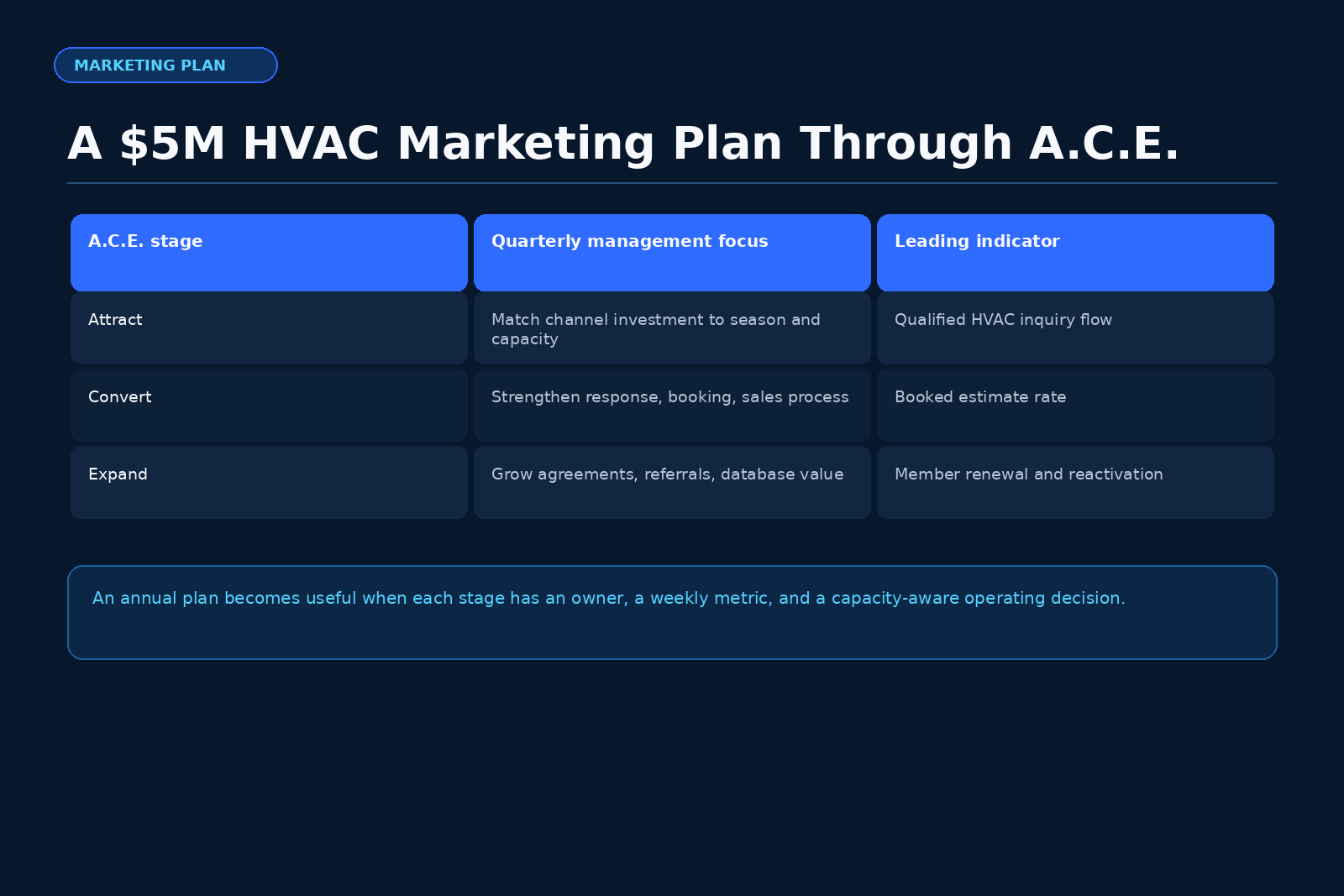
Cash-flow-aware channel allocation for a $5M HVAC company
Protect near-term cash before you fund long-horizon brand activity. Tie channel budgets to seasonal capacity and booked revenue.
Use three budget tiers.
Tier 1: Cash capture channels
These channels get budget first because they target buyers with clear intent.
| Channel | Best use | Budget rule | Scorecard metric |
|---|---|---|---|
| Google Local Services Ads | Emergency service, tune-ups, replacement intent | Fund when phones and dispatch can answer fast | Booked calls, cost per booked call |
| Search ads | Repair, AC replacement, furnace replacement, heat pumps | Scale by service area and install capacity | Cost per qualified lead |
| Retargeting | Website visitors, estimate viewers, financing page visitors | Keep always on at a controlled daily spend | Cost per booked return visit |
| Database campaigns | Unsold estimates, older systems, past repairs | Run in tight batches with call capacity | Booked appointments |
Tier 2: Pipeline creation channels
These channels build future demand and membership growth.
| Channel | Best use | Budget rule | Scorecard metric |
|---|---|---|---|
| Paid social | Maintenance agreement pushes, system age education, heat pump education | Increase before shoulder seasons | Cost per booked tune-up |
| Existing customers, tune-up reminders, unsold estimates | Send by segment and service need | Replies, booked calls | |
| Direct mail to customer file | Older equipment, lapsed maintenance customers | Use for high-fit segments | Booked calls per mail drop |
Tier 3: Proof and trust assets
Keep these assets current before you raise ad spend.
| Asset | Best use | Refresh pace | Owner |
|---|---|---|---|
| Replacement landing page | Heat pump, AC, furnace, financing education | Monthly during peak seasons | Marketing lead |
| Maintenance agreement page | Plan benefits, visit cadence, member perks | Quarterly | Service manager |
| Estimate follow-up messages | Unsold estimates and quote review | Weekly review | Sales manager |
| Call scripts | Booking and qualification | Weekly call review | CSR lead |
This allocation funds booked calls, booked estimates, and memberships before broader awareness spend.
Seasonality plan by quarter
Build campaigns one quarter before each demand spike. Launch spring campaigns before the first hot week and fall campaigns before the first cold week.
Quarter 1: heating demand and spring prep
January and February should emphasize furnace repair, heat pump service, no-heat calls, and age-tied replacements. Shift March toward spring tune-ups, AC readiness, and maintenance agreements.
Recommended moves:
- Run heating repair search campaigns by city.
- Build a list of systems over 10 years old and send spring tune-up offers.
- Call unsold furnace and heat pump replacement estimates.
Quarter 2: tune-ups, AC readiness, and replacement setup
April through June should grow memberships and replacement pipeline to pre-book summer installs.
Recommended moves:
- Launch tune-up paid social to known service areas.
- Segment search by repair, maintenance, and replacement.
- Add system age to forms and CSR scripts.
Quarter 3: cooling demand and installation capacity
July through September strain phones, dispatch, and install crews. Match spend to booking capacity.
Recommended moves:
- Cap paid search by daily appointment capacity.
- Assign one owner to missed-call recovery.
- Run retargeting for AC replacement page visitors.
Quarter 4: heating prep and database revenue
October through December should use fall tune-ups, heating checks, heat pump education, and estimate follow-up. Reactivate past customers before holiday gaps.
Recommended moves:
- Send segmented heating readiness to existing customers.
- Call unsold AC replacement estimates from summer.
- Offer maintenance agreement renewal to lapsed members.
A.C.E. marketing plan for a $5M HVAC company
A.C.E. sets operating order. Fix the earliest constraint first. Scale Your Offers defines Attract as owned paid traffic targeted at replacement and maintenance buyers in the service area, Convert as speed to lead, qualification, booking, and quoted-job follow-up, and Expand as maintenance agreements, repair-to-replacement paths, indoor air quality, and database reactivation [6].
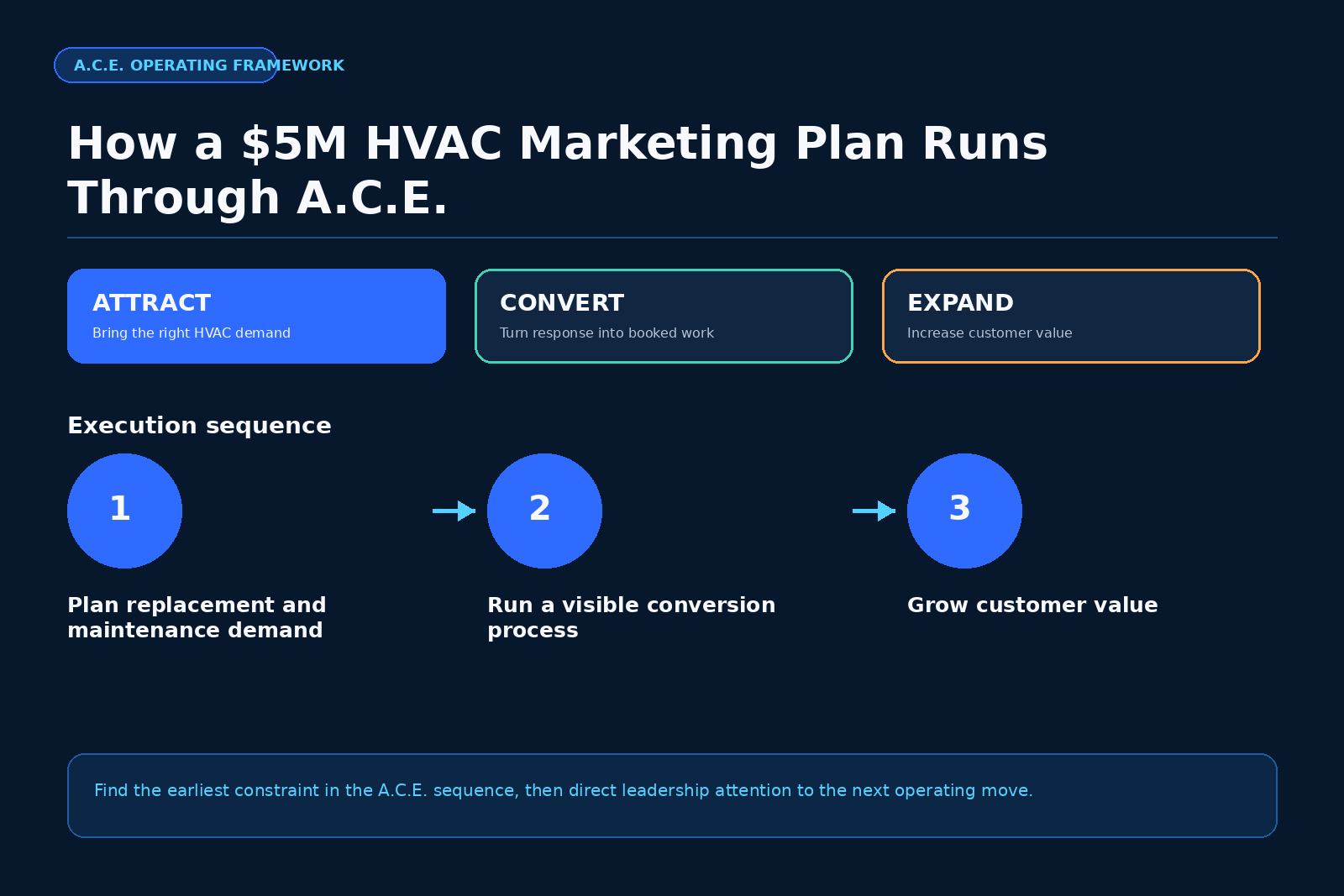
1. Attract: bring the right HVAC buyers into the calendar
Align spend with capacity, service area, and revenue mix. Buy demand that matches technician skill, install capacity, and margin targets.
Attract operating rules:
- Separate campaigns by service, maintenance, replacement, and heat pumps.
- Separate AC and heating by season.
- Use city-level budgets when close rates differ.
- Track cost per booked call, cost per qualified appointment, and cost per sold job.
- Cap budget when the call center cannot answer and book quickly.
- Match landing pages to ad promise and season.
- Send paid traffic to a booking path with call, form, and text.
A simple mix can place 60% into search and Local Services Ads, 20% into paid social for maintenance and replacement education, 10% into retargeting, and 10% into database campaigns. Adjust by booked revenue, margin, and capacity.
The owner who needs a tighter paid-ads setup can read The Booked-Out Contractor, a $2.95 book. It covers offer, ads, funnel, tracking, and follow-up with the purpose of turning ad clicks into booked, high-ticket jobs [7].
2. Convert: turn leads into booked and sold HVAC work
Convert begins the moment a homeowner calls, fills out a form, sends a text, or replies to an ad. Workato reported on a March 2026 study of 114 B2B companies and cited earlier Harvard Business Review research that found lower lead-qualification odds as response time moved from five to ten minutes [4]. Treat that as directional evidence for response discipline.
Convert operating rules:
- Answer inbound calls during ad hours.
- Call web leads within five minutes when staffing allows.
- Text and email after a missed call.
- Qualify system type, age, urgency, homeownership, availability, and prior service history.
- Book the appointment on the first live conversation.
- Confirm the appointment by text and email.
- Record each lead source inside the CRM.
- Follow unsold replacement estimates on a set cadence.
A replacement presentation should cover the current system, repair history, comfort problem, installation scope, equipment options, maintenance plan, available manufacturer rebates when accurate, and financing application path when offered. Mention ENERGY STAR tax credit resources only as education. ENERGY STAR provides federal tax credit information for certain energy efficiency upgrades, and IRS Section 25C contains federal law for the Energy Efficient Home Improvement Credit [2][3]. Tell homeowners to ask a qualified tax pro about eligibility and tax treatment.
For follow-up and response speed, review The Fastest Money, which frames existing customer lists and database reactivation as fast revenue sources when you have install crews, a sales process, and CRM history [6].
3. Expand: raise revenue from existing HVAC customers
Expand monetizes trust from completed work and known equipment history.
Expand operating rules:
- Offer a maintenance agreement after every service call.
- Tag customers by system age and equipment type.
- Create a repair-to-replacement rule for older systems and higher repair tickets.
- Send tune-up reminders before shoulder seasons.
- Reactivate unsold replacement estimates in batches.
- Offer indoor air quality options when the visit creates a valid fit.
- Ask happy maintenance customers for referrals.
- Track agreement renewal rate and member replacement rate.
The FTC CAN-SPAM guide requires a clear opt-out method, that the opt-out works for at least 30 days after sending, and that opt-out requests are honored within 10 business days [5]. Keep suppression lists current and get legal review for SMS rules because email and text rules differ by channel and location.
The $5M scorecard
Review the same scorecard across departments weekly during peaks and monthly during shoulder months.
| Metric | Why it matters | Healthy management action |
|---|---|---|
| Leads by source | Shows where demand enters | Shift budget toward booked revenue |
| Speed to first contact | Shows response discipline | Staff phones during ad hours |
| Booking rate | Shows CSR and dispatch output | Coach call handling and qualification |
| Cost per booked call | Shows paid channel efficiency | Tune bids, locations, and keywords |
| Cost per qualified replacement appointment | Shows sales pipeline cost | Adjust targeting and forms |
| Close rate by comfort advisor | Shows sales output | Review presentations and follow-up |
| Average replacement ticket | Shows revenue per sold job | Track options, add-ons, and maintenance plan attachment |
| Maintenance agreement adds | Shows recurring base growth | Train tech handoff and CSR offers |
| Unsold estimate follow-up rate | Shows near-term recovery | Assign daily ownership |
| Revenue by booked month | Shows seasonality and cash timing | Match spend to capacity |
Tie each number to one accountable seat. Marketing owns lead source, cost per lead, and pacing. The CSR lead owns speed and booking. Sales owns close rate, average ticket, and follow-up. Service owns maintenance agreement adds, repair handoffs, and indoor air quality fit. Install owns completion capacity and install experience.
Budget guardrails for a $5M plan
Spend with capacity and payback in mind. Move budget with booked revenue, cash position, and schedule.
Use these guardrails:
- Fund response capacity before raising ad spend.
- Keep emergency repair campaigns live during peak seasons.
- Build maintenance campaigns 30 to 60 days before shoulder seasons.
- Keep replacement campaigns live when install capacity exists within two weeks.
- Use database campaigns when cash needs faster payback.
- Cap spend when missed calls cross a set threshold.
- Review sold revenue by lead source, not lead count alone.
- Shift budget away from sources that create unqualified calls.
Separate working media from labor and tools. Media buys traffic. Labor runs buildout, reporting, creative, landing pages, call review, and CRM cleanup. Tools cover tracking, routing, follow-up, automation, and reporting.
Offer design for each HVAC buyer type
Match the offer to the buyer’s situation. Align ads, landing pages, CSR scripts, and follow-up to that need.
| Buyer type | Offer angle | Best channel | Conversion asset |
|---|---|---|---|
| No cooling or no heat | Fast service appointment | Search and Local Services Ads | Call-first landing page |
| Seasonal tune-up buyer | Comfort check and maintenance agreement | Paid social, email, customer file | Tune-up page |
| Older system owner | Replacement options and comfort evaluation | Search, retargeting, database | Replacement page |
| Unsold estimate | Quote review and schedule availability | Phone, text, email | Estimate follow-up script |
| Maintenance member | Renewal, referral, indoor air quality fit | Email, tech handoff | Member script |
| Past repair customer | System check and repair history review | Database campaign | Reactivation script |
Use the same language across marketing, CSR, sales, and field. If an ad promotes AC replacement options, the CSR should qualify system age and set a replacement appointment when the call fits. If a tune-up campaign promotes maintenance agreements, the technician should explain the plan at the end of the visit.
Data hygiene before bigger media buying
Clean the CRM before you raise spend. A clean file improves segmentation, follow-up, and attribution. Use a weekly routine and clear field ownership.
Track these fields:
- Customer name.
- Service address.
- Phone.
- Email.
- Equipment type.
- System age.
- Last service date.
- Membership status.
- Open estimate status.
- Lead source.
- Sold job amount.
- Next follow-up date.
A clean CRM lets you build high-fit lists, such as systems over 10 years old, lapsed maintenance members, unsold replacement estimates, and repair customers with high repair spend. Send each list a message that fits the equipment history and season.
Replacement estimate follow-up for cash timing
Do not treat unsold estimates as lost revenue after one call. The Fastest Money page gives an illustrative database model with 500 unsold replacement estimates contacted over 14 days, a 2% appointment booking rate, a 35% close rate, and a $12,000 average ticket, which produces $42,000 in signed work [6]. Replace the inputs with your own numbers.
Use a simple cadence:
- Same day: thank-you text with the estimate link.
- Day 1: call to answer questions and confirm decision timing.
- Day 3: email with scope recap and available schedule slots.
- Day 7: call with install calendar update.
- Day 14: text and email asking if the homeowner wants a quote review.
- Day 30: seasonal or comfort-based follow-up.
The sales manager should review all open estimates every morning during peak season. Confirm next action, owner, date, quote amount, lead source, and reason for delay.
Compliance and claim control
Market efficiency, tax credits, financing, rebates, and comfort benefits with accurate wording. Keep a claim library that CSRs, sales reps, and marketers use.
Use these rules:
- Quote efficiency ratings from verified equipment information.
- Link tax credit education to ENERGY STAR and IRS resources [2][3].
- Tell homeowners to ask a qualified tax pro about eligibility.
- Avoid promised lending approval.
- Keep rebate language tied to current program documents.
- Keep email opt-out language clear and active [5].
- Keep SMS consent records when text marketing enters the plan.
- Train staff to avoid absolute savings promises.
FAQ
How much should a $5M HVAC company spend on marketing?
The answer depends on capacity, margin, cash, season, and lead source output. Start with the revenue model, calculate needed leads by line of business, and fund the channels that create booked calls and sold work at acceptable cost.
Which HVAC channel should get budget first?
Search, Local Services Ads, retargeting, and database campaigns usually deserve first review because they connect with buyers who already show service or replacement intent. The company should fund the channel that produces booked revenue with available tech and install capacity.
How should seasonality affect an HVAC marketing plan?
The plan should raise tune-up and maintenance agreement campaigns before spring and fall. It should increase repair and replacement capture during summer and winter while keeping spend tied to phone coverage, dispatch slots, and install crew capacity.
What should an owner track each week?
The weekly scorecard should track leads by source, response time, booking rate, cost per booked call, qualified replacement appointments, close rate, average ticket, maintenance agreement adds, and unsold estimate follow-up rate.
If your HVAC company has leads, techs, install capacity, and a CRM, the next move is to find the first A.C.E. leak before spending more. Book an A.C.E. Audit and get a practical review of Attract, Convert, and Expand so your $5M marketing plan matches your cash, capacity, and revenue target.
References
- Air Conditioning Contractors of America, Financial & Operating Performance Survey
- ENERGY STAR, Federal Tax Credits for Energy Efficiency
- Legal Information Institute, 26 U.S. Code § 25C, Energy Efficient Home Improvement Credit
- Workato, Lead Response Time Study
- Federal Trade Commission, CAN-SPAM Act Compliance Guide for Business
- Scale Your Offers, The Fastest Money
- Scale Your Offers, The Booked-Out Contractor
- Scale Your Offers, Lead Flow Score
- Scale Your Offers, A.C.E. Audit