HVAC Maintenance Agreements: How to Price, Sell, and Retain More Members
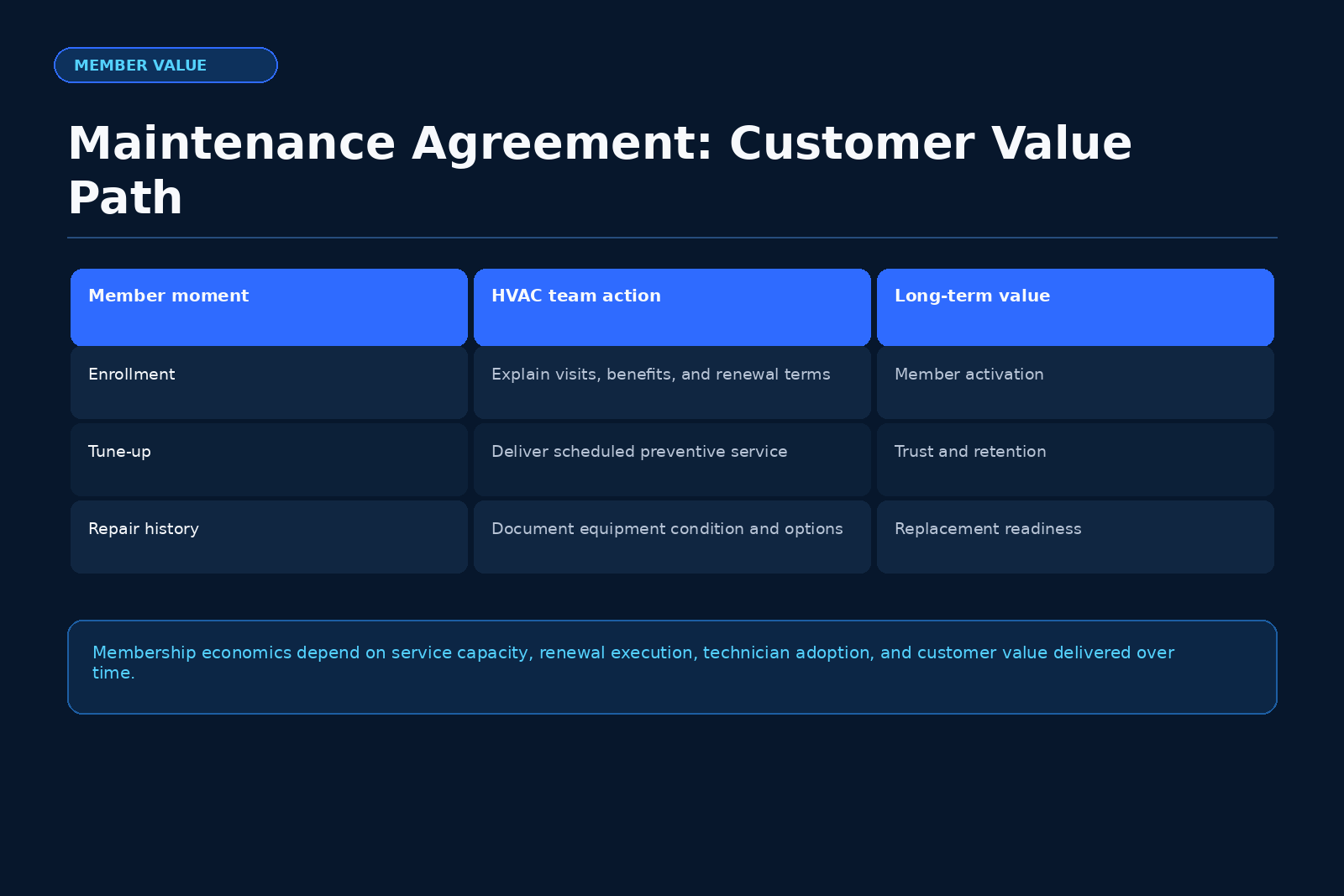
HVAC maintenance agreements can turn a seasonal service company into a steadier operation. The agreement gives the customer planned heating and cooling visits. It gives the company scheduled work, member data, renewal touchpoints, repair paths, indoor air quality conversations, and earlier replacement timing.
Many HVAC companies sell maintenance plans as a cheap tune-up bundle. That decision trains the customer to compare the plan against a one-time coupon. A stronger model prices the agreement around visit cost, dispatch load, repair margin, retention, and replacement readiness.
This article lays out how to price, sell, fulfill, renew, and use HVAC maintenance agreements without guessing. The goal is a plan that pays its way, fills shoulder-season calendars, and gives the sales team cleaner timing when aging equipment starts to cost the homeowner money.
Start With the Earliest Constraint
The first constraint usually sits in the plan economics. A company cannot scale a membership base if each agreement loses money before any repair, indoor air quality sale, or replacement conversation occurs.
The second constraint usually sits in the technician conversation. ACCA states that field service technicians should convert at least 25% of standard repair and diagnostic calls into service agreements [1]. That benchmark gives the owner a way to measure field execution without guessing.
The third constraint usually sits in fulfillment. A plan that the team cannot schedule damages renewal rates. Members bought priority, care, and predictability. Dispatch must protect the visits that the sales process promised.
The fourth constraint sits in renewal and replacement timing. A member with a 12-year-old system needs a different communication path than a member with a 3-year-old system. The agreement should sort customers by equipment age, repair history, comfort complaints, indoor air quality needs, and replacement readiness.
Build Pricing From Unit Economics
A maintenance agreement price should start with cost. Market ranges help, but your price must reflect your labor rate, visit length, drive time, parts use, discounts, payment fees, and admin time.
Smart Service discusses HVAC service agreement pricing around annual plans and monthly billing, with plan price affected by visit count, included benefits, and company costs [2]. The research brief for this article places typical annual tiers at Basic $150 to $250, Premium $300 to $400, and Elite $450 to $600 or higher [2].
Use those ranges as reference points. Then run your own math.
| Plan tier | Annual price range | Included visits | Included HVAC benefits | Pricing test |
|---|---|---|---|---|
| Basic | $150 to $250 | The plan includes two seasonal visits. | The plan includes heating and cooling tune-ups, standard filter handling, and a modest repair discount. | The price must cover visit labor, drive time, dispatch time, and payment cost. |
| Premium | $300 to $400 | The plan includes two seasonal visits. | The plan includes priority scheduling, waived diagnostic fees, and stronger repair benefits. | The price must cover added access benefits and waived fee exposure. |
| Elite | $450 to $600 or higher | The plan includes two seasonal visits with added system care. | The plan includes indoor air quality accessory care, deeper cleaning tasks, and a higher service access level. | The price must cover added task time, materials, and member communication. |
Worked Illustrative Calculation: Price a Plan Before You Sell It
This calculation uses sample inputs. Replace every input with your current cost data.
Assume a Basic plan sells for $219 per year. The plan includes two visits.
Assume each visit uses 60 minutes of technician time and 20 minutes of drive time. The fully burdened technician cost equals $42 per hour. The total labor time per visit equals 1.33 hours. Labor cost per visit equals 1.33 × $42, or $55.86.
Assume dispatch and admin cost equals $8 per visit. Assume standard materials equal $7 per visit. Assume payment processing and billing cost equal $6 per year.
Two visits create these costs:
| Cost line | Calculation | Annual cost |
|---|---|---|
| Technician labor | 2 visits × $55.86 | $111.72 |
| Dispatch and admin | 2 visits × $8.00 | $16.00 |
| Materials | 2 visits × $7.00 | $14.00 |
| Payment and billing | Annual estimate | $6.00 |
| Total direct agreement cost | Sum of cost lines | $147.72 |
The direct margin equals annual price minus direct cost.
$219.00 minus $147.72 equals $71.28.
The direct margin rate equals $71.28 divided by $219.00.
That equals 32.5%.
This agreement may work if the company can schedule visits during slower weeks, retain the member, and use each visit to document equipment condition. It may fail if drive time runs long, visits take 90 minutes, discounts get overused, or technicians skip renewal and replacement documentation.
The calculation also shows why a plan priced at $149 can hurt. If the same cost base equals $147.72, the agreement leaves $1.28 before any callback, card fee variance, extra filter cost, or discount use. That plan depends on future repair or replacement sales to cover the agreement. That approach can work only if the owner tracks it closely and sets a clear limit on included labor.
Price the Plan Around Four Numbers
Use four numbers before you approve any tier.
First, calculate cost per visit. Include technician cost, drive time, dispatch time, customer service time, software cost per visit, materials, and payment processing.
Second, calculate included benefit exposure. Waived diagnostics and repair discounts have cost. Track the average discount used per member per year. A repair discount that gets used on 40% of members costs more than a discount that gets used on 10%.
Third, calculate renewal rate. A 70% renewal rate and a 90% renewal rate create different acquisition pressure. The higher renewal rate lets the company spend less time replacing lost members.
Fourth, calculate replacement flag count. Count how many member systems exceed 10 years of age, how many have repeated repairs, and how many have comfort complaints. The research brief states that regular maintenance touchpoints help contractors present planned replacement choices when systems reach 10 to 15 years of age [3].
Design Tiers That Customers Can Grasp
A three-tier model works because it gives the technician a clean conversation. The customer can choose basic care, stronger access, or a fuller protection plan.
The Basic tier should answer the buyer who wants seasonal care. Keep it clean. Two visits, filter handling within stated limits, safety checks for heating season, cooling checks before summer, and a simple repair discount.
The Premium tier should answer the buyer who wants access and fee relief. Add priority scheduling, waived diagnostic fees within clear rules, and a stronger repair discount. This tier often becomes the main seller because it pairs service access with visible savings.
The Elite tier should answer the buyer with aging equipment, allergy complaints, higher comfort expectations, or indoor air quality accessories. Add IAQ accessory care, added coil or blower cleaning rules within clear limits, and a planned replacement review for older equipment.
Write every tier so the office and the field can explain it the same way. Avoid vague benefits that create disputes. Define visit count, visit timing, filters, discount limits, diagnostic rules, renewal terms, cancellation terms, and transfer rules. Have local counsel review agreement language, auto-renewal terms, and cancellation language before launch.
Sell the Agreement During the Service Call
The technician should not pitch a membership as an afterthought at the door. The conversation should start with the system facts.
The technician inspects the system, records equipment age, captures static pressure or temperature readings when those readings fit company procedure, documents worn parts, and shows the homeowner what each item means. The customer sees the system condition first. The agreement comes next.
A simple talk track works:
“Your system is running, and I want to show you the items I found. The capacitor tests near the low end of our replacement range. The outdoor coil needs cleaning. The furnace is 11 years old. You can handle today as a one-time visit, or you can put this system on our maintenance agreement. The agreement covers the seasonal visits, gives you member scheduling access, and keeps the equipment record updated before peak weather.”
The technician then presents two options. Option one covers the repair and no agreement. Option two covers the repair plus the plan. The customer sees the difference in one place.
Use a tablet or printed menu. Show the plan price, monthly price when available, today’s repair cost, member discount, renewal date, and included visits. Monthly billing presents the annual agreement as a $19 to $49 monthly payment, based on tier [2].
Track Technician Conversion by Call Type
A single companywide close rate hides what actually happens. Track maintenance agreement conversion by call type.
| Call type | Best membership prompt | Metric to track |
|---|---|---|
| No-cool or no-heat repair | The technician explains how planned visits reduce surprise failures. | Track the percentage of repair calls that add an agreement. |
| Tune-up non-member | The technician compares one-time service with annual care. | Track the percentage of tune-up calls that convert. |
| Older system repair | The technician connects maintenance records with planned replacement timing. | Track agreement sales and replacement appointments booked. |
| IAQ visit | The technician ties accessory care to plan tier rules. | Track IAQ member tier mix. |
| New equipment install follow-up | The office positions membership as warranty care and seasonal performance care. | Track install customers enrolled within 30 days. |
ACCA’s 25% technician conversion benchmark for standard repair and diagnostic calls gives the owner a clear floor to manage against [1]. A technician at 8% needs coaching, a cleaner menu, or better timing. A technician at 35% may have a talk track the rest of the team can use.
Do not judge technicians on agreement sales alone. Track callbacks, review trends, visit completion, documentation, and replacement flags. The right behavior is accurate system advice with a clear membership option.
Fulfillment Creates Retention
A company loses member trust when it sells priority access and then cannot schedule the visit. Dispatch must treat maintenance agreements as a capacity plan, not a side task.
Start with member count. Then calculate annual visits. If 900 members receive two visits per year, the company owes 1,800 maintenance visits. If one technician can complete five planned visits per day with drive time, that equals 360 technician days.
1,800 visits divided by 5 visits per day equals 360 technician days.
If the company wants those visits completed across 36 shoulder-season weeks, it needs 10 planned maintenance technician days per week.
360 technician days divided by 36 weeks equals 10 days per week.
That math tells the owner how many technician days must stay protected. If dispatch fills every open slot with demand calls, maintenance visits slide. The company then creates a renewal problem that no script can fix.
Segment the dispatch board into three buckets. The first bucket holds demand service. The second bucket holds member maintenance. The third bucket holds replacement estimate follow-up and system review appointments. The dispatcher can move capacity across buckets when weather spikes, but the service manager must reset the board each week.
Renewal Communication Should Start Before Expiration
Renewal work starts at the second visit, not at the renewal notice. The technician should tell the member what the company completed, what remains stable, and what may need attention in the next season.
Use a 90-day renewal sequence for annual plans.
At 90 days before expiration, send a service record recap. List visits completed, repairs performed, and the next recommended season visit.
At 60 days, send the renewal invoice or card update request. Keep the message short and clear.
At 30 days, call members with expiring cards, older systems, repeated repairs, or missed visits.
At 7 days, send a final renewal reminder by email and text only if your consent and messaging rules allow that channel.
For commercial email, the FTC states that marketing email must give recipients a clear opt-out method, the opt-out must remain active for at least 30 days after sending, and opt-out requests must be honored within 10 business days [4]. SMS has different duties by channel and location, so get legal review before sending renewal texts at scale.
Connect Memberships to Replacement Readiness
The best replacement lead often starts as a member visit. The homeowner knows the company. The technician has system age, repair history, and comfort notes. The office has a reason to call before the system fails.
Build a replacement readiness score inside the CRM. Keep it simple.
Give one point when the system is 10 years old or older. Give one point for repair spend above a set threshold during the last 24 months. Give one point for recurring comfort complaints. Give one point for refrigerant or major part risk noted by the technician. Give one point when the homeowner asks about financing, efficiency, noise, or replacement timing.
A score of three or higher should trigger a comfort advisor task. The task should not force a replacement pitch. It should create a planned system review. The advisor can show repair history, expected next repairs, comfort concerns, and replacement options.
Scale Your Offers describes Expand as maintenance agreements, repair-to-replacement paths, indoor air quality, and database reactivation [5]. That definition fits the membership base because every agreement creates repeat touchpoints with a known customer.
For a deeper database reactivation path tied to existing HVAC customers and unsold estimates, review The Fastest Money. Its page frames existing customer lists as a fast revenue source for HVAC owners with install crews, a sales process, and CRM history [5].
Use Indoor Air Quality Without Forcing the Sale
Indoor air quality fits naturally inside maintenance agreements when the customer already has IAQ accessories or clear comfort complaints. The plan can cover filter replacement reminders, UV lamp replacement reminders, humidifier pad checks, dehumidifier checks, air purifier cartridge reminders, and duct-mounted accessory inspection.
Do not bury free IAQ labor inside every plan. Price the tier around the task time and material cost. If the IAQ accessory adds 20 minutes per visit and $18 in materials, add that cost to the tier. Then add margin.
The technician conversation should stay factual. “Your media filter is loaded, and your UV lamp has passed its rated replacement date. Your current plan covers the seasonal tune-up. The Elite plan adds IAQ accessory care and reminder tracking.”
That script gives the customer a clean upgrade path. It also protects the company from selling a low-priced plan that absorbs IAQ labor without payment.
Use New Installs to Add Members
Every new install should end with a maintenance agreement path. The install team has just placed equipment that the customer wants to protect. The office should call within 7 to 14 days after startup. The call confirms comfort, answers thermostat questions, and offers the membership.
This call should not sound like a cold sale. It should sound like care after the install.
“Your new cooling system has been running for two weeks. We are calling to confirm comfort and answer any thermostat questions. We also want to set up the maintenance agreement so the first seasonal visit stays on schedule.”
Track install-to-member conversion. If the company installs 40 systems in a month and only 5 enroll, the office has a process gap. If 25 enroll, the install handoff is working.
Owners who need a paid advertising and follow-up base for booked HVAC jobs can study The Booked-Out Contractor, a $2.95 book, which its page describes as a 75-page paid-ads machine covering offer, ads, funnel, tracking, and follow-up [6].
A.C.E. for HVAC Maintenance Agreements
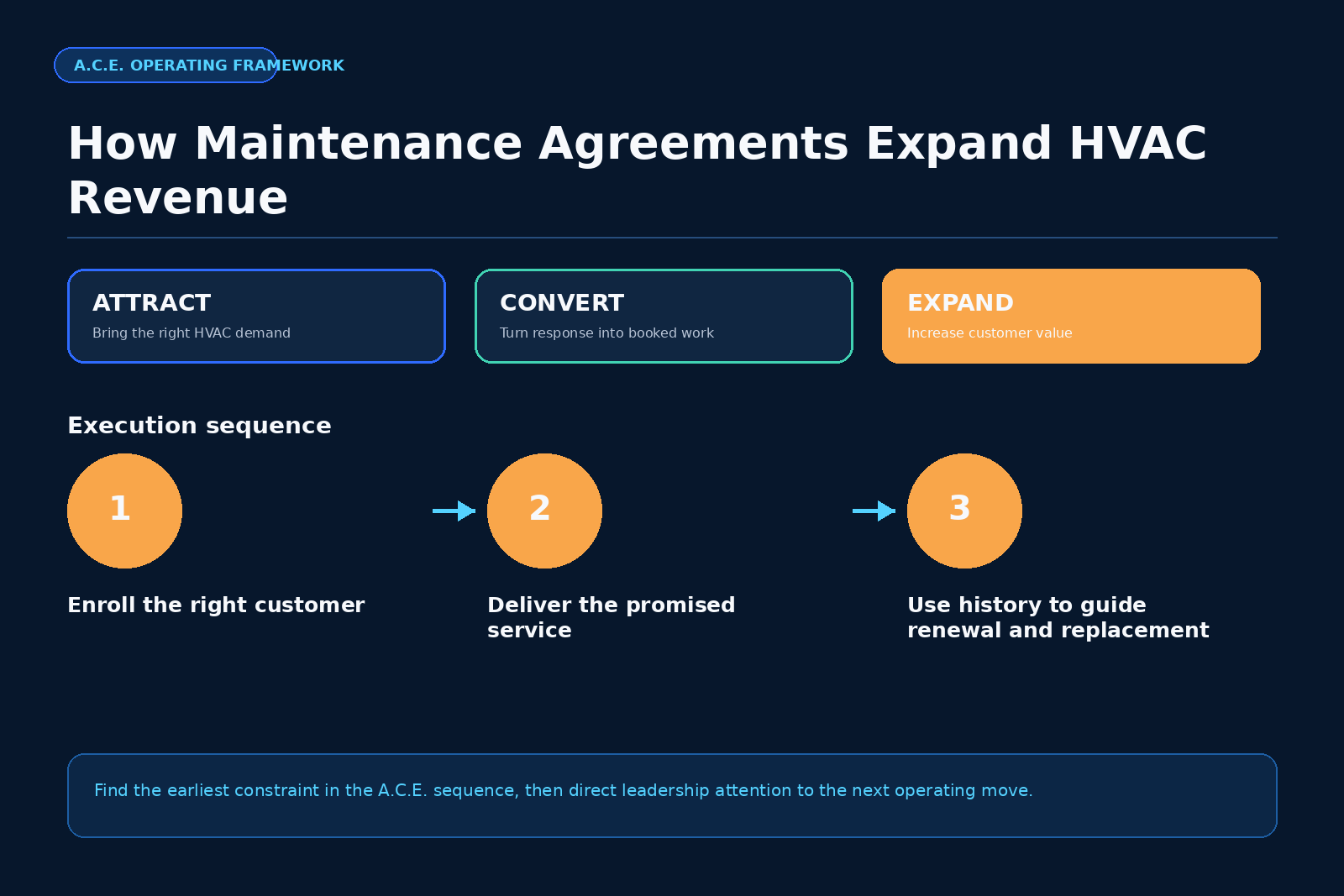
A.C.E. stands for Attract, Convert, and Expand. Scale Your Offers defines Attract as owned paid traffic aimed at replacement and maintenance buyers in the service area, Convert as speed to lead, qualification, booking, and quoted-job follow-up, and Expand as maintenance agreements, repair-to-replacement paths, indoor air quality, and database reactivation [5].
Assess the stages in order and fix the earliest constraint first [5].
Attract: Bring in Maintenance and Replacement Buyers
Attract comes first because the company needs the right customer flow. For maintenance agreements, the buyer pool includes tune-up shoppers, repair callers, older equipment owners, and recent install customers.
Paid ads can promote seasonal tune-ups, second-opinion replacement reviews, IAQ inspections tied to HVAC accessories, and member enrollment offers. The ad should match the service area, season, and dispatch capacity.
Do not sell more tune-ups than the team can fulfill. If the company has 80 open maintenance slots next month, the campaign should fit that limit. If the company has 300 open slots in shoulder season, the campaign can push harder.
Convert: Answer, Qualify, Book, and Follow Up
Convert comes second because interest does not create revenue until the office books the right call. The team must answer calls, respond to forms, reply to texts, qualify system needs, and place calls on the board.
Workato’s 2026 B2B study cites earlier research showing lead-qualification odds fell sharply when response moved from five to ten minutes, and Workato’s own sample found that no sampled company called within five minutes [7]. That research is not HVAC-specific, so treat it as directional evidence for response discipline, not a home services guarantee.
For maintenance agreements, fast response matters during seasonal tune-up pushes and repair spikes. A missed call from a homeowner with a failing system can turn into a lost member, lost repair, and lost replacement chance.
Expand: Retain, Add, Refer, and Prepare Replacements
Expand comes third because the member base contains future work. The company can renew agreements, add IAQ care, request referrals, convert repairs into replacement reviews, and reactivate older customers.
Oxmaint frames HVAC service agreements as a way to build recurring revenue through planned work and customer retention [3]. That fits the Expand stage. The agreement gives the company permission to return, inspect, document, and advise.
The owner should review five Expand metrics every month. Track active members, renewal rate, member repair revenue, IAQ add-ons, and replacement appointments from member visits. These five numbers show whether the agreement base is maturing or drifting.
Operating Framework for a Stronger Membership Program
-
Audit the current plan list. Export every active member, plan tier, price, renewal date, equipment age, visit count, and last contact date.
-
Calculate visit cost. Use actual labor rates, drive time, dispatch time, materials, and payment cost.
-
Set three tiers. Create Basic, Premium, and Elite tiers with clear HVAC benefits and defined limits.
-
Train one technician script. Use system condition, photos, readings, repair history, and a two-option close.
-
Add monthly billing. Offer annual and monthly choices when your billing system can handle renewals and failed cards.
-
Protect dispatch capacity. Reserve maintenance slots by week before demand calls fill the board.
-
Track technician conversion. Measure conversion by call type, not only by technician total.
-
Create renewal cadence. Start 90 days before expiration and use email, phone, and approved text paths.
-
Score replacement readiness. Use age, repair spend, comfort complaints, major part risk, and homeowner interest.
-
Review the numbers monthly. Hold a 30-minute membership meeting with the owner, service manager, dispatch lead, and sales lead.
Common Mistakes That Shrink Member Profit
The first mistake is underpricing. A low annual price may fill the CRM with members while draining technician time. If the agreement cannot cover direct cost, the owner must know that fact and use the plan as a measured acquisition cost.
The second mistake is vague benefits. Phrases like “free service” or “covered maintenance” create confusion. State exactly what the customer receives.
The third mistake is missed visits. A missed visit damages renewal trust and weakens replacement readiness.
The fourth mistake is weak documentation. A membership without equipment age, photos, readings, repair notes, and next action loses much of its business use.
The fifth mistake is treating renewals as admin work. Renewal is sales, service, dispatch, and customer care combined. The office should own the cadence, and the service manager should own visit completion.
FAQ
How much should HVAC maintenance agreements cost?
Use your actual visit cost first. Market ranges often place Basic plans around $150 to $250 per year, Premium plans around $300 to $400, and Elite plans around $450 to $600 or higher [2]. Your final price should reflect labor, drive time, materials, admin time, payment fees, discount exposure, and tier benefits.
What conversion rate should HVAC technicians reach on maintenance agreements?
ACCA states that field service technicians should convert at least 25% of standard repair and diagnostic calls into service agreements [1]. Track the rate by call type so coaching stays fair and useful.
How do maintenance agreements create replacement opportunities?
Maintenance visits create repeat contact with known customers. The technician can document age, repair history, comfort complaints, and major part concerns. When the system reaches 10 to 15 years of age, those records help the company present planned replacement choices before a peak-season failure [3].
How can an HVAC company retain more maintenance members?
Retention depends on fulfilled visits, clear benefits, clean renewal communication, and accurate system records. Start renewal messages 90 days before expiration, call high-risk members, update failed cards fast, and protect dispatch capacity for member visits.
If your HVAC maintenance agreement base has unclear pricing, weak technician conversion, missed visits, or poor replacement tracking, book an ACE Audit. Scale Your Offers will review the Attract, Convert, and Expand path in order and identify the earliest constraint holding back member growth.
References
- Air Conditioning Contractors of America, “Strategies for Increasing Service Agreement Sales”
- Smart Service, “How Much to Charge for HVAC Service Agreements”
- Oxmaint, “How to Build Recurring Revenue with HVAC Service Agreements”
- Federal Trade Commission, “CAN-SPAM Act: A Compliance Guide for Business”
- Scale Your Offers, “The Fastest Money”
- Scale Your Offers, “The Booked-Out Contractor”
- Workato, “Lead Response Time Study”