Are Angi Leads Worth It? The Math on a Lead Sold Four Times
Angi leads make sense only when your cost per booked job fits your gross profit. A $50 lead can look cheap, then turn thin after four contractors call the same homeowner, only some answer, and price pressure enters the sale.
Use round-number math for planning. Replace each input with your trade, market, close rate, average ticket, and gross margin.
For a $3M to $10M home-service company, start with Attract. Check whether the source brings enough qualified demand at a cost your crews can fulfill with profit.
The Short Answer
Angi leads are worth a test when you track cost per booked job, contact rate, close rate, job size, and gross profit from day one. They get hard to justify when you buy shared inquiries, respond slowly, quote against several contractors, and treat lead price as the full acquisition cost.
One industry guide reports that Angi leads often go to 3 to 8 competing contractors at the same time, with each contractor paying for access to the same inquiry [1]. The same guide reports average shared-lead conversion rates of 13% to 20%, compared with 27% to 30% for exclusive leads [1]. A separate source states that 35% to 50% of sales can go to the contractor who calls first in a marketplace race [2].
Those figures set a working range for your local math. If you buy shared leads, audit Attract efficiency first and Convert speed second.
Define the Unit You Buy
A lead is not a booked job. A lead is a name, phone number, job request, and timestamp. A booked job follows contact, qualification, estimate, quote, and a signed agreement.
You need six core numbers before you judge the channel.
| Metric | Definition | Formula | Why It Matters |
|---|---|---|---|
| Lead cost | What you pay for each inquiry | Spend ÷ leads | This starts the math. |
| Contact rate | The share of leads you reach | Contacts ÷ leads | Dead contacts raise job cost. |
| Close rate on contacts | The share of reached prospects who buy | Booked jobs ÷ contacts | This shows sales yield. |
| Cost per booked job | Spend required for one sold job | Spend ÷ booked jobs | This decides profit. |
| Gross profit per job | Money left after direct job cost | Revenue × gross margin | This pays overhead and net. |
| Allowable acquisition cost | Max spend per job before the job gets thin | Gross profit × target acquisition share | This sets your ceiling. |
A contractor who spends $5,000 and books 10 jobs pays $500 per booked job. A contractor who spends $5,000 and books 5 jobs pays $1,000 per booked job. Lead price does not tell the whole story.
The shared-lead setup pushes down contact rate, changes sales tone, and raises price pressure. If four contractors pay for one inquiry, the homeowner can receive four calls fast. The fastest response with the cleanest booking flow often wins the first conversation.
Worked Example: 100 Shared Leads at $50 Each
Use round numbers for planning. Do not treat this as an Angi average. Run this arithmetic before you raise or cut spend.
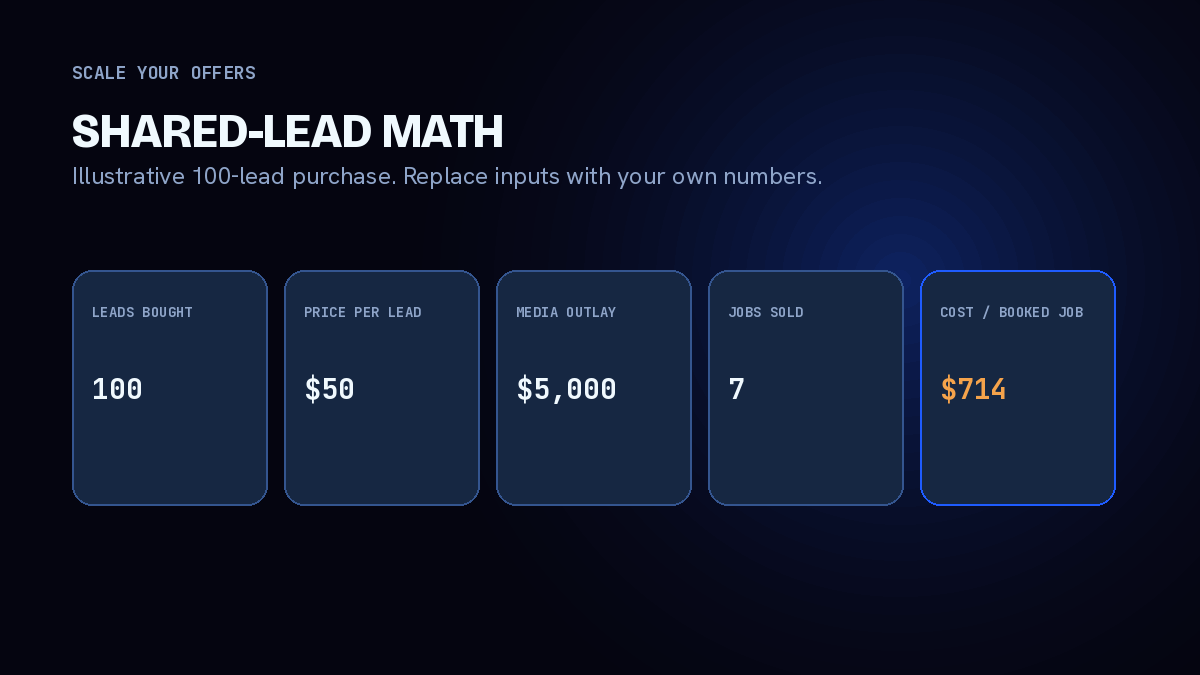
Assume you buy 100 marketplace leads at $50 each.
Spend equals 100 × $50 = $5,000.
Assume the same inquiry goes to four contractors. You still pay $50 per inquiry, and three other companies may call the same homeowner.
Assume a 50% contact rate. You reach 50 homeowners.
Assume a 15% close rate on reached homeowners. You book 7.5 jobs. Use 7 jobs for a conservative whole-job view. Use 7.5 jobs for cleaner monthly math.
With whole-job rounding, cost per booked job equals $5,000 ÷ 7 = $714.
With decimal math, cost per booked job equals $5,000 ÷ 7.5 = $667.
Now add gross profit. Assume the average booked job brings $6,000 in revenue at a 40% gross margin. Gross profit per job equals $2,400.
At 7 booked jobs, gross profit equals 7 × $2,400 = $16,800.
After the $5,000 lead spend, contribution before overhead equals $11,800.
This can work. The same model gets tight when the inputs move.
If contact rate falls to 35%, you reach 35 homeowners. If close rate stays at 15%, you book 5.25 jobs. Cost per booked job equals $5,000 ÷ 5.25 = $952.
If close rate falls to 10% on 35 contacts, you book 3.5 jobs. Cost per booked job equals $5,000 ÷ 3.5 = $1,429.
That final number sits inside the $1,400 to $2,500 true customer acquisition cost range reported by one industry guide after shared leads, fees, and competitive pressure enter the math [1]. Your own dashboard should show whether your account sits below or above that range.
Four Contractors Do Not Split the Cost
Do not think a four-way shared lead creates a four-way cost. It does not for the contractor.
If four contractors each pay $50, the marketplace earns $200 from one inquiry. Each contractor still carries a full $50 cost in his own P&L.
The homeowner makes one request. Each contractor sees one paid lead and one race for one job.
That setup changes your sales math. You need faster response, stronger qualification, clear financing, clean estimates, and tight follow-up. Slow contact turns a paid lead into a stale name.
Many owners blame the source after they already lost the first call by minutes. Track source economics and response execution separately.
The Response-Speed Multiplier
Shared leads magnify response speed. A source can send a valid inquiry, and your team can still waste it through slow contact.
A contractor marketing source reports that 35% to 50% of sales can go to the contractor who calls first [2]. Treat that as directional. The operating lesson still stands. If four contractors receive the same request, the first clean call holds an edge.
Track five timestamps:
- Lead arrival time.
- CRM record creation time.
- First call attempt time.
- First live conversation time.
- Estimate booking time.
A 60-second call attempt and a 10-minute call attempt can produce different economics from the same batch. Lead cost stays the same. Cost per booked job moves.
If you operate HVAC and you already have a CRM full of past estimates, tighten response before you buy more shared leads. Scale Your Offers frames HVAC database reactivation and fast follow-up as a first revenue lever on The Fastest Money.
The Price Pressure Problem
Shared leads push price-first selling. The homeowner can compare several bids from the first call. You need a reason to book beyond availability.
Protect margin by defining the job type you want before you buy the lead. A roofing company may want full replacements, storm inspections, and retail roof estimates. A bathroom remodeler may want full wet-area jobs with a minimum ticket. An HVAC company may want replacement calls, repair-to-replacement paths, and financing-ready households.
The source cannot fix a loose offer. Your intake team must disqualify small jobs fast, book right-fit jobs fast, and move wrong-fit calls off the sales calendar.
Cost per lead gives weak guidance by itself. A $35 lead that produces a $600 repair may cost too much. A $150 inquiry that books a $14,000 replacement may produce strong profit. Job mix decides the outcome.
Marketplace Leads Versus Owned Acquisition Over 12 Months
A marketplace can bring demand fast. Owned acquisition gives more control over message, tracking, follow-up, and remarketing. You still pay for traffic, landing pages, software, and labor. Control and compounding data create the difference.
Here is a 12-month illustration with equal spend. This does not claim an average result. It shows how the math moves when you control more of the path.
Marketplace model:
You buy 100 shared leads per month at $50 per lead. Monthly spend equals $5,000. Annual spend equals $60,000. Contact rate equals 50%. Close rate on contacts equals 15%. Annual leads equal 1,200. Annual contacts equal 600. Annual booked jobs equal 90. Cost per booked job equals $667.
Owned acquisition model:
You spend $5,000 per month on owned paid traffic, landing pages, tracking, and follow-up. Annual spend equals $60,000. Your average cost per exclusive inquiry equals $75. Annual inquiries equal 800. Contact rate equals 65%. Close rate on contacts equals 25%. Annual contacts equal 520. Annual booked jobs equal 130. Cost per booked job equals $462.
The owned model wins in this illustration because inquiries stay exclusive, contact rate rises, and close rate rises. The model also leaves you with campaign data, landing page data, retargeting audiences, email lists where consent allows, call recordings, and quote follow-up sequences.
Your local math can differ. If owned campaigns bring poor inquiries at $200 each, the marketplace may beat them. If your team responds slowly to both sources, both sources leak. If your offer and follow-up stay tight, owned acquisition often gives more control.
Scale Your Offers sells The Booked-Out Contractor, a $2.95 book that covers the offer, ads, funnel, tracking, and follow-up behind a paid-ads machine for booked, high-ticket jobs. This fits owners who want to move from renting inquiries toward controlling more of their own path.
How to Decide Before You Spend Another Month
Use a clean cutoff. Every lead source must beat your allowable acquisition cost.
Start with average ticket. Assume your average job is $8,000. Assume gross margin is 40%. Gross profit equals $3,200.
Now choose a maximum acquisition share. Many owners use different limits by trade, cash, and plan. For this illustration, use 25% of gross profit.
Allowable acquisition cost equals $3,200 × 25% = $800.
If your Angi cost per booked job runs at $500, the channel can fit. If it runs at $1,000, the channel needs repair or removal. If it runs at $1,500, you need a higher ticket, a higher close rate, a better contact rate, or a different source.
Run this math by job type. Do not blend tiny repairs and full replacements into one number. A blended report can hide the fact that one category funds the other.
Use these columns in your weekly lead-source sheet:
- Source.
- Leads.
- Spend.
- Avg lead cost.
- Contacts.
- Contact rate.
- Appointments.
- Appointment rate.
- Sold jobs.
- Close rate on contacts.
- Revenue.
- Gross profit.
- Cost per booked job.
- Lead spend ÷ gross profit.
This sheet shows whether Angi belongs in the budget. It also shows whether Attract or Convert needs the first fix.
The A.C.E. Diagnosis for Angi Leads
A.C.E. stands for Attract, Convert, and Expand. Attract brings the right buyers. Convert turns inquiries into booked revenue. Expand raises revenue per customer.
For this topic, the earliest weak stage usually sits at Attract. Shared marketplace leads can raise the cost of access to qualified demand because several contractors may pursue the same homeowner. If the source sends wrong-fit jobs, low-budget callers, or job types your crews should not take, Attract holds the first leak.
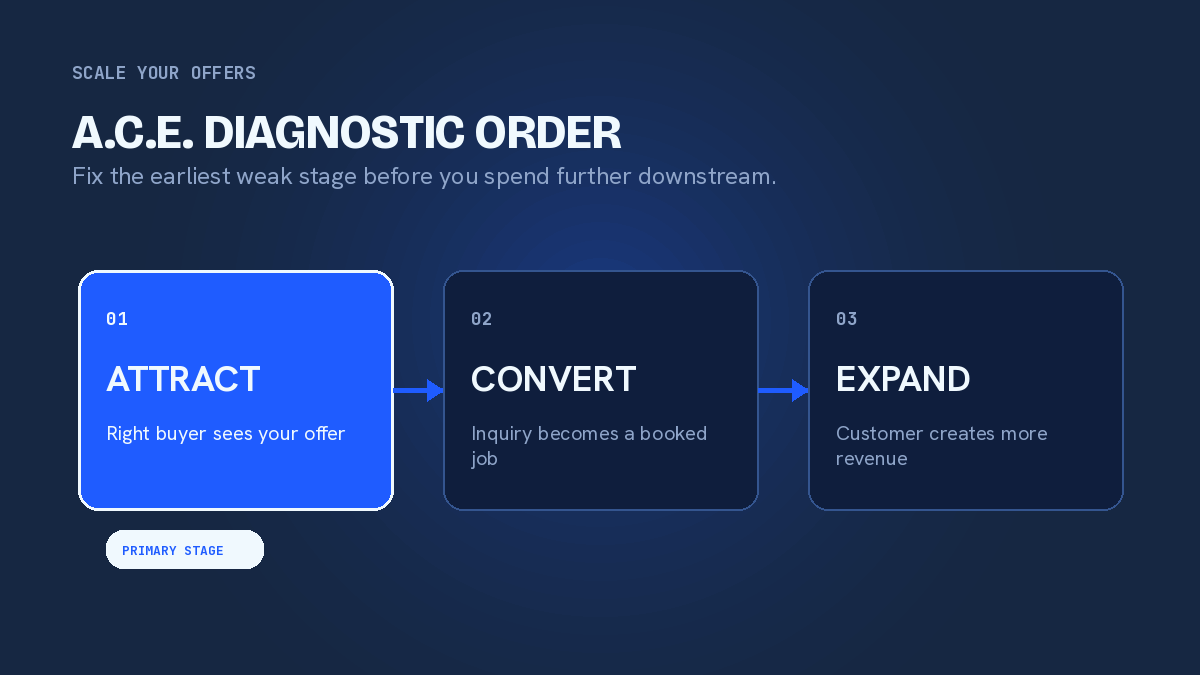
Convert comes next. If the source sends valid prospects and your team responds slowly, misses calls, fails to qualify, or lets quotes sit, Convert becomes the active leak. A shared source exposes slow speed faster than an exclusive source because competitors chase the same request.
Expand matters after the first job. If you buy a customer through a marketplace, your profit rises when you sell maintenance, future repairs, upgrades, and referral paths where the trade allows. A company that treats every marketplace customer as a one-time transaction leaves gross profit unused.
Fix the earliest constraint first. Do not pour money into Attract when Convert cannot handle current lead flow. Do not build Expand campaigns when the company cannot book enough right-fit first jobs.
Scale Your Offers has tracked more than $12 million in revenue and more than 50,000 leads across accounts it has touched. That record shows why source math, response speed, and follow-up discipline belong in the same operating review.
A Practical 30-Day Test
Run a 30-day test before you make a long decision. Keep it clean.
Pick one job category. Set the budget. Define the minimum ticket. Define the service area. Train the person who answers the lead. Create a call script for qualification and booking. Set a response target under five minutes, with an internal goal near one minute when staffing allows.
Track every lead manually if needed. Put each inquiry in the CRM with source, timestamp, first call time, contact result, appointment result, sold result, and revenue.
At 30 days, calculate cost per booked job and lead spend as a share of gross profit. Then separate the misses.
Wrong trade, wrong location, or wrong job size points to Attract. No answer, delayed call, weak booking, or missed follow-up points to Convert. Low repeat purchase, no maintenance path, and no future offer points to Expand.
Use that review to decide: keep, cut, cap, or repair the source.
FAQ
Are Angi leads exclusive?
One industry guide reports that Angi leads often go to 3 to 8 competing contractors at the same time [1]. You should verify your own agreement, market, lead type, and account settings before you rely on exclusivity.
What is a good cost per booked job from Angi?
A good cost per booked job sits below your allowable acquisition cost. If a job creates $3,200 in gross profit and your limit is 25% of gross profit, your ceiling is $800 per booked job.
Should I stop buying shared leads?
Judge shared leads by gross profit, not by opinion. Keep the source if it produces right-fit jobs at an acceptable cost per booked job. Cap or cut the source if it misses your margin target after your team fixes response speed and follow-up.
What should I build besides marketplace leads?
Build channels you control, including paid search, paid social, landing pages, tracking, database reactivation, referral systems, and quote follow-up. The right mix depends on your trade, ticket size, service area, crew capacity, and sales process.
Next Step
If you want to know whether your first leak sits in Attract, Convert, or Expand, take the Lead Flow Score. The assessment has 12 questions, takes about 90 seconds, costs nothing, and gives an instant result that names the leak holding back your lead flow.
References
[1] LeadTruffle, “The Complete Guide to Angi Leads for Home Service Contractors in 2026.” Used for reported shared-lead range, reported shared and exclusive conversion ranges, and reported true customer acquisition cost range.
[2] Olly Olly, “Angi for Contractors: Still Worth It?” Used for reported first-caller sales share in shared contractor lead markets.
[3] Blessed Arc Media, “Stop Paying for Angi & HomeAdvisor Leads.” Used for the research brief item on the 2023 FTC order involving HomeAdvisor, now Angi.