
How to Sell High-Ticket HVAC Replacements
High-ticket HVAC replacement sales fail when an advisor enters the home without a defined Convert process. Leads can come from ads, forms, technician turnovers, or old unsold estimates. The sale still depends on fast response, strong qualification, credible diagnosis, simple options, clear financing language, and disciplined estimate follow-up.
A $12,000 to $20,000 decision asks the homeowner to trust the company, the advisor, the diagnosis, the equipment plan, the install crew, and the payment path. Build that trust with a repeatable sales path. Do not rely on one closer.
The operating target is simple. Help each advisor identify the comfort problem, present the technical basis, show good-better-best choices, discuss payment early, and follow up until the homeowner decides.
Start With the Earliest Constraint in the Replacement Sale
Inspect the replacement path in order. The earliest constraint limits everything that follows.
If calls, forms, texts, and social messages sit unanswered, presentation training will not move the number. If the dispatcher books weak appointments, the advisor loses time in homes that lack urgency, authority, or budget fit. If the advisor arrives without load notes, photos, airflow data, and equipment age, the presentation becomes a price quote. If the proposal shows one option, the homeowner compares it to every other number in town.
The Convert stage covers response speed, qualification, booking, presentation, and follow-up. Scale Your Offers defines Convert as speed to lead, qualification, booking, and quoted-job follow-up in its A.C.E. system [1]. Fix the first broken link before adding lead spend.
A March 2026 Workato study reviewed response behavior from 114 B2B companies and cited prior Harvard Business Review research that connected slower response with lower qualification odds when response moved from five minutes to ten minutes [2]. That evidence is directional for HVAC. The operating lesson applies. Fast human or AI-enabled response improves qualification and booking while intent remains fresh.
The High-Ticket HVAC Replacement Sales Path
Give the advisor and the customer a clear path from problem to decision.
| Sales stage | Owner standard | Advisor action | Manager check |
|---|---|---|---|
| Response | Contact every inbound replacement lead fast | Call, text, and confirm appointment details | Review missed calls, aged forms, and unworked messages daily |
| Qualification | Book fit-based calls | Confirm system age, symptoms, decision makers, timeline, and access | Audit booked calls for missing fields |
| Discovery | Find comfort and risk drivers | Ask about rooms, noise, repair history, utility concerns, allergies, humidity, and timeline | Review call recordings and advisor notes |
| Diagnosis | Prove the problem | Document equipment condition, airflow concerns, electrical wear, duct concerns, and sizing basis | Require photos and diagnosis summary |
| Options | Give good-better-best choices | Present three tiers with plain differences | Track close rate by option tier |
| Financing | Discuss monthly paths early | State payments as estimates, subject to credit approval and lender terms | Review scripts and disclosures |
| Follow-up | Work every open estimate | Use same-day recap, next-day call, and 7 to 14 day cadence | Track stale estimates by age |
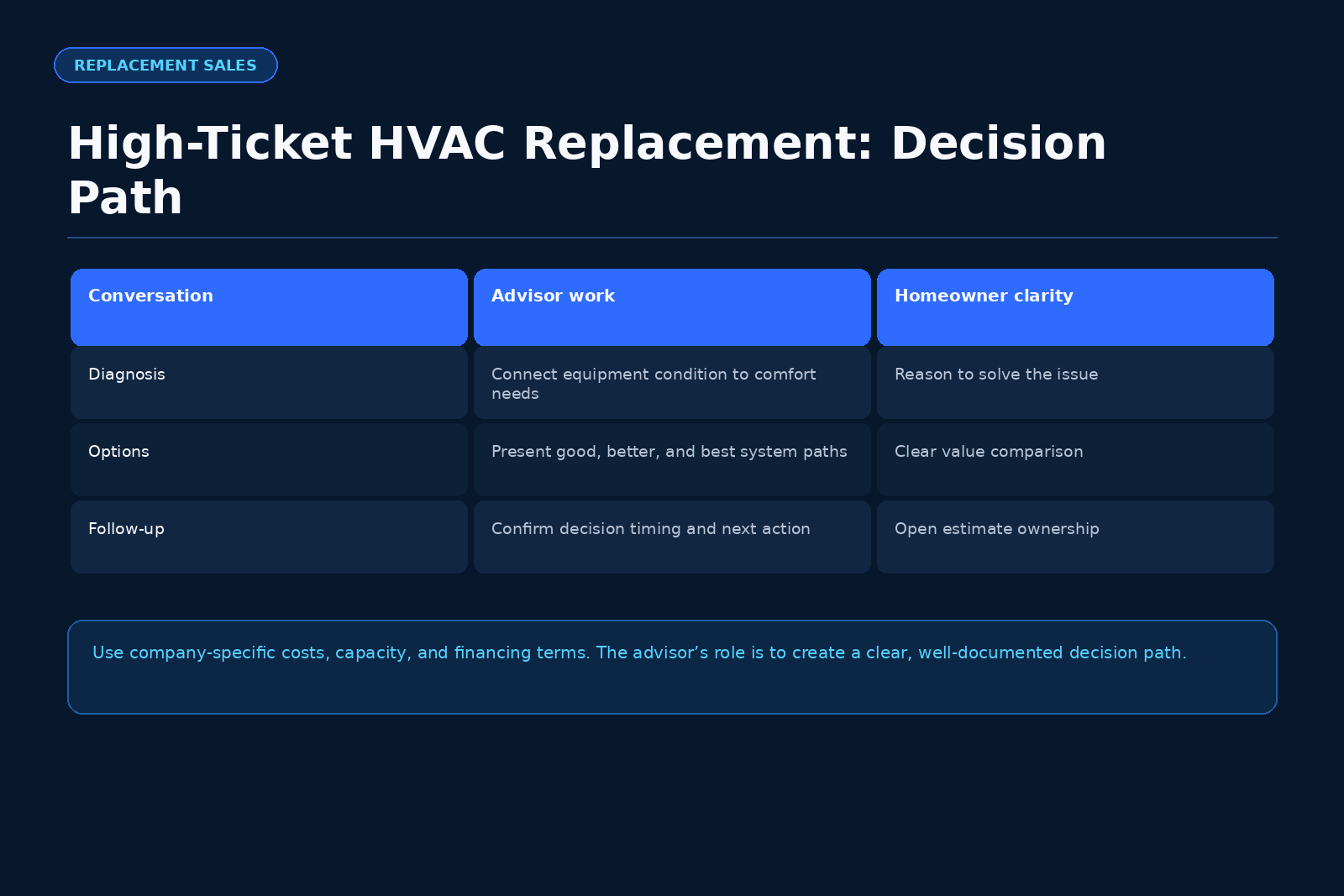
Use this as a weekly coaching tool. Inspect each stage to see where a high-ticket replacement missed long before the proposal.
Discovery Must Come Before the System Pitch
Discovery sets the context for the right system. Ask complete questions and document exact answers. Build a comfort and decision profile that ties the plan to the home.
Cover seven areas:
- Comfort complaints: rooms, timing, and duration.
- Repair history: what failed and what it cost in the last three years.
- Equipment age and breakdown pattern: models, visible wear, and service notes.
- Air concerns: dust, humidity, odors, filtration, and airflow.
- Noise and placement: indoor and outdoor sound concerns.
- Decision process: who approves and how they compare choices.
- Timeline: heat, cooling, or planning before peak season.
When a homeowner says, “The upstairs never cools,” sell the comfort outcome. Connect the complaint to airflow, duct condition, capacity, thermostat placement, insulation clues, and equipment operation before you discuss models.
Diagnosis Builds Credibility Before Price
Prove what you recommend. Show what the team found and why it fits.
ACCA publishes recognized residential design standards through Manual J and related methods [3]. Tie replacement diagnosis to load calculations aligned with Manual J and equipment selection aligned with Manual S. Set a written rule for when advisors need load data, duct notes, static pressure readings, photos, and supervisor review.
Include items that matter:
- Equipment age, model, condition, and service history.
- Photos of corrosion, wear, damaged wiring, coil condition, cabinet issues, or safety findings when present.
- Airflow observations and duct concerns.
- Static pressure readings when company procedure calls for them.
- Room-by-room comfort complaints.
- Proposed capacity basis and installation constraints.
- Indoor air quality findings tied to filter type, humidity, dust, or ventilation.
Present photos on a tablet and explain each one in plain terms. Show what failed, what is at risk, what can be repaired, what replacement solves, and what each tier includes.
Separate findings from opinions. “The blower wheel has heavy buildup in this photo” carries more weight than “This system is terrible.” Let the photo do the heavy lift and translate it into choices.
Good-Better-Best Options Reduce Price-Only Comparisons
One quote trains the homeowner to compare one number. Good-better-best gives the homeowner a choice of comfort, efficiency, air quality, warranty, and payment range.
ACHR News reported survey coverage on proposal methods tied to higher close rates by double digits [4]. Track your own results by market, price point, and lead source.
Structure the options with clear differences:
- Good: code-ready installation, matched system, standard thermostat, standard warranty. Restores heating and cooling with the fewest add-ons.
- Better: higher efficiency, upgraded thermostat, better filtration, maintenance agreement. Improves control, filtration, and operating cost for homeowners staying in the home.
- Best: variable or inverter where suitable, advanced filtration, humidity control where appropriate, extended labor coverage. Delivers the strongest comfort package and protection.
Present all options together with price, estimated monthly payment if financing applies, main inclusions, warranty terms, and install scope. Do not hide the Good option. Make higher tiers tangible with documented system type, sound data where available, filtration and humidity plans, labor coverage, and maintenance.
Use Efficiency Claims With Sourced Language
Energy and comfort claims need sources and home-specific limits. ENERGY STAR states that replacing a 15-year-old conventional heating and cooling system with an ENERGY STAR certified heat pump or high-efficiency central air conditioner can reduce energy consumption by up to 15 percent or more [5]. Use DOE and ENERGY STAR guidance for training language, proposal footnotes, and advisor education [5][6].
Use careful phrasing:
- “ENERGY STAR states up to 15 percent or more in energy consumption reduction when replacing a 15-year-old conventional system with an ENERGY STAR certified heat pump or high-efficiency central air conditioner.”
- “Your actual bill effect depends on thermostat settings, duct condition, weather, utility rates, system sizing, and home construction.”
- “We can show the system ratings and the available manufacturer information. We cannot promise a specific monthly utility bill.”
This protects the sale and builds credibility.
The Financing Conversation Should Start Early
Introduce financing before the price reveal so monthly framing feels normal.
Ask:
- “Many homeowners compare both cash price and monthly payment. Would you like to see both on the options?”
- “If the system plan fits, do you prefer to pay in full or review monthly options?”
- “Any payment figures I show are estimates and depend on lender approval and final terms.”
The FTC advises consumers to scrutinize project and payment claims. Keep financing communication clear and documented [7]. Do not quote financing as guaranteed. State the lender, promotional term if any, estimated payment, rate when required by the program, dealer fee treatment if disclosed in company policy, and approval status.
Use precise language. “This option shows an estimated payment of $145 per month, subject to credit approval and lender terms. The written lender disclosure controls the final payment.” Train every advisor on approved financing language. Review recorded presentations and proposal notes. Put financing language in the company playbook.
Worked Illustrative Calculation: How Option Mix Changes Revenue
The following math is illustrative. Replace every input with actual appointment counts, close rates, option mix, average tickets, gross margin, and financing approval data.
Assume the company runs 100 replacement appointments in one month.
Single-option proposal model:
- 100 appointments.
- 38 percent close rate.
- $12,000 average ticket.
- 38 sold jobs.
- 38 × $12,000 = $456,000 sold revenue.
Good-better-best proposal model:
- 100 appointments.
- 42 percent close rate.
- 42 sold jobs.
- 20 percent choose Good at $11,000.
- 50 percent choose Better at $14,000.
- 30 percent choose Best at $18,000.
Revenue by tier:
- Good: 42 × 20 percent = 8.4 jobs. 8.4 × $11,000 = $92,400.
- Better: 42 × 50 percent = 21 jobs. 21 × $14,000 = $294,000.
- Best: 42 × 30 percent = 12.6 jobs. 12.6 × $18,000 = $226,800.
Total sold revenue:
- $92,400 + $294,000 + $226,800 = $613,200.
Illustrative lift:
- $613,200 minus $456,000 = $157,200.
This model does not predict outcomes. It shows why owners should track close rate, option mix, average ticket, and gross margin together and align sales with install capacity.
Estimate Follow-Up Turns Open Quotes Into Managed Pipeline
Treat every open replacement estimate as a managed sales asset. Scale Your Offers frames quoted-job follow-up as part of Convert and notes that rapid human or AI-enabled response aids qualification and booking across calls, forms, texts, and social messages [1].
Run a 14-day cadence:
- Same day, within two hours: recap text with the selected option, install window, and direct callback number.
- Same evening: email the proposal, photos, and financing link if requested.
- Next day: call to ask what the homeowner needs to decide.
- Day three: send a short personalized video that reviews the diagnosis and the three options.
- Day five: send an availability update if install capacity or equipment availability matters.
- Day seven: call and offer to simplify the choices if the homeowner feels stuck.
- Day ten: send a final comparison summary that shows Good, Better, and Best in one view.
- Day fourteen: move to a long-term nurture list if the homeowner is not ready.
Reactivate older estimates, too. Scale Your Offers describes database reactivation as fast revenue from the existing HVAC customer list. Its illustrative model uses 500 unsold replacement estimates contacted over 14 days, 2 percent booked, 35 percent closed, and a $12,000 average ticket to show $42,000 in signed work [1]. See The Fastest Money and replace the inputs with your CRM data.
Every touch should recap facts, answer concerns, and make the next step easy. Do not pressure with claims you cannot back.
A.C.E. Section: Fix Convert Before Scaling Replacement Lead Spend
A.C.E. gives the owner a clean order of operations.
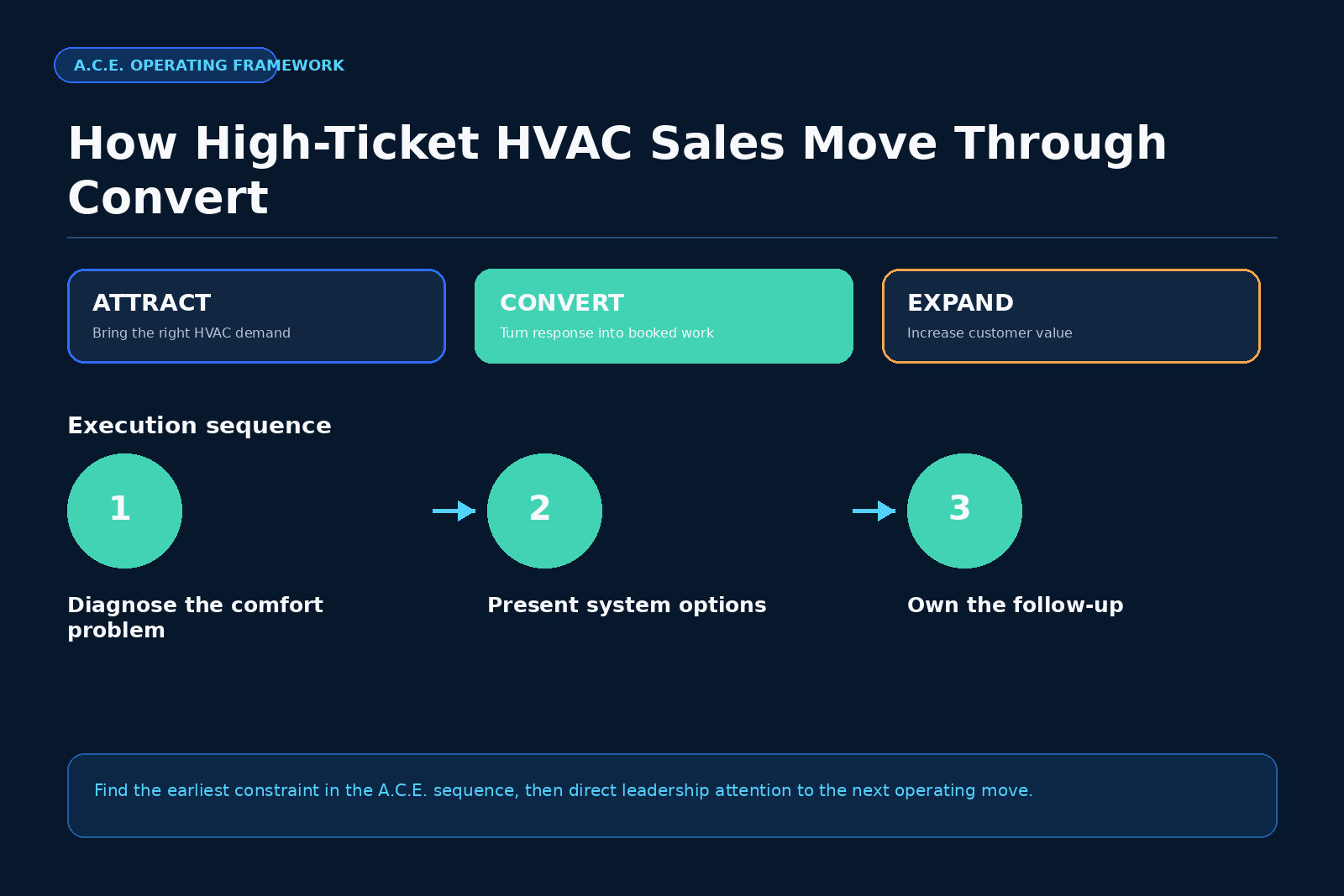
- Attract brings HVAC maintenance and replacement buyers from the service area. Scale Your Offers defines Attract as owned paid traffic targeted at replacement and maintenance buyers in the service area [1]. For replacement sales, Attract includes the offer, ad, landing page, tracking, and speed path. The Booked-Out Contractor, a $2.95 book, covers the offer, ads, funnel, tracking, and follow-up for a paid-ads machine according to the page copy [8].
- Convert turns demand into booked replacement opportunities, then into sold work. This article sits here. Convert covers fast response, call handling, qualification, advisor arrival, discovery, diagnosis, options, financing, estimate follow-up, and sales management.
- Expand grows revenue from the existing customer base. Scale Your Offers defines Expand as maintenance agreements, repair-to-replacement paths, indoor air quality, and database reactivation [1]. Expand matters because member lists, aged equipment, repair histories, and open estimates create timing data for advisor schedules.
Fix the earliest constraint. If Attract creates enough demand and Convert wastes it, fix Convert first. If Convert runs well and the database sits untouched, run Expand plays. If both work, add Attract volume with tighter tracking.
Owners can find the earliest constraint with the free Lead Flow Score, described as 12 questions, 90 seconds, no cost, and an instant result [9].
Sales Manager Scorecard for High-Ticket HVAC Replacements
Manage behavior weekly. Revenue alone arrives too late. Track:
- Inbound replacement response time to first call and text.
- Contact rate: leads that reached a live conversation.
- Booked appointment rate: booked appointments divided by qualified inquiries.
- Show rate: completed in-home or virtual appointments.
- Diagnosis completion rate: photos, notes, system age, and sizing basis.
- Option presentation rate: three choices presented.
- Financing presentation rate: payment path offered when suitable.
- Close rate: sold jobs divided by presented estimates.
- Average ticket: sold revenue divided by sold jobs.
- Gross margin by option tier: Good, Better, Best.
- Follow-up completion rate: scheduled touches completed on open estimates.
- Stale estimate count: older than 14 days with no clear next action.
Review three appointments per advisor each week. Inspect the call recording, photos, proposal, option mix, financing language, and follow-up history. Coach the exact missed action and train the replacement. Example: “You missed room-by-room comfort complaints. On your next appointment, ask for the three least comfortable rooms before you inspect equipment.”
Advisor Script Flow for the In-Home Visit
Give advisors a repeatable flow that sounds natural.
- Arrival and agenda: “I will review the system, confirm comfort issues, document what I find, and then show you a few replacement choices. I can include cash price and monthly payment estimates if you want to compare both.”
- Discovery: “What made you start looking at replacement now.” “Which rooms give you the most trouble.” “What repairs has the system needed in the last few years.” “How long do you plan to stay in the home.” “Who else should review the choices before you decide.”
- Diagnosis presentation: “Here are the photos from the indoor equipment.” “This shows the condition of the cabinet and coil area.” “This reading tells us how the system is moving air today.” “Based on the age, repair history, and comfort complaints, replacement gives you a cleaner path than another repair.”
- Options: “I built three choices. Good restores heating and cooling with a basic matched system. Better adds efficiency, filtration, and maintenance. Best adds the strongest comfort package and coverage. I will walk through the differences before we talk about price.”
- Financing: “These payment numbers are estimates. The lender makes the credit decision, and the written lender terms control the final payment. I can show cash price and monthly estimates side by side.”
- Close: “Which option fits the way you want the home to feel and the way you want to pay for the project.”
- Follow-up if undecided: “I will send the proposal, photos, and a short recap today. I will call tomorrow to answer questions and help you compare the options.”
FAQ
What should an HVAC advisor do before presenting replacement pricing?
The advisor should complete discovery, inspect the system, document findings, and explain the diagnosis. Pricing should follow the evidence. A homeowner can make a better decision when the advisor ties each option to comfort complaints, equipment condition, air quality concerns, and installation scope.
How many HVAC replacement options should the proposal include?
Most HVAC companies should present three options: Good, Better, and Best. Each option needs distinct equipment, comfort, efficiency, air quality, warranty, maintenance, and payment differences. The company should track close rate, average ticket, option mix, and margin by tier.
When should financing come up during an HVAC replacement sale?
Financing should come up during discovery or before the final proposal review. The advisor should ask whether the homeowner wants to compare cash price and monthly payment estimates. Every payment number should stay subject to credit approval and lender terms.
How long should an HVAC company follow up on open replacement estimates?
A strong replacement estimate cadence runs for 7 to 14 days, then moves the opportunity into longer-term nurturing. The first follow-up should happen the same day. The company should track every open estimate until the homeowner buys, declines, or chooses a later timing path.
High-ticket HVAC replacement sales reward process discipline. If your advisors need a tighter Convert system for response, booking, discovery, diagnosis, options, financing, and estimate follow-up, request an A.C.E. Audit. Scale Your Offers will inspect the sales path, find the earliest constraint, and give you the next operating moves to tighten replacement revenue.
References
- Scale Your Offers, The Fastest Money
- Workato, Lead Response Time Study
- Air Conditioning Contractors of America
- ACHR News, Survey Reveals Strategies to Boost HVAC Close Rates by Double Digits
- ENERGY STAR, Replace Heating and Cooling Equipment
- U.S. Department of Energy, Purchasing Energy-Efficient Residential Central Air Conditioners
- Federal Trade Commission, Consumer Advice on Project Scams
- Scale Your Offers, The Booked-Out Contractor
- Scale Your Offers, Lead Flow Score