
HVAC SEO: The 3 Metrics That Turn Search Traffic Into Booked Jobs
HVAC SEO should earn booked service calls, maintenance visits, and replacement estimates from homeowners in your service area. Rankings and sessions matter only when they connect to calls, forms, texts, and scheduled work.
Google’s SEO Starter Guide explains that SEO helps search engines understand content and helps users decide whether to visit a site [1]. Local results rely on relevance, distance, and prominence [2]. An HVAC company needs a scorecard that ties those facts to dispatchable demand.
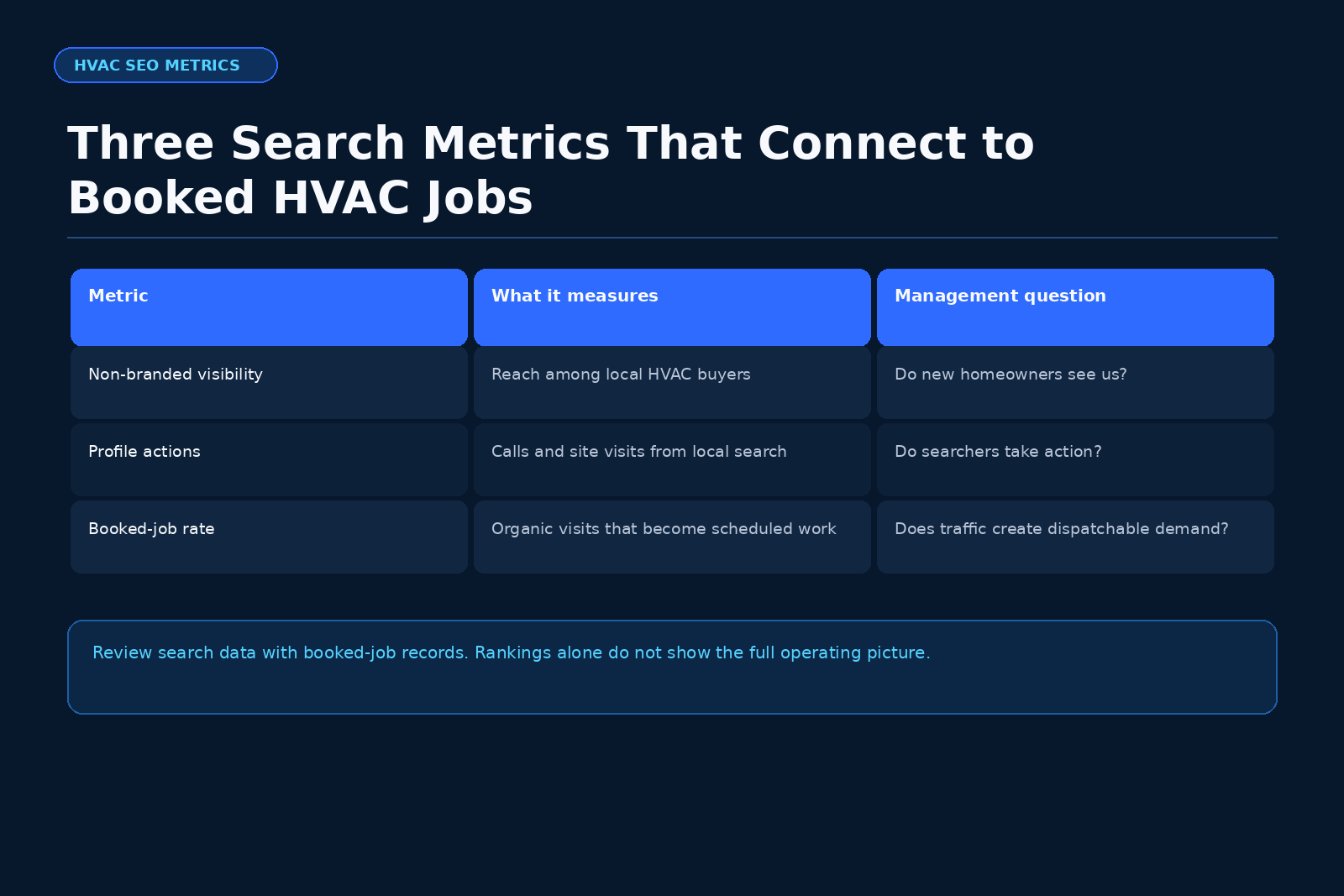
An HVAC owner with technicians, installers, call handling, lead costs, and a customer database needs three SEO metrics. The first shows non-branded local HVAC visibility. The second shows Google Business Profile actions. The third shows the organic traffic-to-booked job rate.
| Metric | What it tracks | Why it matters for an HVAC owner | Weekly operating check |
|---|---|---|---|
| Non-branded local HVAC visibility | Impressions and ranking for searches that do not include the company name | It separates new market demand from people who already know the company | Track a fixed set of repair, replacement, heat pump, furnace, and maintenance terms by city |
| Google Business Profile actions | Calls, website clicks, and other listing actions | It shows whether map visibility creates direct buyer movement | Compare calls and clicks against profile views and top service queries |
| Organic traffic-to-booked job rate | Organic visitors that become scheduled service calls or replacement estimates | It connects SEO to dispatch boards, sales calendars, and revenue tracking | Match organic source data to call tracking, forms, booking records, and field service records |
Metric 1: Non-branded local HVAC visibility
Non-branded visibility tracks searches from people who need HVAC service and do not search for your company name. Branded searches reflect prior marketing or referrals. Non-branded searches show whether SEO reaches a new homeowner at the moment of need.
Use terms that match HVAC buyer intent in your service area. Examples include “AC repair near me,” “furnace repair [city],” and “heat pump replacement [city].” Track the same terms every week so the trend has meaning.
Because local results use relevance, distance, and prominence [2], treat geography and service fit as inputs. A service page should name the service, service area, and next action. A Google Business Profile should list accurate business information, correct categories, service details, and current photos where appropriate.
Do not grade HVAC SEO by broad national terms. You need search visibility from homeowners inside your dispatch area. Track the cities, suburbs, and service lines your team can service profitably.
Build a weekly visibility sheet with these columns:
- Service line.
- City or service zone.
- Search term.
- Map position range.
- Organic page position range.
- Search Console impressions where available.
- Leads or calls tied to the page or listing.
- Booked jobs tied to organic search.
This turns visibility into a managed asset. The owner can see whether heat pump replacement, furnace repair, and AC tune-up pages create exposure in the right locations.
Metric 2: Google Business Profile actions
For many HVAC searches, the Google Business Profile acts as the first contact point. A homeowner can call, click to the website, read services, or compare nearby options before visiting your site. Treat the profile as an operating channel.
Local ranking depends on relevance, distance, and prominence [2]. Make HVAC services clear in the profile and on the linked page. Category selection, service entries, hours, photos, review activity, and landing page alignment affect how searchers read your presence.
Track actions in a weekly GBP section. Include phone calls from the profile, website clicks from the profile, direction requests if relevant, top queries, and profile views. Compare those actions against booked calls in your call tracking and field service system.
Run this audit path:
- Confirm that the primary category matches your main HVAC service model.
- Confirm that service areas match the dispatch territory.
- Confirm that major services appear on the profile.
- Confirm that the linked landing page matches buyer intent.
- Confirm that profile calls reach a live booking path during business hours.
- Confirm that after-hours calls route to a tracked message, booking line, or response path.
- Confirm that reviews and responses follow FTC guidance for endorsements and consumer review claims [3].
Review handling matters because trust signals influence attention in the map pack. Follow FTC guidance. Avoid fabricated review language, undisclosed incentives, or unverifiable claims [3].
GBP actions also reveal a common HVAC SEO leak. A company may appear often in maps while calls stay flat. That points to a weak listing, unclear offer, stale photos, weak review recency, wrong categories, poor call handling, or a landing page mismatch.
Metric 3: Organic traffic-to-booked job rate
Organic traffic-to-booked job rate measures the share of organic visitors that become scheduled work. It shows how SEO affects the dispatch board.
Use this formula:
Organic booked job rate = organic booked jobs ÷ organic website sessions
For replacement estimate pages, count booked estimates. For repair pages, count booked diagnostic calls. For maintenance pages, count booked tune-ups or maintenance agreement appointments. Separate service lines because ticket size and sales motion differ.
Set up tracking with four data points:
- Source and landing page from analytics.
- Call tracking source for phone calls.
- Form source for web submissions.
- Booked job status in the field service system.
Every organic call, form, and booked appointment needs a source tag that survives from first click to dispatch record. A drop in booked job rate with stable traffic means the problem sits after visibility. Common causes include page copy, mobile speed, phone placement, form length, service mismatch, or call handling. That turns an SEO meeting into a revenue meeting.
Worked illustrative calculation: organic booked jobs
Assume an HVAC company receives 2,400 organic sessions in a month from service-area traffic. The site books 60 organic jobs from calls and forms. The average booked repair, maintenance, or estimate visit produces $450 in same-month revenue across the mixed job set.
Formula:
Organic booked job rate = 60 booked jobs ÷ 2,400 sessions
Organic booked job rate = 2.5%
Revenue tied to booked organic jobs = 60 booked jobs × $450
Revenue tied to booked organic jobs = $27,000
Now assume the company keeps organic sessions flat at 2,400 and raises booked jobs from 60 to 84 through stronger phone placement, faster response, clearer service pages, and better GBP action routing.
New organic booked job rate = 84 booked jobs ÷ 2,400 sessions
New organic booked job rate = 3.5%
New revenue tied to booked organic jobs = 84 × $450
New revenue tied to booked organic jobs = $37,800
Illustrative gain = $37,800 - $27,000
Illustrative gain = $10,800
This math does not promise a result. It shows why the owner should track booked jobs, not traffic alone.
Build the weekly HVAC SEO operating rhythm
HVAC demand shifts with season, weather, equipment age, and service area. A weekly review keeps the team focused on search demand that can turn into booked work.
Use this nine-point rhythm:
- Review non-branded local visibility for the fixed term set.
- Review which service pages gained or lost impressions.
- Review GBP calls, website clicks, and top queries.
- Review call answer rate for organic and GBP calls.
- Review missed calls from search sources.
- Review form submissions from organic landing pages.
- Review booked jobs by organic landing page.
- Review booked job rate by service line.
- Assign one owner for the next correction.
A correction can include a service page update, call routing fix, GBP category review, new city page, repair-to-replacement call script, or tighter estimate follow-up. If you want a wider operating view, compare this SEO scorecard with the A.C.E. Audit.
A.C.E. scorecard for HVAC SEO
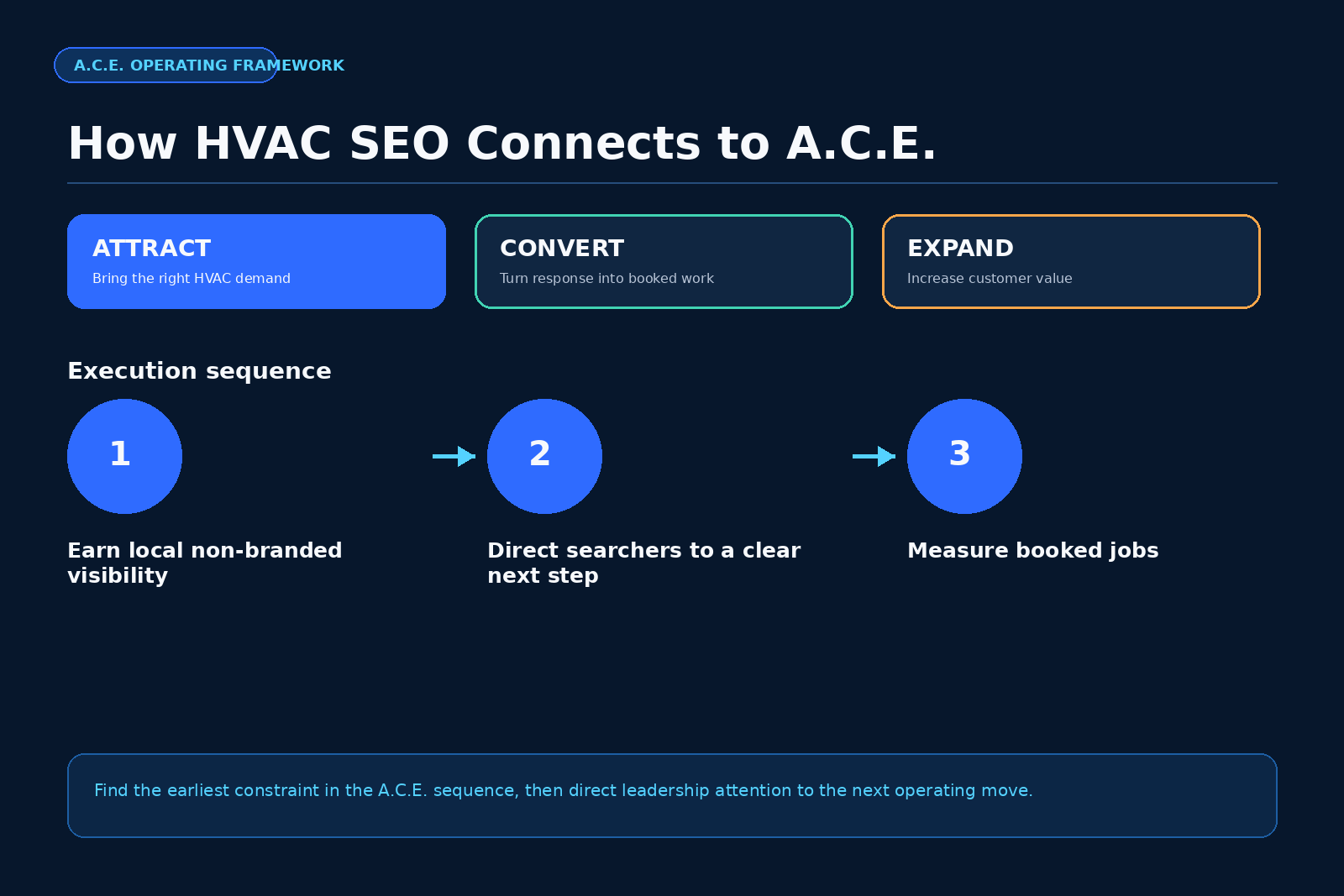
A.C.E. gives the operating order. Assess the earliest constraint first. Attract comes before Convert, and Convert comes before Expand.
Attract: prove that search reaches the right HVAC buyers
Attract brings HVAC maintenance and replacement buyers from the service area. For SEO, Attract starts with non-branded visibility and GBP actions. The owner needs proof that the company appears when a homeowner searches for AC repair, furnace replacement, heat pump service, indoor air quality, or maintenance in the dispatch market.
Attract metrics:
| Attract check | Good operating sign | Owner action |
|---|---|---|
| Non-branded search visibility | Service pages and GBP appear for local HVAC terms | Build or refine service pages by city and service line |
| GBP actions | Calls and clicks rise with relevant queries | Tighten categories, services, photos, hours, and landing page match |
| Service-area fit | Leads come from profitable dispatch zones | Adjust page targeting and GBP service areas |
Convert: turn organic searchers into scheduled work
Convert covers response speed, qualification, booking, presentations, and estimate follow-up. Organic SEO cannot carry weak call handling. If a homeowner clicks from Google and no one answers, the search win disappears.
Track these Convert items for organic and GBP leads:
- Call answer rate.
- Missed call count.
- Form response time.
- Text response time.
- Appointment booking rate.
- Replacement estimate set rate.
- Follow-up rate on open estimates.
Scale Your Offers’ HVAC page for database reactivation and speed-to-lead frames rapid human or AI-enabled response as useful for qualification and direct appointment booking on inbound calls, forms, texts, and social messages [7]. Apply the same operating rule to HVAC SEO. If search creates inbound demand, the office must answer and book.
Expand: grow revenue from customers SEO already reached
Expand covers maintenance agreements, referrals, indoor air quality, repair-to-replacement, and database reactivation. SEO can feed Expand when the customer record stores the original service source, system age, equipment type, estimate status, and next recommended appointment.
An AC repair lead can become a maintenance agreement buyer. A furnace repair call can create a replacement estimate. A heat pump tune-up can create an indoor air quality conversation. A no-sale estimate can enter a follow-up path.
For database reactivation, Scale Your Offers’ page for The Fastest Money frames the existing customer list as a fast revenue source for HVAC companies with CRM history [7]. The page labels its math as illustrative, so owners should replace each input with their own records [7]. If an owner wants a paid-ads operating resource that covers offer, ads, funnel, tracking, and follow-up, Scale Your Offers describes The Booked-Out Contractor, a $2.95 book as a 75-page resource with six free tools and a 30-day “Read It, Keep It” guarantee [6].
How to read the three metrics together
Read the three metrics as one scorecard:
- If non-branded visibility and GBP actions rise but booked jobs stay flat, inspect Convert. Look at call handling, form response, booking friction, and follow-up.
- If non-branded visibility and booked jobs stay flat, inspect Attract. Improve service pages, city targeting, GBP alignment, and technical basics from Google Search Central [1].
- If booked jobs rise while average ticket falls, inspect job mix. Aim for more replacement, heat pump, furnace, or maintenance agreement opportunities.
- If organic leads book well but repeat revenue stays flat, inspect Expand. Improve maintenance agreement conversion, repair-to-replacement routing, indoor air quality prompts, referrals, and database reactivation.
This reading order prevents random SEO work. Assign work by constraint.
FAQ
What is the best first metric for HVAC SEO?
The best first metric is non-branded local HVAC visibility. It shows whether the company appears for searches from homeowners who need HVAC service and do not already know the company name.
How should an HVAC company track Google Business Profile results?
Track calls, website clicks, top queries, and booked jobs tied to the profile. Compare those actions with call records, form records, and field service bookings each week.
Why does organic traffic fail to create booked HVAC jobs?
Organic traffic fails to create booked jobs when the searcher meets friction after the click. Common causes include missed calls, slow form response, weak mobile pages, unclear service pages, and weak appointment booking.
How does A.C.E. apply to HVAC SEO?
A.C.E. starts with Attract, which measures local search visibility and profile actions. Convert then measures response, booking, and estimate follow-up. Expand then grows maintenance agreements, referrals, indoor air quality sales, repair-to-replacement, and database reactivation.
If your HVAC SEO gets traffic but the dispatch board still has gaps, diagnose the earliest A.C.E. constraint first. Take the free Lead Flow Score assessment from Scale Your Offers. The page says it takes 12 questions, 90 seconds, and gives an instant result that names the leak holding lead flow back [4].
References
- Google Search Central, SEO Starter Guide
- Google Business Profile Help, Understand local search results on Google
- Federal Trade Commission, FTC's Endorsement Guides: What People Are Asking
- Scale Your Offers, Lead Flow Score ACE Assessment
- Scale Your Offers, ACE Audit
- Scale Your Offers, The Booked-Out Contractor
- Scale Your Offers, The Fastest Money