
HVAC Call Booking Scripts: Turn Paid Leads Into Appointments
In A.C.E., paid HVAC lead flow starts with Attract, then the first constraint often moves to Convert. When Google, Meta, referral, and database calls reach the office, the CSR must answer fast, qualify the need, set the appointment, and place the call outcome into the CRM. Lead response research from Harvard Business Review reports that lead qualification odds drop sharply when teams wait beyond the first five minutes, based on a study covering 15,000 leads and 100,000 call attempts.[1] HVAC owners should treat every paid call, form, text, and missed call as a Convert event with a script, a target, and a manager review rhythm.
Why the phone script controls paid lead return
Paid ads can create HVAC demand, yet the office team decides how much of that demand turns into booked work. A caller with a failed AC system, a noisy furnace, a weak heat pump, or a replacement estimate request usually wants a fast path to relief. The CSR has to lower confusion, collect the right details, and ask for the appointment without drifting into a loose price chat.
A script does not turn CSRs into robots. A script gives the team a shared call path. The CSR can still sound calm, human, and local. The script removes guesswork from the first 90 seconds of the call.
The owner also gains cleaner data. If every CSR follows the same booking path, the manager can compare calls by lead source, call type, objection, and outcome. That makes training specific. The manager can hear where callers drop, which lines cause confusion, and which CSR needs coaching on appointment control.
For paid lead flow, the phone script should cover four common call types:
- Service call with an active comfort problem.
- Replacement inquiry after an aging or failed system.
- Tune-up or maintenance agreement inquiry.
- Price shopper who leads with cost before diagnosis.
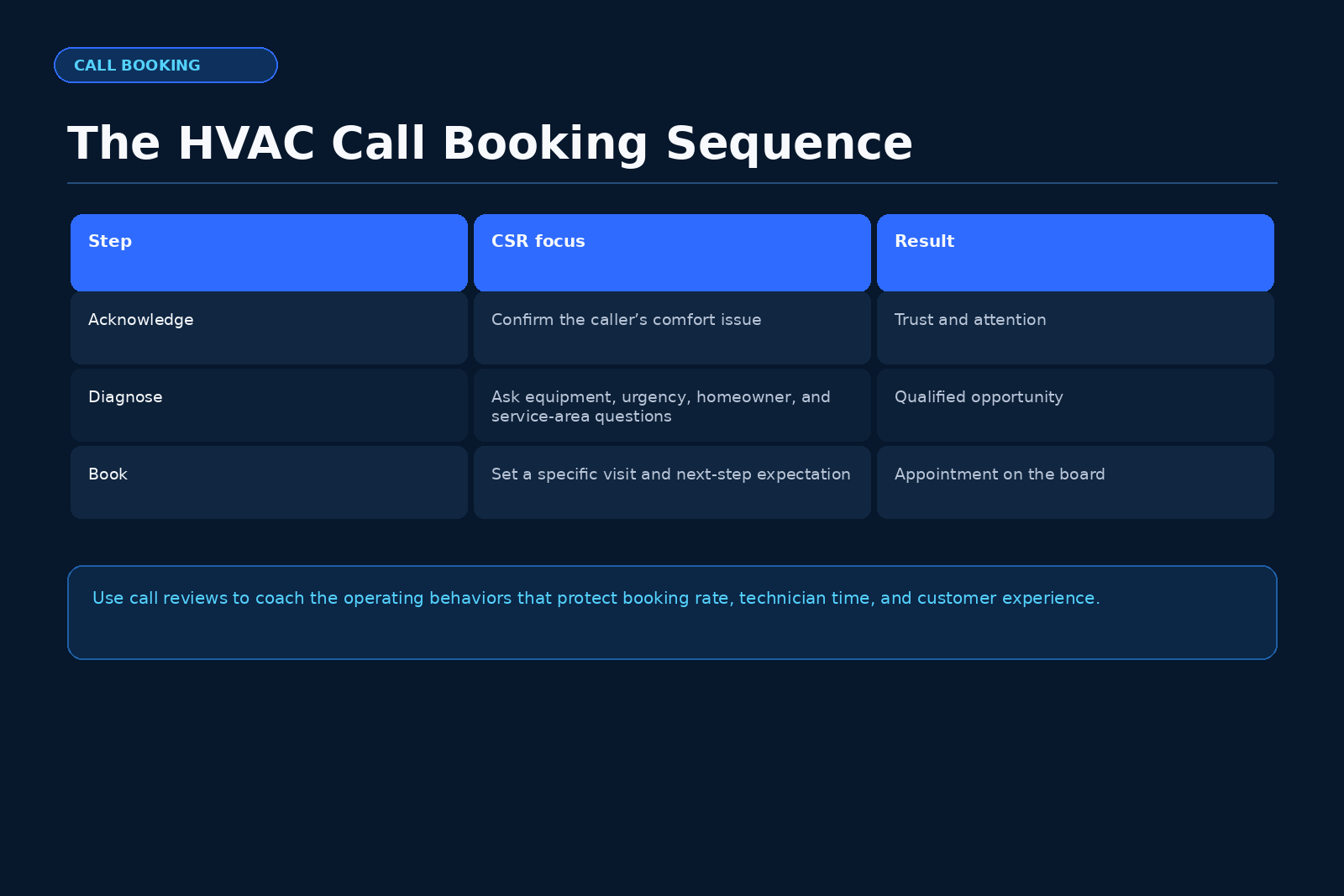
Each call type needs a different opening, yet every call needs the same outcome. The CSR should book a firm appointment with a clear arrival window, confirm the address and contact details, set expectations, and send the call to dispatch or sales follow-up.
Primary HVAC inbound call table
| Call type | CSR goal | First line after greeting | Booking move | CRM field to track |
|---|---|---|---|---|
| No cooling or no heat | Book urgent diagnostic visit | “I can get the right details and find the next appointment window.” | Give two windows and ask which works | System status |
| Replacement inquiry | Book comfort advisor or sales visit | “I can help set up a system review so we can size and quote the right equipment.” | Confirm age, ownership, and decision timeline | System age |
| Tune-up inquiry | Book maintenance visit | “I can get that scheduled and check if our maintenance plan fits your system count.” | Offer visit window, then mention plan option | Plan offered |
| Price shopper | Move from raw price to diagnosis | “I can give you the right path once I know what is happening with the system.” | Ask two diagnostic questions, then give two windows | Price objection |
| Missed call callback | Recover lead fast | “This is [Name] with [Company]. I saw we missed your call and wanted to help with your heating or cooling issue.” | Ask call reason, then book | Callback time |
Worked illustrative calculation: booking leakage from paid calls
This model uses simple math. Replace every input with your own call count, booking rate, close rate, and revenue data.
Assume the company buys 50 paid inbound HVAC calls in a month.
- Paid inbound calls: 50
- Current call-to-booking rate: 52%
- Target call-to-booking rate after scripting and coaching: 68%
- Close rate from booked visit to paid job: 45%
- Average collected revenue per paid job: $900
Current booked appointments:
50 calls × 52% booking rate = 26 booked appointments
Booked appointments after script rollout:
50 calls × 68% booking rate = 34 booked appointments
Added booked appointments:
34 booked appointments - 26 booked appointments = 8 added booked appointments
Added paid jobs:
8 added booked appointments × 45% close rate = 3.6 added paid jobs
Added collected revenue:
3.6 paid jobs × $900 = $3,240
This model does not predict a result. It shows why a CSR script matters. A 16-point lift in call booking creates eight more dispatches from the same lead spend in this example. The owner does not need more ad spend to get those added appointments. The owner needs faster response, cleaner control, better booking language, and call review.
The base HVAC call booking script
A base script should fit service, maintenance, replacement, and callback calls. The CSR can adjust details for each call type.
1. Greeting and control
“Thank you for calling [Company]. This is [Name]. I can help you with that. Are you calling about heating, cooling, a heat pump, or indoor air quality today.”
The line states the company name, gives the CSR name, and places the caller into a service lane. The caller does not need to retell the whole story before the CSR has basic control.
2. Confirm urgency
“Are you without heating or cooling right now, or is the system still running with a concern.”
This question sorts urgent diagnostic demand from planning demand. It also helps dispatch protect capacity when weather creates a rush.
3. Gather system details
“What type of system do you have, and about how old is it.”
“What are you hearing, seeing, or feeling from the system.”
“Has another company already looked at it.”
These questions help the office assign the right technician or sales visit. They also separate a simple maintenance request from a repair-to-replacement path.
4. Confirm location and ownership
“What is the service address.”
“Do you own the home.”
“Who else should be present for a replacement appointment.”
Ownership and attendance questions matter for replacement inquiries. A salesperson can give a cleaner presentation when the right decision makers attend.
5. Present two appointment windows
“We can get you on the schedule today between 2 and 4, or tomorrow morning between 9 and 11. Which window works better.”
The CSR should not ask if the caller wants to schedule. The caller already called. The CSR should provide two workable choices and wait.
6. Set expectations
“Our technician will diagnose the system, review the findings with you, and give repair or replacement options before work starts.”
This line sets trust without making claims about the final price, repair success, or system savings.
7. Confirm and close
“I have you scheduled for [day] between [window]. We will send the appointment details to [phone or email]. If anything changes, call or text this number.”
The close should include day, time window, address, contact method, and next step.
Service call script for no cooling or no heat
A service call script must move fast. The caller wants help, not a long interview.
CSR: “Thank you for calling [Company]. This is [Name]. I can help. Are you without cooling right now.”
Caller: “Yes, the AC stopped.”
CSR: “I am sorry you are dealing with that. I will get the details and find our next appointment. Is the system running at all.”
Caller: “The fan runs, but it is blowing warm air.”
CSR: “Got it. What is the service address.”
Caller: Gives address.
CSR: “About how old is the system.”
Caller: “Maybe 12 years.”
CSR: “Thank you. We have today between 3 and 5, or tomorrow between 8 and 10. Which works better.”
Caller: “Today.”
CSR: “You are booked today between 3 and 5. The technician will diagnose the AC, review the findings, and give options before work starts. The diagnostic visit fee is [fee]. I will send the appointment details now.”
This script keeps the CSR from drifting into troubleshooting. The technician diagnoses. The CSR books.
Replacement inquiry script
Replacement calls need a different path. The office should confirm system age, comfort concern, home ownership, and decision timing.
CSR: “Thank you for calling [Company]. This is [Name]. I can help set up a replacement estimate. Is your current system still running.”
Caller: “It runs, but it is old.”
CSR: “Understood. About how old is the system.”
Caller: “Around 18 years.”
CSR: “What made you start looking at replacement now.”
Caller: “It needs repairs again.”
CSR: “That makes sense. We can schedule a comfort advisor to review the system, check sizing needs, and give equipment options. Do you own the home.”
Caller: “Yes.”
CSR: “Who else would help make the equipment decision.”
Caller: “My spouse.”
CSR: “Great. We have tomorrow at 10 or Thursday at 4. Which time works for both of you.”
The CSR should avoid quoting a full equipment price over the phone. Replacement pricing depends on sizing, equipment selection, duct conditions, installation scope, and site conditions. ACCA publishes quality standards for HVAC installation and maintenance, which gives owners a reason to anchor calls to assessment and scope before they discuss an estimate.[3]
Price shopper script
Price shoppers are not bad leads. Many callers ask about price first because they do not know what else to ask. The CSR’s job is to answer with control and move toward the visit.
Caller: “How much do you charge for an AC repair.”
CSR: “I can help with that. The first step is a diagnostic visit, because the repair price depends on what the system needs. What is the AC doing right now.”
Caller: “It is blowing warm air.”
CSR: “Thank you. Is the outdoor unit running.”
Caller: “I am not sure.”
CSR: “No problem. About how old is the system.”
Caller: “Ten years.”
CSR: “For that situation, we should send a technician to test the system and review options with you. The diagnostic visit fee is [fee], and any repair would be reviewed before work starts. We have today between 1 and 3, or tomorrow between 10 and noon. Which works better.”
This script gives a price answer without selling the call as a commodity. The CSR gives the diagnostic fee, states what happens during the visit, and asks for the appointment.
Objection lines for HVAC CSRs
CSRs need short, approved answers for the objections they hear every week.
| Objection | Approved CSR response | Next move |
|---|---|---|
| “I need to call around.” | “That makes sense. I can hold a window now so you have a spot if you want service.” | Offer two windows |
| “Your diagnostic fee is too high.” | “Our technician will test the system, review the findings, and give options before work starts.” | Restate two windows |
| “Can you quote a system over the phone.” | “A system quote needs a home and equipment review so the sizing and scope are right.” | Book advisor visit |
| “I only want the cheapest option.” | “We can start with the diagnostic visit and show the repair and replacement paths.” | Book visit |
| “I might wait.” | “I can place you in the next open window so the system gets checked before the schedule fills.” | Offer window |
The CSR should not argue. The CSR should acknowledge, answer, and ask for a booking decision.
Speed-to-lead rules for calls, forms, texts, and missed calls
The office should treat speed as a daily operating metric. Harvard Business Review’s lead response work reports a steep drop in lead qualification odds after the first five minutes.[1] Workato’s 2026 study also used this lead response topic as directional evidence and found that, in its sample of 114 B2B companies, no sampled company called within five minutes after a demo request.[2] That data gives HVAC owners directional evidence for response discipline, without establishing an HVAC conversion outcome.
For HVAC calls, use these rules:
- Answer live whenever the office is open.
- Return missed calls within five minutes during staffed hours.
- Route forms and ad leads to a call, text, and email queue.
- Assign one person to own each open lead until it books or closes.
- Log first response time, booking status, and next follow-up time.
- Review unbooked paid leads every day.
Response speed matters because many homeowners contact more than one HVAC company during a comfort problem. The first company that reaches the caller, qualifies the need, and offers a workable window often earns the visit.
For replacement estimates, missed calls, and old quote follow-up, connect call speed with database work. Scale Your Offers describes database reactivation as an HVAC first-priority revenue path for companies with install capacity, sales process, and CRM history.[5] The same response rule applies when an old replacement estimate raises a hand again. Call fast, qualify cleanly, and book the next appointment. For a deeper HVAC database angle, review The Fastest Money.
CSR scorecard for weekly coaching
A script only works when managers listen to calls and coach the team. The weekly CSR scorecard should fit on one page.
| Metric | Definition | Weekly review question | Owner action |
|---|---|---|---|
| Answer rate | Share of inbound calls answered live | Did we miss paid calls during staffed hours | Adjust routing or staffing |
| First response time | Time from form, missed call, or text to first reply | Did we respond inside five minutes | Add alerts and ownership |
| Booking rate | Booked appointments divided by qualified calls | Which call type leaks the most | Coach exact call section |
| Price objection save rate | Price calls that still booked | Did the CSR ask diagnostic questions | Drill price shopper lines |
| Replacement set rate | Replacement inquiries booked for advisor | Did the CSR confirm owner and attendance | Train replacement script |
| Plan mention rate | Eligible calls where the plan came up | Did the CSR mention maintenance plan | Add plan line to call close |
| CRM completion | Calls with source, type, outcome, and notes | Can managers read the pipeline | Clean required fields |
Managers should review at least five calls per CSR per week. The review should score opening, diagnostic questions, appointment ask, objection handling, and CRM notes. The manager should then pick one skill for the CSR to work on during the next week.
A.C.E. section: Attract, Convert, Expand for HVAC call booking
Scale Your Offers defines A.C.E. for HVAC growth in order. Attract uses owned paid traffic targeted at replacement and maintenance buyers in the service area. Convert covers speed to lead, qualification, booking, and quoted-job follow-up. Expand covers maintenance agreements, repair-to-replacement paths, indoor air quality, and database reactivation.[5] The operating rule is to assess A.C.E. in order and address the earliest constraint first.[5]
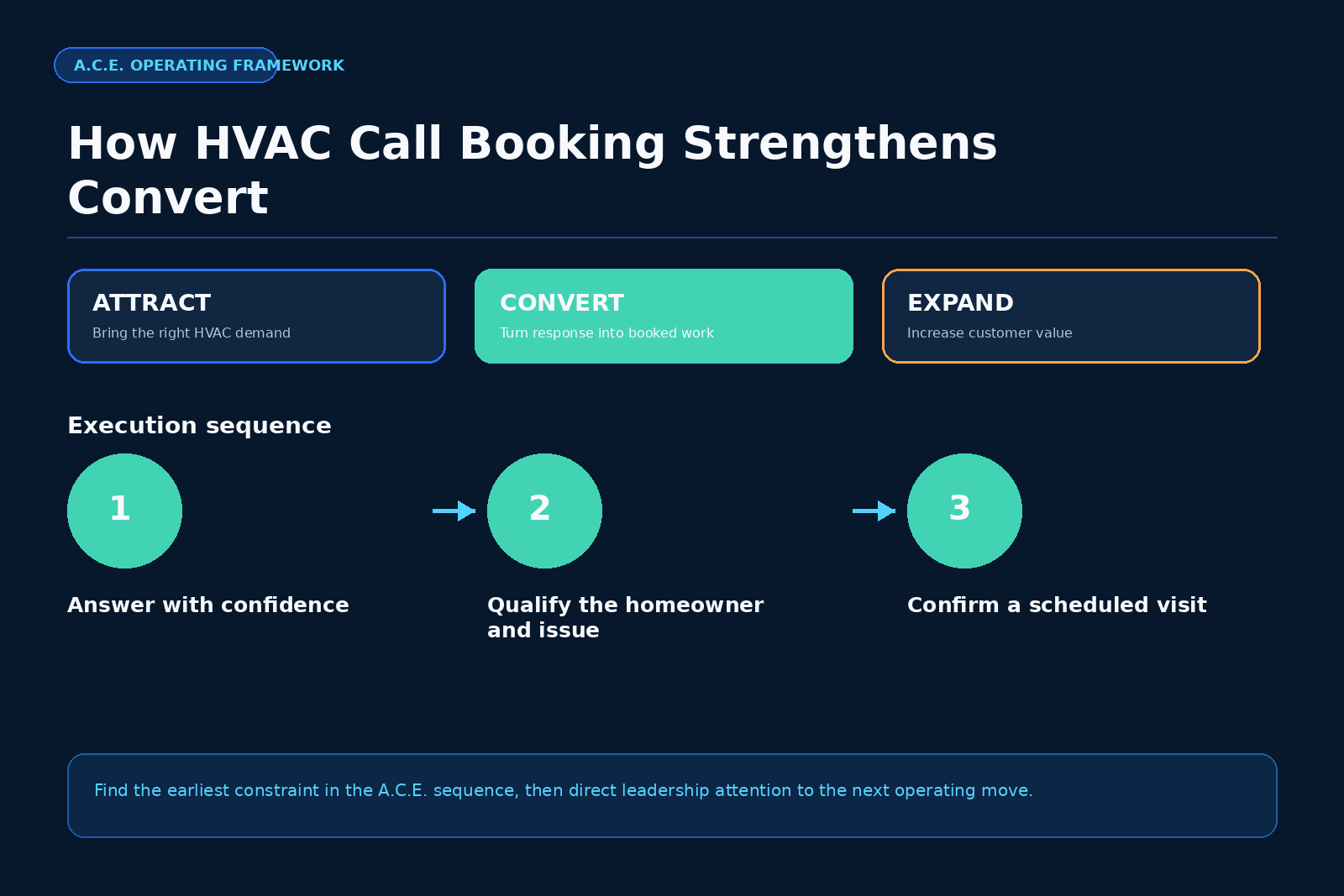
Attract creates the inbound call
Attract brings the caller to the phone. This includes paid search, paid social, local pages, database campaigns, and referral traffic inside the service area. If lead volume is low, the owner starts with targeting, offer, ad creative, landing page, and tracking.
For paid ad funnel setup, The Booked-Out Contractor, a $2.95 book presents a paid-ads machine covering offer, ads, funnel, tracking, and follow-up, according to the Scale Your Offers page copy.[6]
Convert turns the call into a booked visit
Convert owns the office handoff. This article sits here. The script, call routing, response speed, objection lines, appointment windows, estimate follow-up, and CRM notes all belong in Convert.
A Convert bottleneck shows up in plain data. Paid leads arrive, but appointments lag. Calls last several minutes, but they do not book. CSRs quote prices early. Missed calls sit too long. Replacement inquiries get basic callback notes with no booked advisor visit.
The fix starts with the earliest Convert leak. If calls go unanswered, fix answer rate first. If calls get answered but do not book, fix the script. If replacement appointments book but do not close, fix sales presentation and estimate follow-up.
Expand grows revenue from the booked customer
Expand starts after the first booking. CSRs should mention maintenance agreements on eligible service calls. Technicians should flag repair-to-replacement situations. The office should follow up on unsold replacement estimates. The database should receive timely reactivation campaigns for aging systems, old repairs, missed tune-ups, and expired maintenance agreements.
Expand depends on clean Convert data. If the CSR fails to tag system age, repair concern, membership status, and outcome, the company loses future follow-up paths.
Compliance guardrails for call scripts
HVAC call scripts should stay accurate and documented. The Federal Trade Commission’s Telemarketing Sales Rule governs many telemarketing practices, including do-not-call rules and other requirements.[4] Owners should get legal review for outbound callback sequences, automated texts, recorded lines, and marketing claims. Email, SMS, and phone rules differ by channel and location.
Use these guardrails in CSR training:
- State diagnostic fees plainly.
- Avoid guaranteed repair prices before diagnosis.
- Avoid energy savings promises that lack approved basis.
- Avoid financing approval language before the proper finance process.
- Track opt-out requests in the CRM.
- Keep callback attempts within approved office policy and legal review.
The CSR can still sell the appointment with confidence. The script should say what the visit includes, what the customer can expect, and what the next step will be.
Implementation plan for the next 14 days
A script rollout should move fast and stay practical.
Day 1: Pull the last 100 inbound calls from paid sources, organic sources, and database campaigns. Tag each call by type, outcome, missed call status, and objection.
Day 2: Build one approved script for service calls, one for replacement inquiries, one for tune-ups, and one for price shoppers.
Day 3: Set CRM required fields for call source, system type, system age, urgency, appointment status, plan status, and objection.
Day 4: Record CSR practice calls. Use actual HVAC scenarios from your call log.
Day 5: Set two appointment-window language rules. Every CSR must present two options when capacity exists.
Day 6: Build missed call alerts and form alerts. Assign ownership for every open lead.
Day 7: Review the first week of calls. Coach one skill per CSR.
Days 8 through 14: Repeat call review, objection practice, CRM cleanup, and booking rate tracking. Share the scorecard with dispatch, sales, and service leadership.
The owner should end the two-week rollout with cleaner calls, cleaner data, and a better view of where paid leads leak.
FAQ
What should an HVAC call booking script include?
An HVAC call booking script should include a branded greeting, urgency question, system details, address confirmation, ownership question for replacement calls, two appointment windows, diagnostic fee wording, expectation setting, and CRM notes.
Should CSRs quote HVAC replacement prices over the phone?
CSRs should avoid full replacement quotes over the phone. They should book a home and equipment review because sizing, equipment choice, installation scope, duct conditions, and site conditions affect the final quote.
How fast should an HVAC company respond to paid leads?
An HVAC company should respond as close to immediately as staffing allows. Lead response research cited by Harvard Business Review reports that qualification odds fall sharply after the first five minutes.[1]
How should CSRs handle callers who only ask for price?
CSRs should answer the price question at the diagnostic-fee level, ask what the system is doing, explain that repair or replacement pricing depends on findings, and offer two appointment windows.
If paid HVAC leads are reaching your office and too many fail to book, your Convert stage needs a direct review. Schedule an A.C.E. Audit so Scale Your Offers can inspect response speed, CSR scripting, qualification, booking, presentation flow, and follow-up across your HVAC funnel.
References
- Harvard Business Review: The Short Life of Online Sales Leads
- Workato: Lead Response Time Study
- Air Conditioning Contractors of America: ACCA Quality Standards
- Federal Trade Commission: Complying with the Telemarketing Sales Rule
- Scale Your Offers: The Fastest Money
- Scale Your Offers: The Booked-Out Contractor