
Google Local Services Ads for HVAC Contractors: The Complete Guide
Google Local Services Ads can place an HVAC company near the top of local search results for urgent cooling, heating, furnace, and heat pump searches. Google describes Local Services Ads as a way for local businesses to reach nearby customers and receive leads through calls and messages from the ad unit [1]. The channel works on a pay-per-lead model, so the owner pays for lead contact, not for every click [1].
For an HVAC company with technicians, installers, lead costs, a sales process, and a customer database, LSA only works when the operation behind it can handle the lead flow. The ad unit can bring high-intent repair and replacement inquiries, yet slow response, loose qualification, weak booking, and poor follow-up can burn budget fast.
The earliest constraint sits inside Attract. The HVAC company must pass screening, define profitable service settings, set budget controls, and give Google clean lead feedback. Convert comes next because every LSA call needs fast handling, clear booking rules, and estimate follow-up. Expand comes after booked work because service customers, tune-up buyers, and sold installs can feed maintenance agreements, indoor air quality, referrals, and database campaigns.
How Google Local Services Ads fit an HVAC lead system
Google Local Services Ads sit above many traditional search placements and can show verified business information, ratings, and contact options to homeowners searching for local service help [1]. Topic research for this article identifies LSA as a top-of-screen channel for immediate HVAC repair and replacement intent, including emergency AC repair and furnace installation searches [1].
That placement matters because the homeowner often wants a technician, a comfort advisor, or a fast appointment. The lead path usually starts with a call or message. Your office must then turn the contact into a booked diagnostic, replacement appointment, maintenance visit, or qualified next step.
LSA does not replace search ads, Google Business Profile work, organic pages, referral systems, or maintenance agreement marketing. It gives the HVAC company another high-intent intake lane. The owner still needs lead tracking, call handling, booking standards, sales accountability, and estimate follow-up.
The operating target looks simple on paper. A qualified homeowner contacts the company. The office answers or calls back fast. The CSR confirms location, system type, urgency, and service need. The dispatcher books the right appointment. The technician or comfort advisor runs the visit. The office tracks the result back to the LSA lead source.
That chain breaks when the company treats LSA as a marketing-only task. An LSA lead can arrive while technicians sit in attics, installers work a changeout, and CSRs manage other inbound calls. The lead still needs immediate handling because response speed appears as a ranking factor in Local Services Ads guidance summarized in the supplied topic research [2].
Eligibility and screening come first
Google requires business screening and verification before a Local Services Ads profile can run in covered categories and markets [3]. The supplied research states that HVAC companies must provide valid state and local contractor licenses that match the business entity name and address [4]. The same research states that insurance verification includes proof of general liability insurance through Google’s screening process or its partners [4].
Background checks also apply during the screening path. The supplied research states that business owners, officers, and field technicians may need to pass criminal and identity checks before the ad can serve [5]. Review integration also matters because the supplied research states that an active, highly rated Google Business Profile relates to earning and keeping the Google Screened badge [6].
Treat screening like an operations file, not a one-time marketing task. Assign one person to maintain the license, insurance, entity name, address, technician roster, and profile access records. Store renewal dates in the same system that tracks vehicle registrations, technician certifications, and insurance paperwork.
Use this checklist before the marketing manager raises the weekly LSA budget.
| Area | Owner task | Failure point to prevent |
|---|---|---|
| Entity data | Match business name, address, phone, and license data across LSA and Google Business Profile. | Profile review delays from mismatched records. |
| Licensing | Keep state and local HVAC license data current in the screening record. | Ad pause from expired or mismatched license data. |
| Insurance | Upload current general liability proof when Google requests it. | Inbound lead stoppage from expired insurance proof. |
| Technician roster | Keep field staff data aligned with background check requirements. | Scheduling limits from unapproved personnel. |
| Reviews | Maintain an active Google Business Profile review process tied to service and install visits. | Weak review signals in LSA ranking. |
| Access | Give login rights only to the staff who manage budgets, calls, lead notes, and credits. | Lost records, missed credits, or untracked edits. |
Service settings decide lead fit
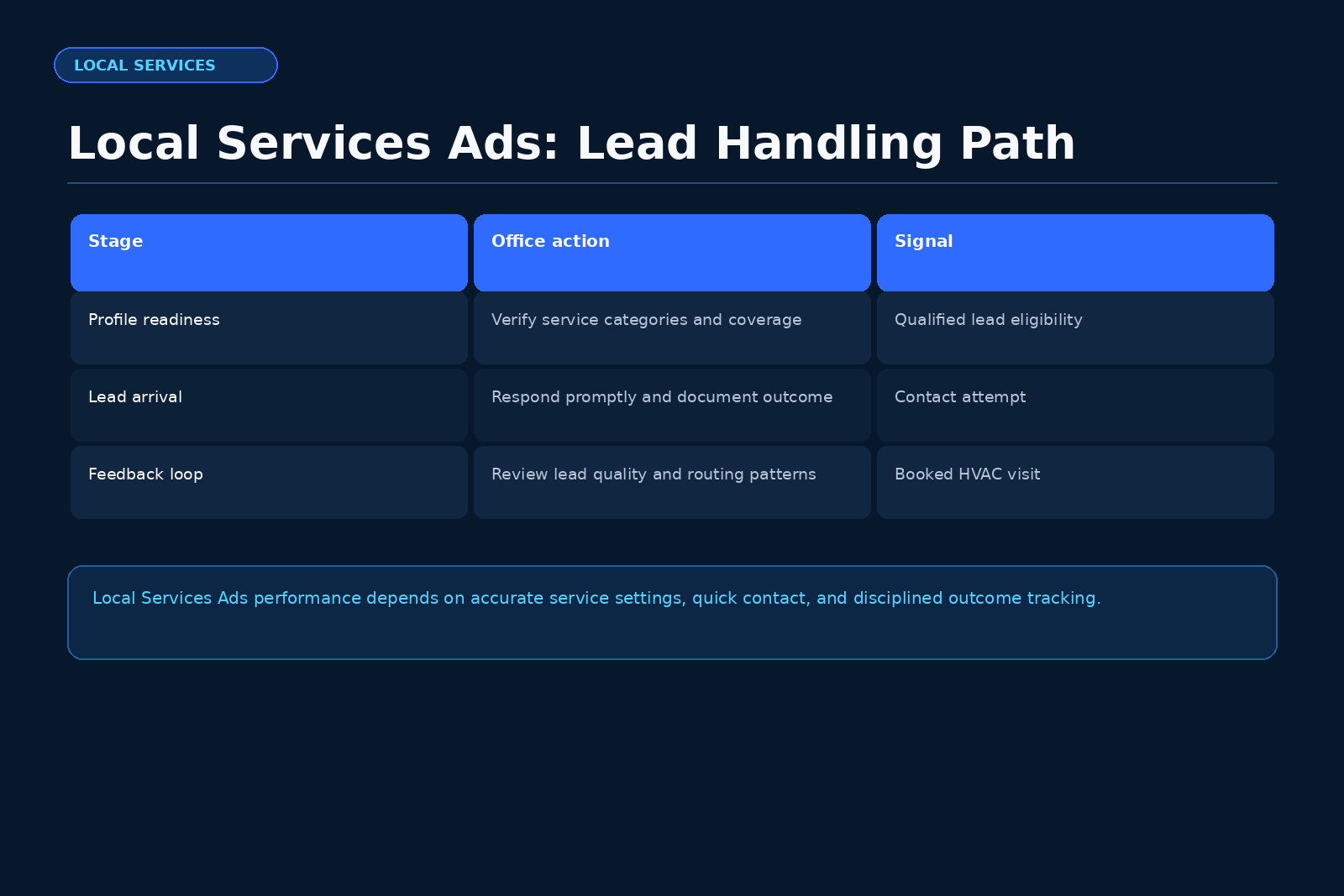
Google Local Services Ads require the company to choose service areas and job types. Google’s budget documentation states that businesses can edit budget settings inside Local Services Ads [7]. The supplied research states that contractors should select targeted zip codes or cities where profitable service calls remain viable. It also states that job type toggles can align LSA lead flow with operational capacity.
This setup can create or destroy margin. A company that accepts every far edge zip code can pay for calls that produce long drive times, late arrivals, and low booking rates. A company that leaves every job type active can receive leads for work that does not fit the current labor plan.
Build the LSA service map from profit, not pride. Start with cities and zip codes where the company can dispatch quickly, maintain review quality, and run profitable repair and replacement calls. Add fringe zones only when the company can handle travel time and still meet arrival windows.
Set job types to match seasonal capacity. During peak cooling demand, AC repair and AC replacement may sit at the center. During heating season, furnace repair, furnace installation, heat pump repair, and heat pump replacement may deserve more budget attention. If installers reach capacity, do not keep feeding low-margin install categories without a booking and scheduling plan.
Use a monthly service settings review. Pull the LSA lead log, CRM booked-job report, dispatch board, and invoice data. Compare service area, job type, booked rate, sold rate, and average invoice. Remove zones and categories that drain capacity without enough booked work.
Budget and bidding need allowable cost rules
Local Services Ads use weekly budget settings to manage lead volume [7]. Google has also documented a bidding option related to target cost per lead or maximum cost per lead for Local Services Ads [8]. Those settings need an allowable cost rule from the owner, not a guess from the ad account.
The rule starts with gross margin, closing rate, booking rate, and average job size. Repair calls, tune-ups, IAQ visits, and replacement estimates all need different allowable lead costs. A $289 diagnostic path has a different budget ceiling than a booked replacement estimate with a $12,000 average ticket.
Worked illustrative calculation: LSA replacement lead ceiling
This calculation uses sample numbers only. Replace each input with your HVAC company’s actual figures.
- Average replacement ticket: $12,000.
- Gross margin target on replacement work: 40 percent.
- Gross profit per sold replacement: $12,000 × 40 percent = $4,800.
- Close rate from booked LSA replacement appointments: 35 percent.
- Expected gross profit per booked appointment: $4,800 × 35 percent = $1,680.
- Maximum marketing share of expected gross profit: 20 percent.
- Allowable cost per booked appointment: $1,680 × 20 percent = $336.
- Booking rate from qualified LSA leads: 60 percent.
- Allowable cost per qualified lead: $336 × 60 percent = $201.60.
In this sample, the company should treat $200 as a rough ceiling for a qualified replacement lead before it studies sold work, refunds, dispatch cost, and capacity. A lead cost above that number may still work if the close rate, average ticket, or margin runs higher. A lead cost below that number can still fail if the office misses calls or books poor-fit appointments.
Run the same math for repair calls. Repair work often produces lower immediate invoice totals, yet it can feed maintenance agreements, repair-to-replacement paths, IAQ options, and later replacement timing. The owner should still set a lead ceiling from actual service invoices and membership conversion.
Lead feedback and automated lead credits
Google has shifted Local Services Ads lead credit handling toward automated lead credits. Google’s help page states that automated Local Services Ads lead credits use Google systems to review leads and issue credits when eligible [10]. The supplied research states that Google’s models can reassess charged leads over time and issue credits for spam, wrong numbers, or unrelated service requests [10]. The supplied research also states that manual lead dispute tickets have been deprecated in favor of automated handling [9].
This does not remove the need for internal lead notes. The HVAC company still needs a clean record for every LSA inquiry. If the office treats the dashboard as a junk drawer, the company loses visibility into spend, booking rate, lead fit, and disputed billing patterns.
Rate and label every lead inside the LSA dashboard when the platform asks for feedback. Track the same lead in the CRM with source, call result, job type, zip code, technician assignment, invoice amount, sold estimate amount, and final disposition. Keep a list of wrong numbers, spam, out-of-area calls, duplicate contacts, and service requests outside selected HVAC categories.
Create a weekly billing hygiene meeting that takes 20 minutes. The marketing manager, call center lead, and owner or GM review charged leads, credited leads, booked calls, and dead leads. The team identifies settings that caused poor-fit contacts and then edits service areas, job types, hours, or call routing.
Review signals and profile completeness
The supplied topic research identifies review velocity, review sentiment, geographic proximity, response speed, and profile completeness as ranking pillars for LSA [2]. The same research links an active, highly rated Google Business Profile to Google Screened status [6]. Those factors make review operations a revenue system, not a vanity project.
Build review requests into the HVAC visit closeout. The technician or comfort advisor should ask after the homeowner has received the service summary, knows the next step, and has a clear invoice or estimate. The office should send the request through the approved review process, then log the request in the CRM.
Review quality starts before the request. Accurate arrival windows, clean uniforms, clear diagnosis, photos, options, and tidy cleanup all affect the homeowner’s willingness to leave a strong rating. An LSA profile with weak reviews can lose trust before the first ring.
Profile completeness also deserves a monthly pass. Confirm business hours, service categories, phone routing, photos, service area, license data, insurance data, and Google Business Profile alignment. Any mismatch can create friction for the homeowner or the screening process.
First-contact operations turn LSA spend into booked calls
LSA brings lead flow into the company, but Convert decides whether that flow becomes booked revenue. Scale Your Offers defines Convert as speed to lead, qualification, booking, and quoted-job follow-up in its HVAC A.C.E. material [11]. That definition matches the operational reality of Local Services Ads because many LSA contacts arrive with immediate need.
The supplied Workato research is B2B evidence, not home-services proof. Workato reported that it submitted demo requests to 114 B2B companies and cited earlier Harvard Business Review research showing a major decline in lead qualification odds when response time moved from five to ten minutes [12]. Use that as directional evidence for response discipline, not as an HVAC conversion guarantee.
For LSA, set a tighter house rule. Answer live when possible. Call back missed LSA calls within two minutes during staffed hours. Send a text if the homeowner does not answer the callback. Route after-hours calls to a trained intake path that can book or qualify.
The CSR script should gather only the facts needed to book the right appointment. Use a short sequence.
- Confirm the caller’s name, address, and callback number.
- Confirm the system need, including AC, furnace, heat pump, ductless, thermostat, or IAQ concern.
- Confirm urgency, comfort status, and any safety-related symptom.
- Confirm system age if replacement may make sense.
- Offer the next available appointment that fits the call type and service area.
- State the diagnostic fee, arrival window, and booking confirmation.
- Log the source as Google Local Services Ads in the CRM.
Replacement estimate follow-up needs its own rules. If an LSA repair call turns into an unsold replacement estimate, the comfort advisor should trigger same-day follow-up, next-day follow-up, and a short multi-day sequence. Scale Your Offers positions existing HVAC lists and CRM history as a fast revenue source, with database reactivation as an operating priority for qualified companies [11]. Its HVAC page also frames rapid human or AI-enabled response as part of inbound call, form, text, and social message handling [11]. For deeper work on response speed and replacement estimate follow-up, review https://scaleyouroffers.com/the-fastest-money.
Operating scorecard for HVAC LSA
A weekly scorecard keeps LSA grounded in booked work. Use the same definitions each week so the owner can see trend lines.
| Metric | Formula | Operating use |
|---|---|---|
| Charged leads | Count from LSA dashboard. | Shows lead flow from current budget and settings. |
| Credited leads | Count from automated credits. | Shows billing hygiene and poor-fit patterns. |
| Qualified leads | Charged leads minus spam, wrong number, out-of-area, and unrelated requests. | Shows usable lead flow. |
| Booking rate | Booked appointments ÷ qualified leads. | Shows Convert strength. |
| Sold rate | Sold jobs ÷ booked appointments. | Shows technician, comfort advisor, and offer performance. |
| Cost per booked appointment | LSA spend ÷ booked appointments. | Shows budget fit. |
| Revenue from LSA | Invoiced repair and sold install dollars from LSA source. | Shows production from the channel. |
| Follow-up completion | Completed follow-up tasks ÷ required follow-up tasks. | Shows leakage after estimates. |
Do not judge LSA by lead cost alone. A low lead cost can hide poor booking, weak dispatch fit, and unsold estimates. A higher lead cost can make sense when the lead turns into a replacement appointment in a profitable service area with strong close rates.
A.C.E. for Google Local Services Ads
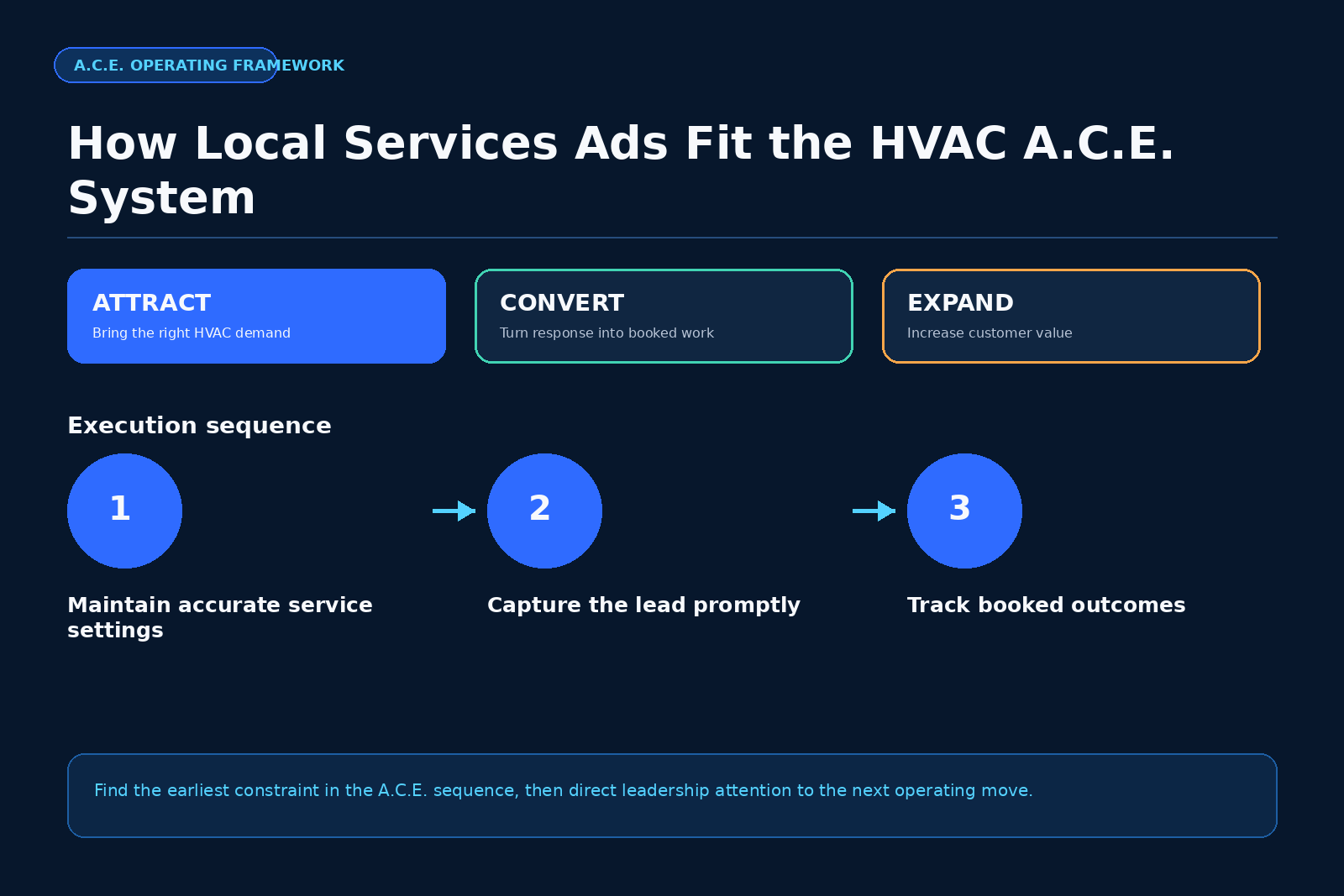
A.C.E. gives the owner a sequence for diagnosing LSA performance. Start with the earliest constraint, then move forward.
Attract: screening, settings, budget, and feedback
Attract covers owned paid traffic targeted at replacement and maintenance buyers in the service area, according to Scale Your Offers’ HVAC A.C.E. material [11]. For LSA, Attract starts with verification and screening. The ad cannot produce reliable lead flow if licenses, insurance, background checks, reviews, or profile data fail the process [3].
After screening, Attract moves to service area, job type, budget, bidding, and lead feedback. The owner should know which zip codes, cities, and HVAC job categories deserve spend. The team should rate leads and maintain internal logs so Google’s automated lead credit process has cleaner feedback and management has accurate numbers [10].
Convert: response speed, qualification, booking, and follow-up
Convert covers speed to lead, qualification, booking, and quoted-job follow-up [11]. LSA calls demand a live-answer culture because homeowners often contact several HVAC companies at the same time. The CSR must confirm need, location, system type, urgency, and appointment fit before the lead cools off.
A booked call still needs source tracking. The office should tag Google Local Services Ads in the CRM, link the call to the job, and track invoice or estimate result. Every unsold replacement estimate needs follow-up tasks, owner visibility, and a closeout reason.
Expand: agreements, IAQ, repair-to-replacement, and database
Expand covers maintenance agreements, repair-to-replacement paths, indoor air quality, and database reactivation [11]. LSA repair calls can create future revenue when technicians follow a clean service process. A no-cool call can lead to a maintenance agreement. A furnace repair on an aging system can lead to a replacement conversation. An airflow or comfort complaint can lead to an indoor air quality option when the diagnosis fits.
Database reactivation also belongs in Expand. LSA leads that did not book, did not buy, or postponed replacement should enter compliant follow-up lists. Email marketing must include a clear opt-out method, keep that opt-out mechanism available for at least 30 days, and honor opt-out requests within 10 business days under the FTC’s CAN-SPAM guide [13]. SMS programs need separate legal review because channel rules and location rules differ.
Common LSA setup errors for HVAC companies
The first error is launching before the call center can answer. LSA can create urgent calls, and missed calls can waste paid demand. Staff the phones, train the script, and track callbacks before budget rises.
The second error is broad service coverage. A map that looks impressive can produce long drive times and poor homeowner experience. Use dispatch history and invoice data to pick service areas.
The third error is leaving weak job types active. If the company cannot service a category well this month, reduce or pause that category. LSA settings should follow capacity.
The fourth error is ignoring automated lead credit data. Credits show patterns. Wrong-number volume, out-of-area calls, duplicate leads, and poor-fit requests point back to settings, profile data, or routing.
The fifth error is stopping at booked calls. A booked diagnostic still needs a technician process. A quoted replacement still needs follow-up. A sold install still needs review requests, maintenance agreement enrollment, and future customer communication.
For HVAC owners who want a broader paid-ads machine around offer, ads, funnel, tracking, and follow-up, Scale Your Offers sells The Booked-Out Contractor, a $2.95 book. The page copy states that it includes 75 pages, six free tools, and a 30-day “Read It, Keep It” guarantee.
30-day rollout plan for HVAC LSA
Use a 30-day rollout to keep the launch controlled.
Days 1 through 7: screening and records
Gather license, insurance, entity, owner, officer, technician, and Google Business Profile records. Confirm name, address, phone, website, service categories, and hours. Assign one admin for screening requests and one manager for profile changes.
Days 8 through 14: settings and call routing
Pick the first service areas from profitable dispatch history. Select job types that match current technician and installer capacity. Set phone routing, call recording where allowed, CRM source tracking, and missed-call alerts. Train CSRs on the LSA booking script.
Days 15 through 21: budget and lead handling
Set an initial weekly budget that the office can handle. Use allowable cost math by job type. Review every lead daily. Rate leads in the LSA dashboard and track every inquiry in the CRM.
Days 22 through 30: scorecard and edits
Hold the first weekly LSA scorecard meeting. Review charged leads, credits, qualified leads, bookings, sold jobs, booked appointment cost, and follow-up completion. Edit service areas, job types, hours, routing, and budget based on lead fit and booked work.
FAQ
How do Google Local Services Ads charge HVAC companies?
Google Local Services Ads use a pay-per-lead model for local business inquiries [1]. The HVAC company pays for lead contact through the platform, subject to Google’s policies, budgets, and credit handling [1][10].
What does an HVAC company need before LSA can run?
The company needs to pass Google’s business screening and verification process [3]. The supplied research states that HVAC screening can include license checks, insurance verification, background checks, and Google Business Profile review signals [4][5][6].
How should an HVAC owner judge LSA performance?
The owner should review qualified leads, booked appointments, sold jobs, credited leads, cost per booked appointment, and revenue tied to LSA. Lead cost matters, but booked and sold work show whether Attract and Convert work together.
Do automated lead credits replace internal lead tracking?
Automated lead credits do not replace internal tracking. Google’s system can review and credit eligible leads [10], but the HVAC company still needs CRM records, call outcomes, job types, service areas, and billing checks.
If LSA lead flow feels uneven, diagnose the earliest A.C.E. constraint first. Take the Lead Flow Score, which the page copy describes as a no-cost 12-question, 90-second assessment with an instant result, or request an A.C.E. Audit for a closer review of Attract, Convert, and Expand.
References
- Google Business Profile, Reach Local Customers with Local Service Ads
- LeadTruffle, The Complete Guide to Google Local Services Ads for Home Service Contractors
- Google Local Services Help, Business screening and verification requirements
- Hook Agency, Google Local Service Ads For HVAC Tips & Tricks That Work
- ACCA HVAC Blog, The HVAC Contractors Guide to Google Local Service Ads
- Building Blocks Digital, Google Local Service Ads Verification Requirements
- Google Local Services Help, How to edit your budget
- Google Local Services Help, New bidding option for Local Services Ads
- Blue Corona, Google Deprecates Lead Disputes in Local Service Ads
- Google Local Services Help, About Automated Local Services Ads lead credits
- Scale Your Offers, The Fastest Money
- Workato, Lead Response Time Study
- Federal Trade Commission, CAN-SPAM Act: A Compliance Guide for Business