
Why Your Facebook Ads for HVAC Are Failing
Facebook ads hvac campaigns often fail before the budget can learn. The earliest constraint sits in Attract when the offer, message, and delivery bring the wrong homeowner into the funnel. The next constraint sits in Convert when the office treats paid-social leads like casual inquiries. Expand comes after booked work, maintenance agreements, referrals, indoor air quality options, and reactivation of past estimates.
An HVAC owner can waste ad spend in five places. The offer can attract coupon shoppers. The ad assets can blend into the feed. The audience setup can restrict delivery. The tracking can feed weak signals back to Meta. The office can respond too slowly, skip qualification, or fail to chase estimates. Meta promotes Advantage+ tools and broader delivery that let its system find likely buyers, while strong ad assets give the system better signals about who should respond [1].
The first failure is a weak front-end offer
Paid social does more than collect names. It sets buying intent before the CSR answers. Vague discounts, tiny tune-up coupons, or broad “call us today” ads pack the pipeline with low-urgency homeowners. Ads Manager can look busy while the schedule stays thin.
Make the offer tie the next action to a clear HVAC outcome the team can deliver. For cooling, use an efficiency inspection for high electric bills, a comfort diagnostic for uneven rooms, or a replacement consultation for aging systems. For heating, use a furnace safety inspection, a heat pump performance check, or a no-heat diagnostic with booking rules that protect dispatch capacity.
Fit the offer to crew capacity and the sales process. If install crews have room, attract homeowners with replacement intent. If the tune-up board has open slots, sell a paid inspection that creates repair, indoor air quality, and maintenance agreement paths. If on-call runs hot, qualify harder before booking.
The second failure is feed-blind ad assets
HVAC owners often judge ads by brand polish. Homeowners judge ads in one second while scrolling. Generic stock photos, flat truck images, and broad claims produce weak engagement signals and low intent. Topic research cites generic imagery and tired claims as common reasons for higher costs and lower response [3].
Use ad assets that show a specific condition and a next step. Short clips can show a dirty condenser coil, a thermostat set low while the upstairs stays warm, a rusted furnace cabinet, or an aging outdoor unit with rising bills. Keep on-screen words tied to the service call reason. Lead with the local service area and problem category.
Run three quick tests. The homeowner can spot the issue in two seconds. The offer tells the next booked action. The team can fulfill that action through normal dispatch and sales.
The third failure is over-controlled audience setup
Many HVAC campaigns try to outguess Meta with tight interest stacks, long exclusion lists, and tiny location pockets. These moves restrict learning. Meta’s Advantage+ suite promotes automation and broader delivery that uses available signals to find likely converters [1]. Ad assets then act like a targeting filter.
Keep ads inside the service area, and avoid suffocating delivery inside that area. Build the zip map around dispatch economics, install crew travel limits, and local closing strength. Give delivery enough room to learn which homeowners respond to the offer.
Aim the ad asset at the right buyer. Replacement ads can show aging equipment, bills, repair frequency, and comfort problems. Maintenance ads can show seasonal tune-up work and a booked inspection. Indoor air quality ads can show duct concerns, filtration, and comfort symptoms without unsupported medical claims.
A practical diagnosis table for failing HVAC Facebook ads
| Failure area | What the owner sees | What to check | Operating fix |
|---|---|---|---|
| Offer | Many leads, few booked calls | Lead source, booked rate, cancellation rate, ticket type | Tie the ad to a paid inspection, replacement consultation, or diagnostic with clear booking criteria |
| Ad assets | High spend with weak lead flow | First three seconds, local wording, problem specificity | Record short HVAC field clips that name one homeowner problem and one next action |
| Audience | Delivery stalls or costs jump | Service radius, zip limits, interest stacks, exclusions | Keep the service area tight for dispatch and broad for delivery learning |
| Tracking | Meta shows form fills while the office sees poor jobs | Pixel events, Conversions API, CRM source tags | Track booked calls, estimates, and sold jobs as far as the tech stack allows |
| Office follow-up | Leads arrive, appointments lag | First response time, call attempts, text consent, CSR script | Call fast, qualify by system age and issue, and book the next appointment on first contact |
| Estimate follow-up | Leads turn into quotes, then sit | Open estimates, cadence, financing handoff notes | Assign ownership, set daily callbacks, and track sold revenue by campaign |
Worked illustrative calculation: lead volume can hide booking failure
Use round numbers for diagnosis and replace each input with your data.
Assume an HVAC company spends $4,000 on Facebook ads during a cooling month.
- The campaign produces 100 leads.
- Cost per lead equals $4,000 divided by 100 leads.
- Cost per lead equals $40.
- The office books 25 of those 100 leads.
- Booking rate equals 25%.
- Comfort advisors or techs sell 6 of the 25 appointments.
- Close rate on booked appointments equals 24%.
- Average sold ticket equals $3,500.
- Revenue equals 6 sold jobs times $3,500.
- Revenue equals $21,000.
The ad account might look acceptable at $40 per lead. The business problem shows up after the lead. Keep the same 100 leads and raise booked appointments to 40, and the math changes.
- Booked appointments rise to 40.
- Close rate stays at 24%.
- Sold jobs equal 9.6, rounded down to 9 for conservative planning.
- Revenue equals 9 sold jobs times $3,500.
- Revenue equals $31,500.
The difference is $10,500 in illustrative revenue from the same ad spend. The gain came from Convert work, not cheaper clicks.
The fourth failure is broken tracking
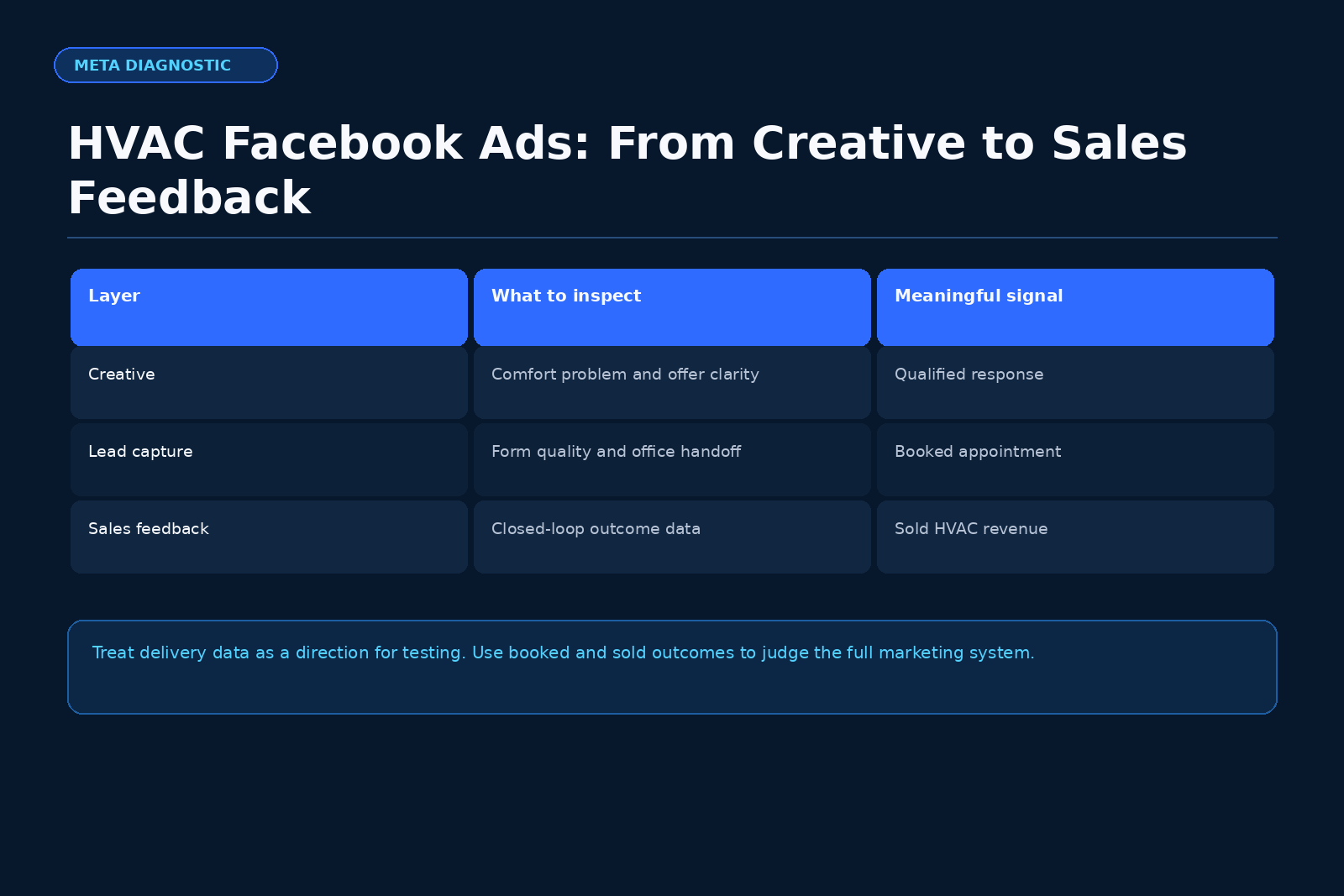
Meta optimizes only against visible events. If the account records form submissions while the CRM holds the truth about booked appointments, sold estimates, and revenue, the system will chase cheap form fills. Meta documents Conversions API for sending web events and other customer actions from a server connection alongside the Pixel [2]. Topic research cites low Conversions API adoption among regional home-service contractors, which limits optimization toward booked revenue [3].
Build a plain tracking ladder. Track lead source, booked appointment, completed appointment, estimate issued, sold job, maintenance agreement, and add-on sales. Carry the campaign name or source tag into the CRM at each stage.
Close obvious gaps while you improve tooling. A CSR can tag every Facebook lead by source. A sales manager can review sold jobs by source weekly. A media buyer can compare Meta lead counts with booked calls. The owner can see whether the failure sits in delivery, the offer, intake, or sales follow-up.
The fifth failure is slow response and weak qualification
Facebook leads often arrive from distracted homeowners. Slow response gives them time to forget the request or call another HVAC company.
Workato’s March 2026 study tested B2B demo requests and cited Harvard Business Review research on the sharp drop in qualification odds as response time moved from five to ten minutes [9]. Workato also found that more than 99% of sampled companies did not send a tailored email within five minutes and none called within five minutes [9]. Treat these findings as directional evidence for response discipline.
Paid-social leads require rapid human or AI-enabled response across forms, calls, texts, and social messages, and Scale Your Offers places that work in Convert for HVAC companies [8]. Treat speed to lead as part of the budget decision. The page for HVAC response speed and database work frames existing list and response systems as practical revenue levers for companies with CRM history [8].
A.C.E. shows the order of repair
A.C.E. gives the owner a sequence. Attract brings HVAC maintenance and replacement buyers from the service area. Convert covers response speed, qualification, booking, presentations, and estimate follow-up. Expand covers maintenance agreements, referrals, indoor air quality, repair-to-replacement, and database reactivation [8].
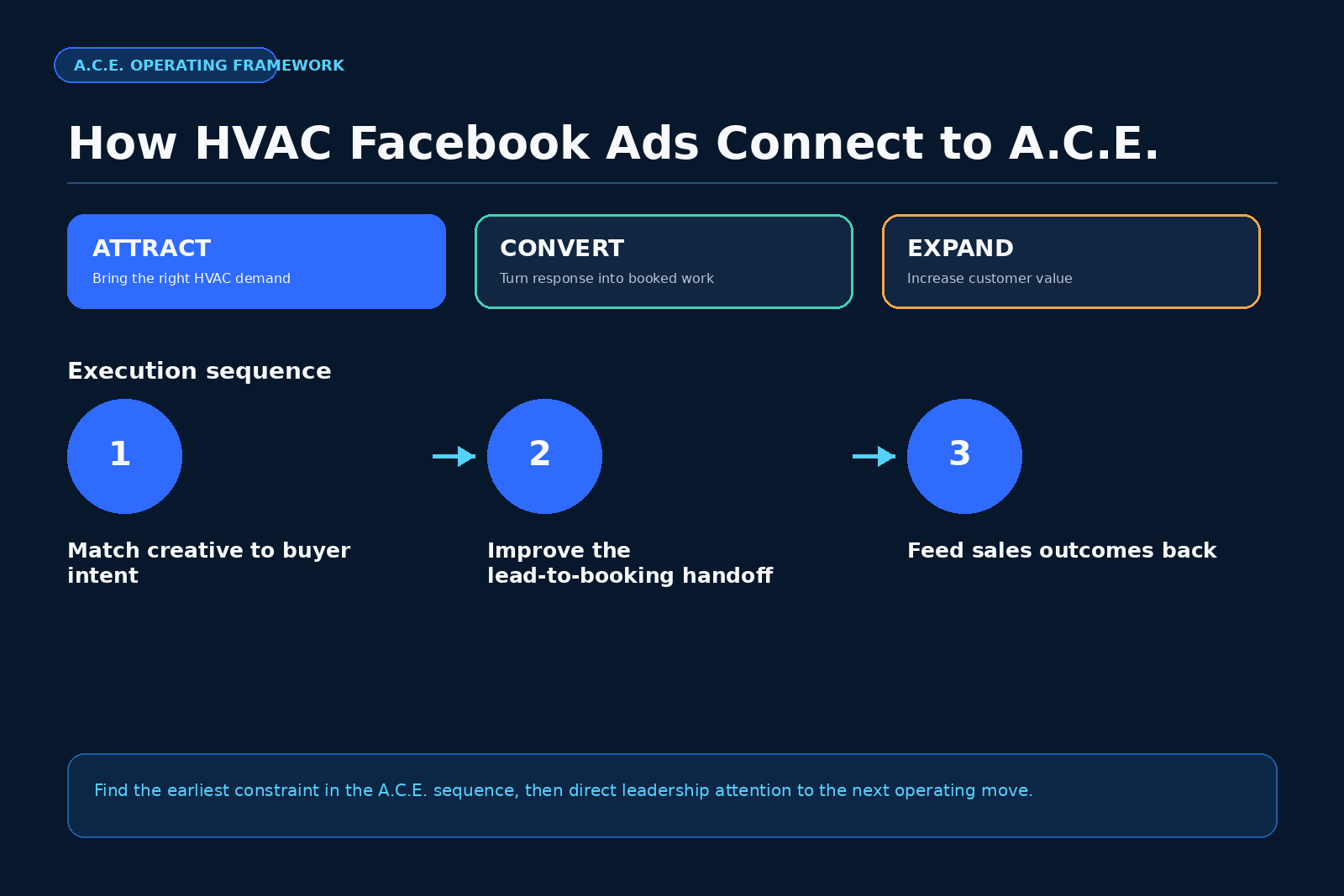
Start with Attract. If the wrong homeowner enters the funnel, the office cannot turn weak leads into booked revenue. Fix the offer, ad assets, audience delivery, and tracking signals first.
Move to Convert after Attract produces enough qualified lead flow. Measure time to first call, contact rate, booked rate, show rate, estimate rate, and sold rate. The CSR script should qualify by equipment type, system age, urgency, homeowner status, and appointment availability. The salesperson or comfort advisor should present repair-to-replacement when system age, repair cost, comfort issue, and homeowner goals support the conversation.
Move to Expand after the company sells work from the campaign. Every completed call can start a maintenance agreement conversation. Every replacement can include a referral ask. Every repair can set a future replacement follow-up. Every unsold estimate can enter a scheduled callback sequence, subject to consent and channel rules.
Scale Your Offers states that the Lead Flow Score at https://scaleyouroffers.com/ace-assessment uses 12 questions, takes about 90 seconds, costs nothing, and gives an instant result that names the leak holding lead flow back [7]. That assessment fits owners who need to locate the earliest A.C.E. constraint before adding spend.
Compliance and claim control matter in HVAC ads
Run plain, supportable claims. ACCA publishes HVAC quality standards and industry guidelines, which gives contractors a recognized source for installation and service quality context [4]. Use field facts the company can back up. A dirty coil photo can talk about airflow and service need. A dated condenser can talk about age, repair frequency, and replacement evaluation. Avoid unsupported medical claims in indoor air quality ads.
Manage testimonials and reviews carefully. The FTC’s endorsement guidance covers endorsements, reviews, and disclosures in advertising [5]. Document permission for any quoted customer and avoid edits that change meaning. If the reviewer received any incentive, handle disclosure requirements.
Honor follow-up channel rules. The FTC’s CAN-SPAM guide requires a clear opt-out in commercial email, an opt-out mechanism available for at least 30 days after sending, and honoring opt-outs within 10 business days [10]. SMS rules vary by channel and jurisdiction, so get legal review before launching text campaigns.
The Booked-Out Contractor connection
Paid social works best when the offer, ads, funnel, tracking, and follow-up operate as one system. Scale Your Offers describes The Booked-Out Contractor, a $2.95 book as a 75-page paid-ads machine that covers those parts with six free tools and a 30-day “Read It, Keep It” guarantee [6]. That resource fits HVAC owners who want the parts in place before increasing spend.
FAQ
Why do Facebook ads hvac campaigns get cheap leads that do not book?
Cheap leads often come from a weak offer, a broad coupon message, or poor qualification. Compare leads, booked calls, estimates, and sold jobs by campaign before judging the channel.
Should an HVAC company use broad audiences on Meta?
Meta’s Advantage+ tools promote broader automated delivery, and the topic research frames ad assets as a major targeting filter [1]. Keep ads inside the service area and give delivery enough room to learn.
What should an HVAC company track after a Facebook lead?
Track lead source, first response time, booked appointment, completed appointment, estimate, sold job, maintenance agreement, and add-on sales. That ladder shows whether the failure sits in Attract, Convert, or Expand.
How fast should the office call a Facebook lead?
Call as fast as staffing allows and set a tight standard during business hours. Workato’s B2B research gives directional evidence that faster response discipline matters, although it does not guarantee HVAC results [9].
Your Facebook ads hvac account needs a diagnosis before it needs more budget. If you want Scale Your Offers to inspect the offer, ad assets, tracking, booking process, and A.C.E. constraint order, book an A.C.E. Audit and bring your current campaign data, CRM reports, and estimate follow-up numbers.
References
- Meta Business: Meta Advantage+ suite
- Meta Business Help Center: Best Practices for Conversions API
- Web Tonic: HVAC Facebook Ads Statistics & Analytics
- Air Conditioning Contractors of America: Quality Standards and Industry Guidelines
- Federal Trade Commission: Endorsements, Influencers, and Reviews
- Scale Your Offers: The Booked-Out Contractor
- Scale Your Offers: Lead Flow Score
- Scale Your Offers: The Fastest Money
- Workato: Lead Response Time Study
- Federal Trade Commission: CAN-SPAM Act Compliance Guide for Business