
The C.L.O.S.E. HVAC Sales Process: From the Driveway to the Signed Job
Two HVAC companies can buy the same demand, run the same number of appointments, and finish the month with very different revenue.
The difference often appears inside the home. One technician or comfort advisor connects with the customer, completes a documented diagnosis, presents choices tied to the customer's priorities, puts financing on the table correctly, asks for a decision, and follows up. The other delivers a price and hopes the homeowner calls back.
A complete HVAC sales process turns that work into a system.
Scale Your Offers organizes the process as C.L.O.S.E.:
- Connect
- Learn
- Offer
- Secure
- Extend
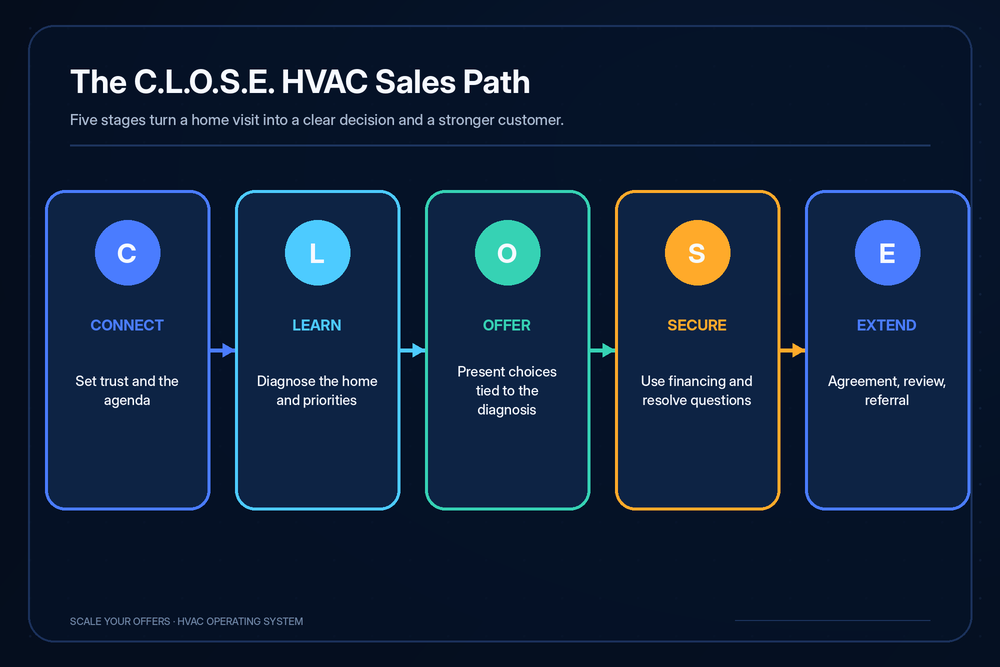
The process begins before the price and continues after the signature.
C: Connect
Connect establishes trust, control, and a clear agenda without turning the visit into a performance.
Before arrival
The office should:
- Confirm the appointment and decision-makers.
- Verify the concern, equipment, access, and property information.
- Explain fees and arrival expectations.
- Send the technician or advisor's name and arrival update.
- Record financing interest when the customer raises it without making approval promises.
At the door
A strong opening includes:
- Introduction and property protection.
- Confirmation of the reason for the visit.
- A simple agenda.
- Permission to ask questions and inspect.
- A clear statement that findings and choices will be reviewed before any decision.
Example:
“I want to understand what the system has been doing, inspect and measure what is happening, then show you the reasonable paths with pricing. Before I start, what matters most to you about getting this solved?”
The goal is clarity. Avoid scripts that sound memorized or imply a result before diagnosis.
L: Learn
Learn is the diagnostic conversation and technical work.
The customer should feel heard, and the proposal should have evidence.
Customer questions
Ask about:
- What changed and when.
- Comfort differences by room, time, or weather.
- Noise, humidity, air quality, odor, dust, or operating-cost concerns.
- Repair history and recurring failures.
- How long the customer expects to stay.
- Priorities around comfort, efficiency, reliability, warranty, and budget.
- Timing and who participates in the decision.
Technical diagnosis
Use the qualified process, standards, codes, manufacturer instructions, measurements, and documentation required for the work. A sales framework cannot replace technical competence.
ACCA's quality standards are designed to outline procedures for design, installation, testing, commissioning, and documentation.[1] The salesperson should never outrun the diagnosis.
Define the problem in the customer's language
Before presenting solutions, summarize:
“You said the upstairs runs hot, the system has needed two major repairs, and you want a dependable plan before summer. The measurements show ____. Here are the reasonable paths.”
Ask the customer to confirm that the summary is accurate.
O: Offer
A single price creates a yes-or-no decision. Multiple clear options help the homeowner compare paths.
The Scale Your Offers C.L.O.S.E. framework uses Good, Better, and Best as a minimum structure.[2]
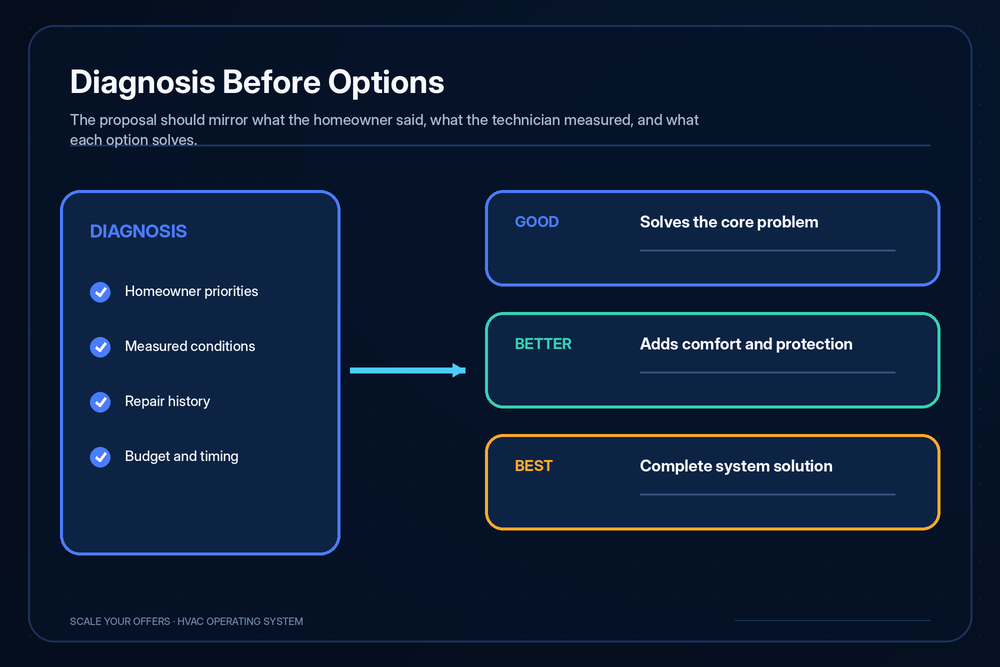
Good
Solves the core problem, meets applicable requirements, and provides the lowest appropriate investment.
Better
Adds the efficiency, comfort, warranty, or system improvements that fit the customer's stated priorities.
Best
Provides the complete solution for the home, which may include higher performance, broader comfort control, air-quality components, zoning, warranties, or maintenance based on the actual diagnosis.
A 2025 ACCA study of more than 1,000 contractors reported that companies presenting four or more proposal options saw a 10% increase in close rates compared with companies using a traditional three-option approach, while premium-equipment mix rose from 26% to 42%.[3] That finding suggests the operating principle is meaningful choice, not loyalty to an exact number of boxes.
Use three to five options your team can explain clearly. More choices can create confusion when differences are cosmetic or the proposal becomes crowded.
Proposal rules
Tie every feature to the diagnosis
Do not list equipment features without explaining what they do for the specific home and priorities.
Show options together
The customer should compare scope, performance, warranty, total price, and payment information on one clear presentation.
Put the recommended path in context
A useful frame:
“Based on the comfort difference upstairs, the repair history, and your plan to stay in the home, the middle option is the one I would examine first. Let me show you why.”
State rebates and incentives precisely
Use current eligibility, dates, amounts, and required disclosures. Do not imply that every customer qualifies.
Stop talking after the presentation
Give the customer time to read, think, and ask questions.
S: Secure
Secure helps the customer make an informed decision and puts the next step on the calendar.
Present financing consistently
The ACCA study reported that contractors offering financing on every job financed 35% of sales, compared with 17% among contractors offering it selectively. It also reported an 11% increase in close rate when financing was offered.[3]
That does not mean financing fits every customer or that every applicant qualifies. It means the process should not rely on a salesperson guessing who needs payment options.
When advertising or presenting credit, use approved lender language and qualified compliance review. Regulation Z states that advertised specific credit terms must actually be available and required disclosures must be clear and conspicuous.[4]
For a deeper funnel and compliance discussion, link to How to Get HVAC Financing Leads That Turn Into Replacement Estimates.
Ask for the decision directly
Use a clear choice question:
“Which of these paths fits the way you want to solve it?”
or:
“What remains unclear before you can choose a path?”
Avoid pressure, fake deadlines, unsupported savings, and manipulative spouse or fear tactics. A clean decision creates a better customer and protects the brand.
Schedule the next action
A signed job without an install date, deposit process, financing next step, or readiness checklist can drift. Complete the operational handoff while everyone is present.
When the customer does not decide, schedule follow-up and record the actual open question, decision process, and timing.
E: Extend
The sale should strengthen the customer relationship and feed future demand.
Extension opportunities may include:
- Maintenance agreement.
- Indoor air quality based on documented need.
- Appropriate accessory or comfort work.
- Second system or property.
- Review request.
- Referral request.
- Future replacement date when the customer repairs.
- Warranty registration and customer education.
Extend is not permission to pile unrelated add-ons onto a customer. It is the process of completing the solution and maintaining the relationship.
The full C.L.O.S.E. workflow
| Stage | Required outcome | Proof |
|---|---|---|
| Connect | Customer knows who is there, why, and what happens next | Arrival communication, agenda, decision-maker status |
| Learn | Customer priorities and technical findings are documented | Questions, readings, photos, problem summary |
| Offer | Clear choices map to the diagnosis | Proposal options, scope, price, warranties, disclosures |
| Secure | Customer makes a decision or leaves with a defined next action | Signature/install date or dated follow-up and open question |
| Extend | Relationship and future value are protected | Agreement, review/referral ask, registration, nurture status |
Build the CRM around the sales process
The CRM should make the next action visible.
Required replacement fields may include:
- Lead source.
- Appointment type.
- Decision-makers present.
- Customer priorities.
- Equipment and system information.
- Findings and documentation.
- Options presented.
- Financing presented and application status where appropriate.
- Selected option or open question.
- Next action and date.
- Lost reason.
- Install date.
- Agreement, review, and referral status.
A contact list stores information. A sales operating system creates action. Link to The Best HVAC CRM and Follow-Up Systems in 2026 for selection and implementation criteria.
Train the process with calls and visits
Use four methods.
Role-play
Practice openings, diagnosis summaries, option transitions, financing language, direct asks, and common questions.
Ride-alongs
Observe the process in the home with customer permission and company policy. Score behavior and proof rather than personality.
Proposal audits
Review whether the proposal reflects the diagnosis, presents meaningful differences, and includes the required disclosures and next action.
Lost-opportunity reviews
Classify why the customer did not buy: fit, trust, timing, price, decision-maker, financing, competition, scope, no urgency, poor follow-up, or another real reason.
Do not force every loss into “price.” The purpose is to improve the process and marketing fit.
C.L.O.S.E. sales scorecard
Track:
- Decision-makers present.
- Diagnostic process completion.
- Proposal-option use.
- Financing presentation rate.
- Same-day close rate.
- Eventual close rate.
- Average ticket.
- Gross margin.
- Open estimates with dated next action.
- Follow-up completion.
- Maintenance-agreement attachment.
- Reviews and referrals requested.
- Cancellations and financing fallout.
- Callbacks by sold option and advisor.
Read close rate with lead source, call type, advisor, equipment, price, market, and capacity. A single company-wide average can hide useful differences.
Illustrative close-rate math
Assume two companies each run 50 qualified replacement opportunities per month at an average signed ticket of $12,000.
| Input | Company A | Company B |
|---|---|---|
| Opportunities | 50 | 50 |
| Close rate | 32% | 48% |
| Jobs sold | 16 | 24 |
| Average ticket | $12,000 | $12,000 |
| Signed revenue | $192,000 | $288,000 |
Company B produces $96,000 more signed revenue from the same number of opportunities. This example is illustrative and ignores capacity, margin, cancellations, financing fallout, and collection timing. It shows why sales process can be a larger lever than lead volume.
A 30-day C.L.O.S.E. installation
Week 1: map and baseline
Record current calls or visits where lawful, audit proposals, define stages, and pull close rate, ticket, follow-up, and lost reasons.
Week 2: build tools
Create the opening agenda, diagnostic question set, documentation standard, proposal structure, financing language, follow-up sequence, and scorecard.
Week 3: train
Role-play daily, run observed calls, score the process, and coach one behavior at a time.
Week 4: manage
Audit proposals and open estimates, review KPIs, solve common gaps, and certify the process owner.
HVAC sales-process checklist
- Appointment confirmation identifies decision-makers.
- The customer receives clear arrival information.
- The opening sets a simple agenda.
- The Learn stage captures customer priorities and qualified technical evidence.
- The problem is summarized in the customer's language.
- Three to five meaningful options map to the diagnosis.
- Total and payment information are presented with approved disclosures.
- Financing is offered consistently without approval promises.
- The advisor asks for a clear decision.
- Every undecided proposal has a dated next action.
- Lost reasons are real and reviewable.
- The install handoff is completed.
- Agreement, review, referral, and future nurture are addressed.
- Managers score the process weekly.
FAQ
What are the steps in an HVAC sales process?
A complete process connects with the customer, learns the priorities and technical condition, offers meaningful choices, secures a clear decision or next action, and extends the relationship through agreements, reviews, referrals, and future service.
Should HVAC companies use Good, Better, Best proposals?
Good, Better, Best is a useful minimum because it creates comparison. Current ACCA research suggests four or more options may improve outcomes for some contractors. Use the number your team can present clearly and compliantly.
When should financing be presented?
Make approved financing information part of the standard proposal process rather than waiting for the customer to express embarrassment or concern. Use lender-approved terms, required disclosures, and qualified compliance review.
Who owns replacement follow-up?
The advisor should own the next action on individual opportunities. The sales manager owns the process, open-estimate visibility, completion, and coaching.
What is a good HVAC close rate?
A useful target depends on lead source, opportunity definition, service area, price, sales model, season, advisor, and how lost or open jobs are counted. Establish a clean baseline, segment the data, and improve process-use and economics together.
Stop treating the price as the sales process
The price should arrive after trust, diagnosis, and priorities are clear. Build the full path and inspect it weekly.
Take the free A.C.E. Assessment to see whether the earliest growth leak sits in Attract, Convert, or Expand.
References
- ACCA, Quality Standards
- Scale Your Offers, The Booked-Out Business Playbook: HVAC Edition, C.L.O.S.E. Sales section.
- ACCA, Inside the Contractor of the Future Study: Key Findings From 1,000+ Contractors
- Consumer Financial Protection Bureau, Regulation Z § 1026.24 Advertising