
How to Build a 3-Year Vision for an HVAC Company
A revenue goal is not a company vision.
“Get to $10 million” tells the team how large the top line should become. It does not tell them what kind of company must exist to produce that revenue, how much profit should remain, how many technicians and crews the operation can support, which markets it will serve, what customers should experience, or what the owner should stop doing.
A useful HVAC business vision describes the company in enough detail that leaders can make tradeoffs today. It gives the team a destination and gives Monday's scorecard a reason.
This article shows how to build a three-year picture that is specific, measurable, and operational.
Why use a three-year horizon
One year is close enough to feel like a larger version of the current calendar. Ten years is far enough away that almost any promise feels possible. Three years forces a useful middle ground.
It is long enough to redesign the team, add capacity, develop managers, improve the market position, and build systems. It is close enough to estimate revenue, profit, headcount, service area, and owner role with discipline.
The Scale Your Offers C.O.R.E. framework treats the three-year picture as an Ownership tool. The owner defines where the business is going, then assigns quarterly objectives and operating numbers to the seats that must build it.[1]
Start with the company you want to operate
Before you choose the revenue number, answer this:
What should feel materially different inside this company three years from now?
Examples:
- The owner no longer approves routine dispatch, pricing, purchase orders, or callbacks.
- A service manager runs the daily huddle and technician coaching.
- A sales manager owns replacement close rate, average ticket, and open-estimate follow-up.
- The company can absorb the first heat wave without abandoning maintenance customers.
- Marketing, booking, sales, and capacity forecasts use the same numbers.
- Every installation includes documented commissioning and a customer handoff.
- The team knows which neighborhoods, customer types, and equipment opportunities fit the plan.
These are operating changes. Revenue should result from them.
Build the vision across eight categories
A complete HVAC vision needs more than a financial target. Write a clear outcome in each category.
1. Revenue and profit
Write total revenue, gross margin, net profit, and the mix between service, replacement, maintenance, indoor air quality, and commercial work.
Do not stop at revenue. A company can grow the top line while owner stress, callback expense, overtime, and debt grow with it.
2. Market and customer
Define the service area, target customer, building type, equipment mix, and reputation you intend to own. “Everyone within 60 miles” is not a strategy. A tighter market can improve routing, review density, brand recognition, and response time.
3. Demand generation
Describe how work enters the company. Include the desired mix of paid search, paid social, local visibility, referrals, database reactivation, maintenance customers, commercial relationships, and other owned channels.
The goal is not to predict each platform. The goal is to reduce dependence on one channel, one salesperson, or one season.
4. Sales system
Define how service opportunities and replacement appointments move from diagnosis to decision. Include proposal structure, financing, follow-up, maintenance agreements, referral asks, and manager review.
5. Capacity and operations
Write the number of service technicians, install crews, dispatch coverage, after-hours model, warehouse capability, install backlog target, and service-area design.
6. People and leadership
Name the seats that must exist, the managers the business must develop, the expected span of control, and the training system that supports them.
The Bureau of Labor Statistics projects 11% growth in HVAC mechanic and installer employment from 2025 to 2035, with about 40,600 openings each year on average.[2] That is a national projection, not a local hiring forecast. It is still a strong reason to make recruiting, development, and retention part of the vision rather than an emergency response.
7. Customer experience and quality
Describe visible standards: communication, arrival, property protection, diagnosis, options, documentation, install handoff, callback handling, and review follow-up.
8. Owner role and life
Write the owner's future job. Include the decisions the owner retains, the meetings the owner attends, the number of hours worked, and the responsibilities that move to managers.
A business vision that leaves the owner in every seat is a larger bottleneck with more payroll.
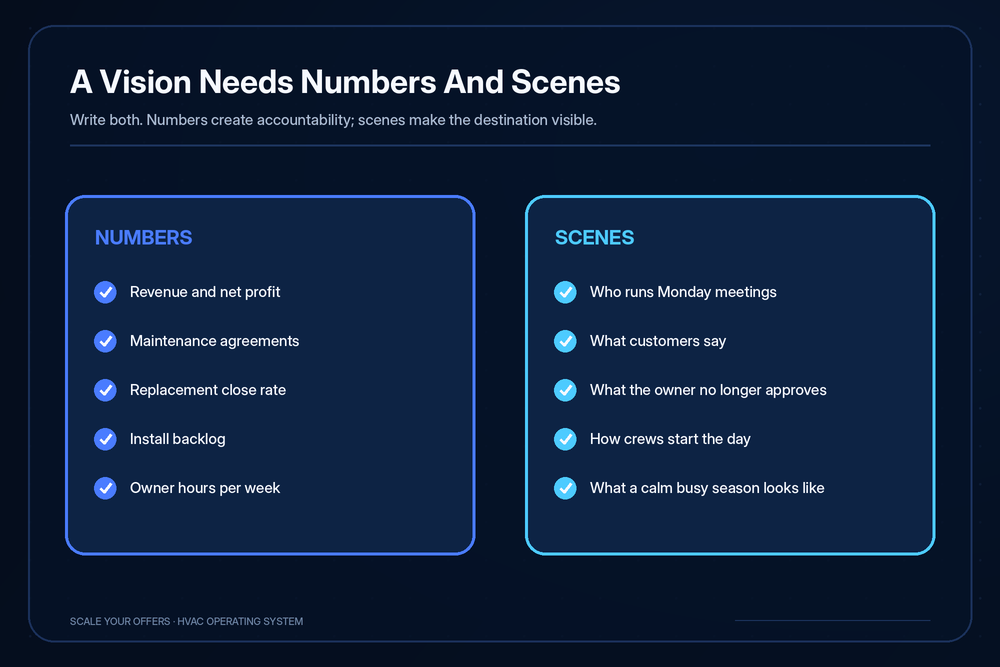
Write numbers and scenes
A useful vision needs both.
Numbers create accountability. Scenes help people understand what success feels like in the work.
Use this pattern:
| Category | Number | Scene |
|---|---|---|
| Financial | $8M revenue, 12% net profit | The monthly review starts with clean numbers by the fifth business day |
| Capacity | 10 service techs, 3 install crews | The first heat wave fills planned capacity without destroying arrival windows |
| Sales | Company target for close rate and average ticket | Every homeowner sees clear choices tied to the diagnosis |
| Customer | Company target for callbacks and reviews | The 24-hour follow-up catches an issue before it becomes a public complaint |
| Owner | 35-hour average week | The service manager resolves routine field issues without owner approval |
All figures in examples should be replaced with your own. The value lies in defining the operating picture.
An illustrative three-year HVAC vision
The example below shows the level of specificity. It is not a benchmark or promise.
Three years from now, the company produces $8 million in annual revenue at a 12% net margin. Residential service and replacement remain the core, with maintenance agreements creating a dependable shoulder-season base. Ten service technicians and three install crews work inside a tighter service area. A service manager owns field performance, a sales manager owns replacement conversion, and an office manager owns booking and customer communication. Every seat has a scorecard. Every replacement customer receives documented options, financing information, and a scheduled follow-up. The owner leads vision, capital, key hires, and the monthly and quarterly reviews while averaging fewer than 40 hours per week.
The paragraph is useful because it creates follow-up questions:
- What revenue mix produces $8 million?
- What gross margin supports a 12% net margin?
- How many calls and replacement opportunities must the company run?
- What productivity and capacity assumptions sit underneath ten technicians and three crews?
- Which manager must be developed or hired first?
- What systems must stop depending on the owner?
Those questions become the planning work.
Run the capacity math backward
A vision should survive arithmetic.
Start with an illustrative model:
| Input | Example only |
|---|---|
| Annual revenue target | $8,000,000 |
| Replacement revenue share | 45% |
| Replacement revenue target | $3,600,000 |
| Average replacement ticket | $12,000 |
| Replacements required | 300 per year |
| Working months | 12 |
| Replacements required | 25 per month |
Calculation:
$3,600,000 divided by $12,000 equals 300 replacements. Divided by 12 months, the plan needs 25 replacements per month.
Now connect sales:
If the company's target close rate is 50%, it needs roughly 50 qualified replacement opportunities per month to sell 25. If the target close rate is 35%, it needs roughly 72. The vision changes the sales and marketing requirements.
Then connect operations:
How many installs can each crew complete while preserving quality? What mix of equipment, ductwork, permits, and job complexity changes that capacity? What install backlog is healthy? What seasonal peaks need subcontractor, overtime, or schedule rules?
Do the same exercise for service calls, maintenance agreements, commercial work, and indoor air quality. Replace assumptions with trailing-twelve-month facts wherever possible.
Translate the three-year picture into one year
A three-year vision becomes useful when it creates a smaller set of one-year outcomes.
Choose five to seven. For example:
- Install a service-manager seat with a weekly scorecard.
- Reach the company's gross-margin and net-profit targets.
- Build a maintenance-agreement base large enough to cover a defined share of shoulder-season capacity.
- Standardize the diagnostic and option-presentation process.
- Reduce the owner's routine approvals by a defined percentage.
- Build a hiring and training pipeline for the next technician seats.
- Produce source-to-sold-job reporting across marketing channels.
Each one-year outcome should clearly move the company toward the three-year picture.
Convert the year into quarterly priorities
Limit the quarter to three to five company priorities. More priorities create a list, not focus.
A useful quarterly priority has:
- One owner.
- One measurable finish line.
- A due date.
- Weekly leading indicators.
- A clear reason it comes before other work.
Example:
Priority: Install the replacement sales operating system by June 30.
Owner: Sales manager.
Finish line: Every qualified opportunity uses the diagnostic form, approved proposal structure, financing presentation, and seven-day follow-up sequence.
Weekly indicators: Process-use rate, open estimates without next action, financing presentation rate, close rate, average ticket.
This is stronger than “improve sales.”
Connect every priority to a Monday number
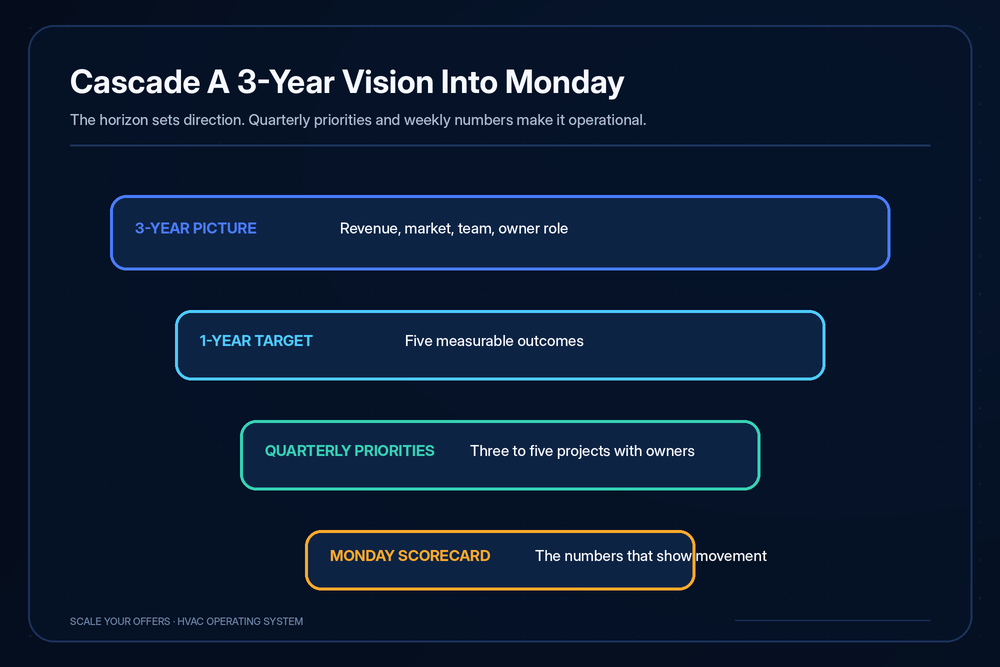
The planning hierarchy should be visible:
Three-year vision → one-year outcomes → quarterly priorities → weekly scorecard → daily work
If a quarterly project has no weekly number, leaders discover delay near the due date. If a weekly number has no connection to the vision, the team measures activity without direction.
Gallup reports that managers account for at least 70% of the variance in team engagement.[3] That does not make managers solely responsible for every result. It does show why managers need a clear picture, priorities, and regular feedback rather than a broad owner ambition handed down once a year.
Use the “stop doing” section
Growth plans often describe what the company will add. A vision also needs to describe what will disappear.
Write the future state of these owner-dependent patterns:
- Owner approval on every discount or purchase.
- Dispatch changes through text messages.
- Important numbers living in private spreadsheets.
- Replacement proposals with no defined follow-up.
- Hiring started only after a truck is empty.
- Managers carrying full individual-contributor workloads.
- Meetings with no agenda, owner, or decision log.
A future company cannot emerge while every current habit remains protected.
Pressure-test the vision
Run these questions with the leadership team.
Is the profit real?
Does the plan account for direct labor, equipment, callbacks, sales compensation, financing cost, vehicles, management, software, and overhead?
Is the labor plan plausible?
Does the company have a recruiting source, training path, compensation design, and manager capacity for the people in the picture?
Does demand match capacity?
Can marketing increase and decrease by season, service area, job type, and available crew days?
Do managers own outcomes?
Can every major number be assigned to one seat, or does responsibility still roll back to the owner?
Does the customer experience survive growth?
Which quality and communication standards could break when call volume doubles?
Does the plan fit the market?
Does the service area contain enough demand, and is the position meaningfully different from competitors?
The 2025 ACCA Contractor of the Future study, based on more than 1,000 contractors, highlighted the relationship between business practices, marketing investment, proposal options, financing, profitability, and training.[4] Use industry research as a prompt. Build the final plan from your own job economics and market.
A one-day vision workshop agenda
| Time | Work |
|---|---|
| 8:00–9:00 | Review trailing-twelve-month revenue, margin, job counts, capacity, people, and owner time |
| 9:00–10:30 | Write the eight-category three-year picture |
| 10:45–12:00 | Run revenue, sales, and capacity math backward |
| 1:00–2:00 | Define the future accountability chart and owner role |
| 2:00–3:00 | Choose five to seven one-year outcomes |
| 3:15–4:15 | Select the next three to five quarterly priorities |
| 4:15–5:00 | Assign owners, weekly numbers, and communication plan |
Do not leave with only a paragraph. Leave with owners, dates, and numbers.
HVAC three-year vision checklist
- Revenue, gross margin, and net profit are defined.
- Revenue mix is defined by work type.
- Service area and target customer are clear.
- Demand sources are diversified and measurable.
- Sales process and follow-up standards are named.
- Service and install capacity are calculated.
- Future leadership seats are defined.
- Quality and customer-experience standards are visible.
- The owner's future role and hours are written.
- One-year outcomes connect to the picture.
- Quarterly priorities have one owner each.
- Weekly numbers show whether the plan is moving.
- A stop-doing list protects the future role.
FAQ
What is an HVAC company vision statement?
An HVAC company vision statement describes the business you intend to operate at a defined future date. It should cover finances, market, people, capacity, sales, customer experience, systems, and the owner's role.
How far ahead should an HVAC company plan?
Three years is a practical strategic horizon for many owner-led companies. Use a one-year operating plan and quarterly priorities to make the three-year direction actionable.
Should the vision include a revenue target?
Yes, but revenue should appear beside margin, work mix, capacity, leadership, customer standards, and owner role. Revenue alone can hide an unhealthy operating model.
Who should help build the vision?
The owner sets direction. Key leaders should contribute operating facts, constraints, and commitments. The final picture must be clear enough for managers to translate into team priorities.
How often should the vision be reviewed?
Review it formally each quarter and rebuild it annually. Do not rewrite the destination every month because a weekly number missed target.
Find the stage that has to move first
A three-year picture creates direction. The next step is locating the earliest weak stage in the current company. Take the free A.C.E. Assessment to score Attract, Convert, and Expand and identify the first constraint to work on.
References
- Scale Your Offers, The Booked-Out Business Playbook: HVAC Edition, C.O.R.E. Ownership section.
- U.S. Bureau of Labor Statistics, Heating, Air Conditioning, and Refrigeration Mechanics and Installers
- Gallup, Employee Engagement Indicator
- ACCA, Inside the Contractor of the Future Study: Key Findings From 1,000+ Contractors