How to Build HVAC SOPs Your Team Actually Follows
Most HVAC standard operating procedures fail in one of two ways.
The first never gets written. The work lives inside the owner's head, the senior technician's habits, or a dispatcher who “just knows” how to make the day work.
The second becomes a fifty-page binder nobody opens during a no-cool call, an install start, a missed-call recovery, or a customer escalation.
A useful HVAC SOP is short enough to use, specific enough to inspect, and connected to the tools and proof the work already requires.
This article shows how to build one-page SOPs, train them with live work, audit them, and improve them without creating bureaucracy.
What an HVAC SOP should contain
An SOP is the current approved method for completing recurring work to a defined standard.
Every one-page SOP should answer six questions:
- Trigger: When does the procedure start?
- Owner: Which seat runs it?
- Steps: What happens, in order?
- Proof: What must be recorded or saved?
- Escalation: When must a manager or specialist step in?
- Metric: What number shows whether the procedure works?
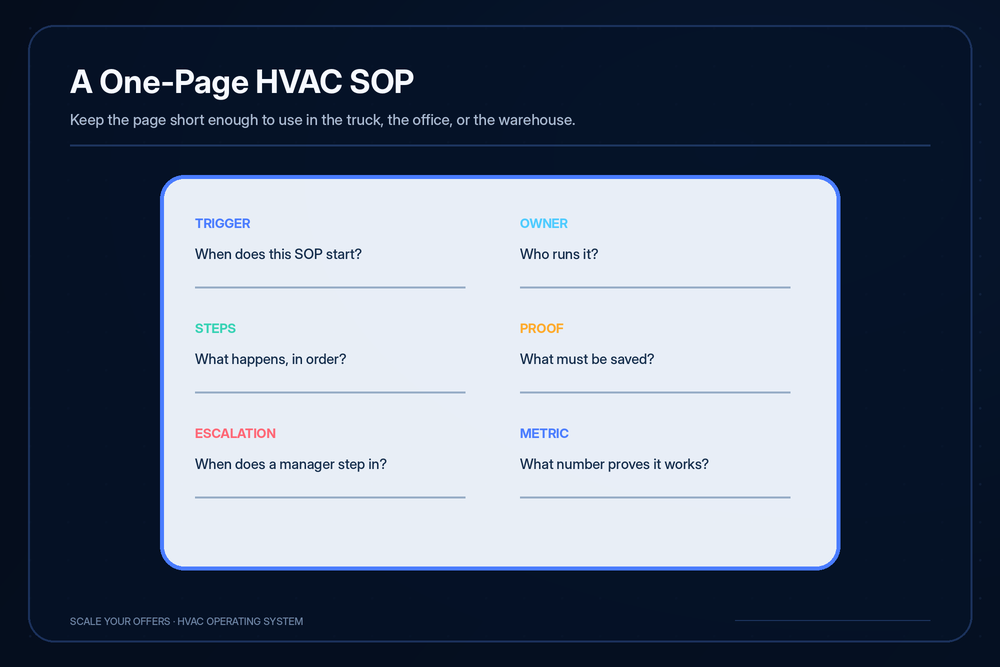
The Scale Your Offers operating material uses this same logic across marketing, booking, sales, and operations: one owner, an ordered process, a number, and visible proof.[1]
Start with high-frequency, high-cost work
Do not begin by documenting everything. Rank processes by:
- Frequency.
- Revenue or margin impact.
- Customer impact.
- Safety or compliance risk.
- Training difficulty.
- Number of handoffs.
- Cost of inconsistency.
Common first SOPs include:
- Inbound call booking.
- Missed-call recovery.
- No-cool or no-heat service-call workflow.
- Repair-to-replacement handoff.
- Replacement proposal and follow-up.
- Install job readiness.
- Equipment receipt and warehouse staging.
- Startup, testing, and commissioning.
- Callback response and root-cause review.
- Maintenance-agreement renewal.
- Review and referral request.
- Customer complaint escalation.
Choose the earliest process currently leaking money, time, customer trust, or quality.
Capture the work before writing it
The best SOP writer is not always the owner. The best current process may live with the person who performs it well every day.
Observe three to five real examples. Record the screen, call, job, or handoff when appropriate and lawful. Ask the employee to explain:
- What starts the process?
- What information must be present?
- Which step prevents the most common failure?
- Where does judgment enter?
- What proof protects the next person?
- When do you stop and escalate?
- What do new employees usually miss?
OSHA's worker-participation guidance says workers often know the most about the hazards associated with their jobs and that effective programs use that knowledge.[2] The same principle improves operational SOPs. Involve the people who perform and receive the work.
Build the SOP in a loop
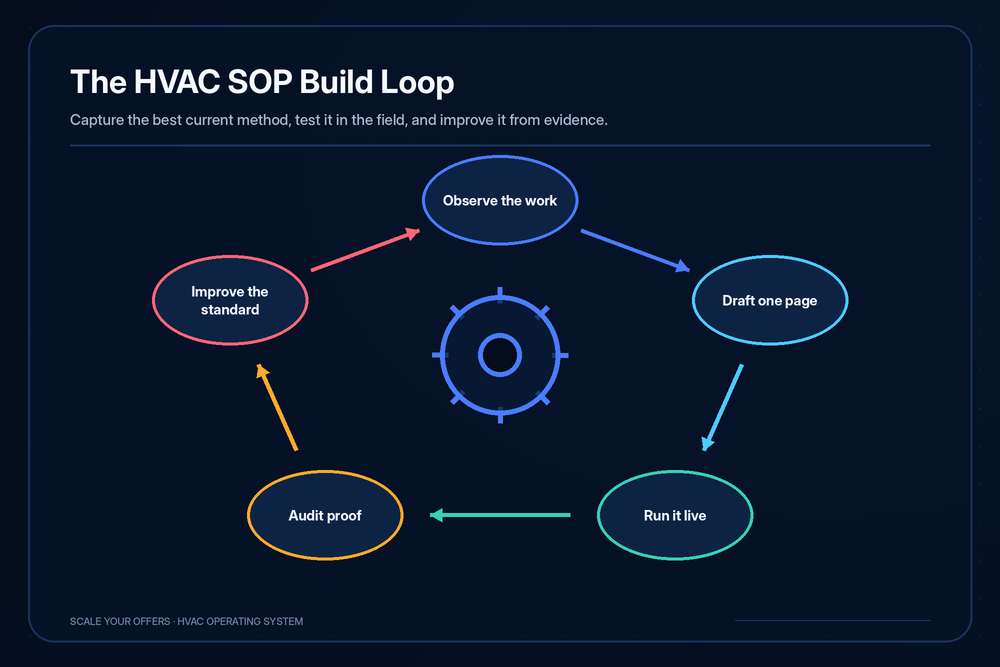
Use five steps.
1. Observe the current best method
Watch the work. Gather examples, forms, photos, call recordings, and exceptions.
2. Draft one page
Write the trigger, owner, steps, proof, escalation, and metric. Use plain language and numbered actions.
3. Run it live
Have two experienced employees and one newer employee use the draft in real work. Mark confusion and unnecessary steps.
4. Audit proof
Review records, calls, photos, readings, customer outcomes, and the metric. A signed training sheet does not prove the SOP works.
5. Improve the standard
Revise from evidence. Add, remove, or clarify steps. Record the version and effective date.
An SOP is a controlled current method, not a permanent monument.
Separate standard work from judgment
Some HVAC work can be standardized tightly. Some requires licensed technical judgment, manufacturer guidance, code knowledge, safety assessment, and conditions at the site.
A good SOP standardizes the process around judgment:
- Required information and measurements.
- Approved references.
- Documentation.
- Customer questions.
- Escalation thresholds.
- Who may make which decision.
- How exceptions are reviewed.
It should not force an employee to ignore conditions or substitute a generic checklist for qualified technical work.
ACCA's quality standards are designed to outline procedures contractors should follow for design, installation, testing, commissioning, and documentation.[3] ACCA also notes that proper residential load calculation under Manual J is required by national codes and most state and local jurisdictions.[4] Use current standards, codes, manufacturer instructions, and qualified technical leadership when building technical SOPs.
This article is an operational framework, not a replacement for applicable law, licensing, code, safety requirements, engineering, or manufacturer instructions.
Example: a missed-call recovery SOP
Trigger
An inbound qualified call is unanswered or abandoned.
Owner
CSR seat. The CSR manager owns the recovery-rate metric.
Steps
- CRM creates a missed-call record and alert.
- Approved acknowledgment text sends when consent and policy allow.
- CSR calls back within the company's target response time.
- CSR confirms service area, customer need, urgency, system information, and requested timing.
- CSR offers an approved appointment window and asks for the booking.
- If no contact, the record enters the approved follow-up sequence.
- If the customer books elsewhere or opts out, update the record accurately.
Proof
Call log, message log, lead source, first-response time, outcome, and next action.
Escalation
Safety emergency, gas or combustion concern, medical vulnerability, property damage, abusive threat, legal contact, or any scenario defined by company policy.
Metric
Missed calls recovered into conversations and booked appointments.
The SOP is useful because it connects action to proof and a number. It can be trained and audited.
Example: replacement proposal follow-up SOP
Trigger
A replacement proposal is presented and the homeowner does not sign during the visit.
Owner
Comfort advisor or sales representative. Sales manager owns completion and conversion metrics.
Steps
- Record options, total and monthly payment presentation, equipment, warranties, rebates, customer priorities, and decision-maker status.
- Confirm the customer's stated decision process and timing.
- Schedule the next follow-up before leaving when possible.
- Send the approved recap and disclosures.
- Complete the next-day call task.
- Follow the approved sequence until a yes, hard no, opt-out, lost reason, or future date is recorded.
- Escalate qualifying open opportunities for manager review.
Proof
Proposal, notes, consent status, next action, messages, calls, lost reason, and future date.
Metric
Open proposals with a dated next action; follow-up completion; close rate by age of estimate.
Use screenshots, photos, and examples
Words alone are weak for many procedures.
A one-page SOP can link to:
- A two-minute screen recording.
- An approved call example.
- A completed proposal.
- Correct and incorrect job photos.
- A warehouse staging photo.
- A commissioning record.
- A customer-handoff example.
- A decision tree for exceptions.
Keep the main page simple. Attach evidence where it improves understanding.
ASQ describes flowcharts as tools for understanding, communicating, and improving processes, including finding waste and root causes.[5] Use a flowchart when the procedure has multiple decisions or handoffs. Use a numbered checklist when the path is mostly linear.
Put the SOP inside the workflow
An SOP stored in a separate drive requires people to remember that it exists.
Place the procedure where the work happens:
- Required CRM fields.
- Dispatch templates.
- Mobile forms.
- Proposal software.
- Job checklists.
- Equipment-staging labels.
- Call-scoring forms.
- Manager dashboards.
- Training modules.
The system should prompt the standard and capture proof. Avoid building unnecessary clicks that slow urgent work.
Train with real work
Use this sequence:
- Explain why the SOP exists and which failure it prevents.
- Demonstrate it on a real example.
- Let the employee perform it with observation.
- Debrief the decisions, not only the clicks.
- Run three to five live repetitions.
- Audit proof and provide specific feedback.
- Certify only after the employee can perform the work to standard.
Training completion is a leading indicator. Customer, quality, safety, and financial outcomes show whether the training transferred.
Audit the process without creating fear
An audit should reveal where the system needs improvement. It should not teach people to hide exceptions.
Review a small consistent sample:
- Ten booking calls every Friday.
- Five replacement proposals per advisor per week.
- Five completed service records per technician per week.
- Every callback above a defined severity.
- A sample of installations and commissioning records.
- Every open estimate without a dated next action.
Score the process, recognize good work, and classify failures:
- The standard was unclear.
- Training was incomplete.
- Information or tools were missing.
- Capacity made compliance unrealistic.
- The employee made a judgment error.
- The employee chose not to follow a clear standard.
- The SOP itself was wrong for the condition.
The response should fit the cause.
Control versions
Every SOP needs:
- Title.
- Owner.
- Version number.
- Effective date.
- Last review date.
- Approver.
- Change summary.
- Linked forms and tools.
Remove outdated versions from active workflows. People should not have to guess which document is current.
ISO's quality-management guidance emphasizes process approaches and continual improvement.[6] A simple version and review system turns improvement into controlled work rather than informal drift.
A 30-day HVAC SOP build
Week 1: choose and observe
Select one high-impact process. Observe real work, collect examples, and identify common failure points.
Week 2: draft and test
Create the one-page SOP. Run it with experienced and newer employees. Revise unclear steps.
Week 3: install and train
Add the SOP to the actual software, form, or job workflow. Train with live examples and observed practice.
Week 4: audit and improve
Review proof, customer outcomes, and the metric. Publish version 1.1 if evidence supports a change.
Then choose the next earliest constraint.
HVAC SOP checklist
- The trigger is specific.
- One seat owns the procedure.
- Steps are numbered and written in plain language.
- Required information appears before action begins.
- Proof is defined.
- Escalation thresholds protect risk and judgment.
- One metric shows whether the process works.
- Technical SOPs use current qualified standards and instructions.
- Workers help design and test the process.
- The SOP lives inside the workflow.
- Training includes demonstration and observed practice.
- A consistent sample is audited.
- Exceptions improve the process rather than disappear.
- Version and review dates are controlled.
FAQ
What does SOP mean in HVAC?
SOP means standard operating procedure: the current approved method for completing recurring work to a defined standard.
How long should an HVAC SOP be?
The core procedure should often fit on one page. Link to forms, videos, technical references, and examples when the work needs more detail.
Which HVAC SOP should I write first?
Start with a high-frequency process where inconsistency creates the largest revenue, customer, quality, safety, or training cost. Booking, missed calls, proposals, install readiness, commissioning, and callbacks are common starting points.
Who should write HVAC SOPs?
The accountable manager should own the document. Build it with the employees who perform the work, qualified technical leadership, and any required legal, safety, code, or compliance expertise.
How often should SOPs be reviewed?
Review on a scheduled cadence and after major incidents, recurring failures, equipment or software changes, regulatory changes, or new evidence. Safety programs require their own formal evaluation process.
Build one process that survives a busy week
A useful SOP is proven when the standard holds under volume, absence, and pressure. Start with the process that currently leaks first.
Take the free A.C.E. Assessment to score Attract, Convert, and Expand and identify the first customer-growth stage to repair.
References
- Scale Your Offers, The Booked-Out Operating System and The Booked-Out Business Playbook: HVAC Edition.
- OSHA, Safety Management: Worker Participation
- ACCA, Quality Standards
- ACCA, Manual J Reaffirmation Public Review
- ASQ, What Is a Flowchart?
- ISO, Quality Management: The Path to Continual Improvement