
HVAC Sales Objections: Prevent Price, Spouse, “Think About It,” and Other Quotes Before the Close
The best HVAC objection handling happens before the objection.
A homeowner says, “I need to think about it,” when something important remains unclear. “I need to talk to my spouse” often means a decision-maker was not included. “That costs more than I expected” may mean the proposal never connected the price to the diagnosed problem and the customer's priorities. “I want other quotes” may mean the customer does not yet trust the scope, number, or comparison.
Pressure rarely repairs those gaps. A complete sales process does.
This article organizes common HVAC sales objections into missing information, missing trust, missing decision-makers, unclear economics, and timing. It gives your team direct, respectful responses and shows where to prevent each objection before the proposal.
Objections are information about the process
An objection can mean:
- The offer is not a fit.
- The customer lacks information.
- The customer does not trust the diagnosis, company, advisor, or number.
- The decision-maker is absent.
- The financial path is unclear or unavailable.
- The customer prefers another option.
- The timing does not justify action.
- The salesperson has not asked the real question.
The Scale Your Offers C.L.O.S.E. framework maps six common objections to the gap underneath them.[1]
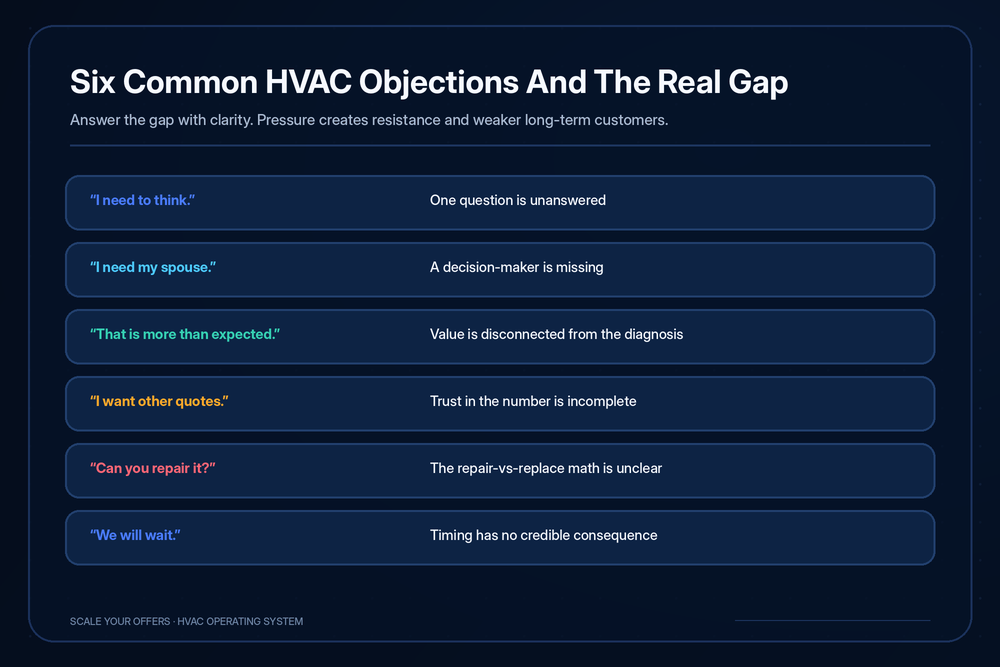
The goal is not to force every homeowner to say yes. The goal is to help the right customer make an informed decision and leave every opportunity with a clear outcome or next action.
Prevent objections across the entire visit
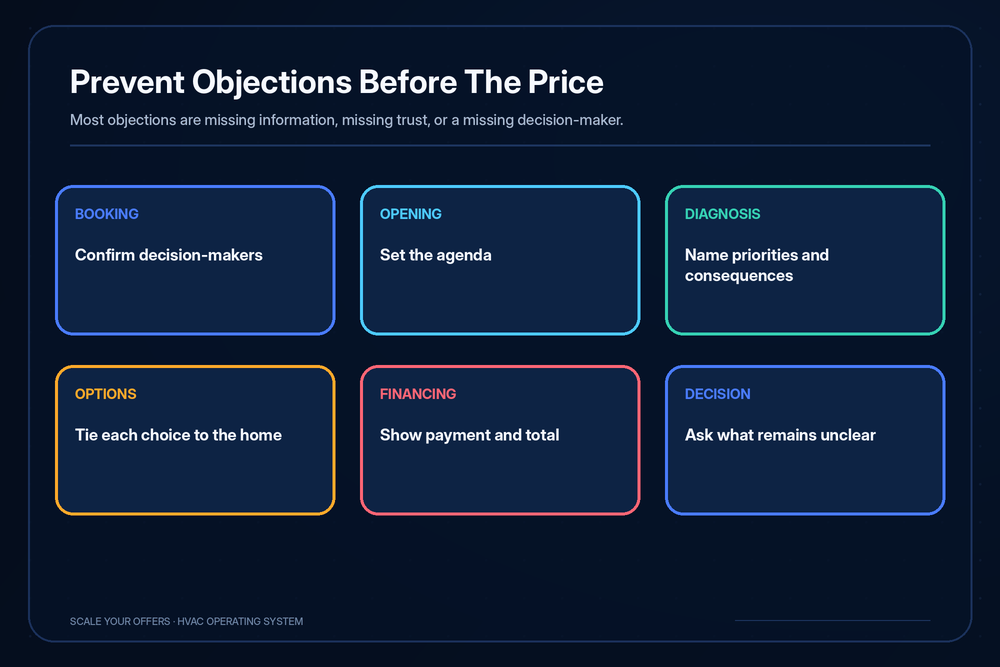
During booking
- Confirm who participates in replacement decisions.
- Explain the appointment and fee accurately.
- Collect the customer concern, timing, and system information.
- Set expectations about diagnosis and options.
During the opening
- Set a clear agenda.
- Ask what matters most.
- Ask how the customer intends to make the decision.
- Get permission to discuss options after diagnosis.
During diagnosis
- Listen to priorities and history.
- Complete qualified technical work.
- Document findings.
- Summarize the problem and ask the customer to confirm it.
During the offer
- Present meaningful choices tied to the diagnosis.
- Show total price, scope, warranties, and approved payment information clearly.
- Explain differences without burying the customer in features.
During the decision
- Ask which path fits.
- Ask what remains unclear.
- Respect a no.
- Schedule the next action when the decision is genuinely open.
Most objections become smaller when the process answers them in order.
Objection 1: “I need to think about it”
What it often means
One or more questions remain unanswered, the customer feels rushed, or the decision process was never discussed.
Prevention
Before the proposal, ask:
“When you have the findings and options, how do you normally make a decision like this?”
After presenting, ask:
“What part would you like to look at again?”
Respectful response
“That makes sense. I want to make sure you have what you need. Is it the diagnosis, the differences between the options, the investment, the timing, or something else you want to think through?”
Listen to the answer. Do not repeat the entire presentation automatically.
Next action
When the customer needs time, agree on a specific follow-up date and record the open question. “Call me if you need anything” is not a follow-up process.
Objection 2: “I need to talk to my spouse”
What it often means
The decision-maker is not present, the customer does not feel comfortable deciding alone, or the spouse statement is a polite way to pause.
Prevention
The office should ask who participates in major home decisions and schedule accordingly when possible.
Use neutral language:
“For replacement decisions, some households want everyone involved. Who should be part of the review so nobody has to relay the technical details later?”
Respectful response
“Absolutely. I would want both of you comfortable. We can review the diagnosis and options together by phone or video tonight, or I can schedule a time when we are all available. Which is easier?”
Do not tell someone they do not need their spouse. Do not frame the spouse as an obstacle. That tactic creates distrust and poor customer experience.
Next action
Schedule the joint review while the information is current. Send an approved recap before the meeting.
Objection 3: “That is more than I expected”
What it often means
The customer expected a repair, had an outdated price anchor, did not understand the scope, or cannot see how the recommendation connects to the problem.
Prevention
- Ask about prior expectations without forcing a budget number.
- Explain the diagnosed condition before price.
- Separate required scope from optional improvements.
- Present several meaningful paths.
- Show approved total and monthly payment information.
Respectful response
“I understand. Which part feels out of line with what you expected: the scope, the equipment, the warranty, or the total investment?”
Then answer the actual gap.
When the customer needs a lower path, return to the option structure. Do not immediately discount the same scope. Discounting without changing anything teaches the customer that the first number was not trustworthy.
Objection 4: “I want to get other quotes”
What it often means
The customer wants confidence in the market, does not yet trust the number, or follows a reasonable purchasing process.
Prevention
- Build trust through documented findings and clear scope.
- Explain exactly what is included and excluded.
- Give the customer a useful comparison framework.
- Avoid attacking competitors.
Respectful response
“That is reasonable. Make sure each company is pricing the same scope. I would compare load or sizing method where applicable, equipment match, duct or electrical work, permits, startup and commissioning, warranties, labor coverage, maintenance, and who handles problems after the install. When you have the other proposals, I am happy to help you compare line by line.”
A comparison guide demonstrates confidence and helps the customer avoid false price comparisons.
Next action
Ask when the other quotes will be complete and schedule a review. Record what the customer intends to compare.
Objection 5: “Can you just repair it?”
What it often means
The customer wants a lower-cost path, believes the current failure is isolated, or does not understand the repair-versus-replace economics and risk.
Prevention
Present repair and replacement honestly when both are reasonable. Use the actual:
- System age and condition.
- Repair amount.
- Repair history.
- Warranty status.
- Efficiency and comfort issues.
- Refrigerant and part considerations.
- Customer plans for the property.
- Consequences and uncertainty.
Respectful response
“Repair may be a reasonable choice. Let us put the math beside replacement so you can see what each path buys. The repair is ____. The system is __ years old, with this history and this remaining risk. Replacement is ____, with these warranties and operating differences. Which risk are you more comfortable carrying?”
Avoid fabricated life-expectancy certainty. State what is known, what is likely, and what remains uncertain.
Next action
When the customer repairs, record a future system-review date and keep service history complete. A repair decision can be a good customer decision.
Objection 6: “We will wait until spring” or “We are not ready”
What it often means
The customer sees no meaningful cost to waiting, has a timing or cash concern, or does not believe the condition requires action now.
Prevention
Explain real timing factors only:
- Current system condition.
- Weather and comfort risk.
- Approved rebate or incentive expiration.
- Equipment availability.
- Install calendar.
- Price-validity period.
- Permit or project lead time.
- Customer's own deadline.
Respectful response
“Waiting may be reasonable. Let us separate what changes and what stays the same. The current condition is ____. This price or incentive is valid through ____. Our install calendar is currently ____. The risk of waiting is ____, and the benefit is ____. With that in mind, what timing makes sense for you?”
Urgency should come from reality, not a fake deadline.
The financing objection
Customers may say:
- “I cannot afford that.”
- “What is the monthly payment?”
- “Will I qualify?”
- “I do not want another payment.”
- “The interest is too high.”
Your team should present financing as an available purchasing path, not a guarantee or a way to hide total cost.
The 2025 ACCA Contractor of the Future study reported that contractors offering financing on every job financed 35% of sales versus 17% among those offering it selectively. The study also reported an 11% close-rate increase when financing was offered.[2] Those findings support consistent presentation, while customer eligibility and terms still vary.
Regulation Z requires specific advertised credit terms to be actually available and required disclosures to be clear and conspicuous.[3] Use current lender-approved language and qualified compliance review for ads, proposals, scripts, websites, and follow-up.
Useful response:
“We can show the approved options available through our lending partners. Approval and final terms depend on the application. I can explain the total price and the available payment paths, then you can decide whether financing fits.”
Do not say “everyone gets approved,” “no credit check,” or a payment amount that is unavailable to the customer.
For campaign and funnel guidance, link to How to Get HVAC Financing Leads That Turn Into Replacement Estimates.
Use questions instead of rebuttals
A canned rebuttal assumes the salesperson already knows the problem.
Use a short question sequence:
- Acknowledge the concern.
- Clarify what the customer means.
- Return to evidence or options.
- Check whether the gap is resolved.
- Ask for the decision or schedule the next action.
Example:
“I understand. When you say the price is high, are you comparing it with another proposal, a repair expectation, or a number you had in mind?”
The answer determines the next conversation.
Train objection prevention before objection response
Role-play the entire visit.
Score:
- Decision-maker confirmation.
- Agenda.
- Customer priorities.
- Diagnostic summary.
- Proposal-option clarity.
- Financing presentation and disclosures.
- Direct decision question.
- Response to the customer's actual words.
- Follow-up scheduling.
- CRM notes and lost reason.
A salesperson who reaches the close with missing decision-makers, weak diagnosis, and one unexplained price cannot “handle” the structure away.
Build an objection library from real calls
Every week, collect the exact customer wording and classify it.
| Field | Example |
|---|---|
| Exact objection | “I thought this would be closer to $8,000” |
| Stage it appeared | Offer |
| Likely gap | Expectation and scope |
| Evidence | Recorded call and proposal |
| Prevention change | Explain scope and options before price |
| Approved response | Clarifying question and scope comparison |
| Outcome | Decided, follow-up, lost, or no fit |
Use recordings and customer data in accordance with applicable law, consent requirements, and company policy.
Measure the objection system
Track:
- Objection frequency by type.
- Stage where the objection appears.
- Decision-maker attendance.
- Option-presentation rate.
- Financing-presentation rate.
- Same-day and eventual close rate.
- Open estimates with next action.
- Follow-up completion.
- Lost reasons.
- Discount rate and gross margin.
- Cancellations.
- Customer complaints and callbacks.
A lower objection count is not automatically better. Salespeople may avoid asking for the decision. Read the numbers with call and proposal audits.
Illustrative objection-cost calculation
Assume the company presents 40 qualified replacement opportunities per month. Twelve reach “think about it” with no scheduled follow-up. If a disciplined process recovers three into a second conversation and one becomes a $12,000 signed job, the month gains $12,000 in signed revenue from process rather than new lead spend.
This is illustrative, not a promise. Use your own opportunity counts, follow-up rates, close rates, average ticket, margin, and capacity.
A 30-day objection-prevention rollout
Week 1: listen
Review 20 lost or open opportunities. Capture exact wording and identify where the process left a gap.
Week 2: build
Create the approved objection library, comparison guide, repair-versus-replace worksheet, decision-maker booking question, and financing language.
Week 3: train
Role-play daily in short sessions. Practice clarifying questions, not speeches. Score the full process.
Week 4: manage
Audit live opportunities, proposal notes, next actions, discounting, and outcomes. Revise the process from evidence.
HVAC objection-handling checklist
- The office confirms decision-makers.
- The opening sets a clear agenda.
- Customer priorities are documented.
- Technical findings support the recommendation.
- The salesperson summarizes the problem before price.
- Three to five meaningful options are clear.
- Financing uses approved language and disclosures.
- The salesperson asks for a direct decision.
- Objections are clarified before answering.
- Competitors and spouses are treated respectfully.
- Repair is presented honestly when reasonable.
- Urgency is real and documented.
- Every open opportunity has a dated next action.
- Discounts require scope or approved authority.
- Managers review real calls and proposals weekly.
FAQ
What are the most common HVAC sales objections?
Common objections include needing to think, needing a spouse or decision-maker, price being higher than expected, wanting other quotes, preferring a repair, wanting to wait, and questions about financing.
How should an HVAC salesperson handle “I need to think about it”?
Acknowledge the need, ask which part needs more thought, answer the specific gap, and schedule a defined follow-up when the customer remains undecided.
How do you overcome the HVAC price objection?
Clarify the customer's expectation, reconnect the scope to the diagnosis and priorities, compare meaningful options, explain approved financing paths, and avoid discounting identical scope without a reason.
What should I say when a homeowner wants other quotes?
Respect the choice and provide a comparison framework covering scope, sizing or design where applicable, equipment match, permits, commissioning, warranties, labor coverage, and post-install support. Schedule a review after the proposals arrive.
Is urgency ethical in HVAC sales?
Urgency is appropriate when it comes from real system condition, weather risk, documented deadlines, incentive dates, availability, or the customer's schedule. Fake scarcity and unsupported fear damage trust.
Remove the gap before you fight the words
Most objections become easier when booking, diagnosis, options, financing, and follow-up are complete. Build the process first and train the responses second.
Take the free A.C.E. Assessment to identify whether Attract, Convert, or Expand is the earliest weak stage in your current growth system.
References
- Scale Your Offers, The Booked-Out Business Playbook: HVAC Edition, C.L.O.S.E. Secure and Extend section.
- ACCA, Inside the Contractor of the Future Study: Key Findings From 1,000+ Contractors
- Consumer Financial Protection Bureau, Regulation Z § 1026.24 Advertising