
How to Write an HVAC Mission Statement Your Team Can Use in the Field
Most HVAC mission statements sound respectable and change nothing.
They promise comfort, integrity, quality, and exceptional service. Those are worthwhile ideas. They are also broad enough to fit almost every contractor in the country. A technician cannot use them to decide whether to recommend a repair on a fourteen-year-old system. A dispatcher cannot use them to decide how to handle a homeowner whose call was missed. A service manager cannot use them to coach the difference between a complete diagnosis and a quick invoice.
A useful HVAC mission statement does more. It gives the company a reason to exist beyond this month's revenue, then translates that reason into a standard the team can apply in a real customer moment.
This article gives you a field-ready method for writing one. The goal is a sentence your office and field teams can remember, explain, and prove.
What an HVAC mission statement is supposed to do
Your mission answers one question:
Why does this company exist for the people it serves?
That is different from a vision, which describes the company you intend to build, and different from values, which define how people are expected to behave while building it.
| Leadership asset | Question it answers | Useful time horizon |
|---|---|---|
| Mission | Why do we exist for customers and the community? | Durable |
| Vision | What will this company look like in three years? | Future |
| Values | How do we make decisions and do the work? | Every day |
| Goals | What measurable result must move next? | Quarter or year |
The Scale Your Offers C.O.R.E. framework places mission and values inside Culture because culture is visible in the choices people make when nobody is standing over them.[1] The sentence matters only when it changes one of those choices.
Gallup's current employee-engagement indicator says only 31% of U.S. employees reported that their company's mission or purpose made them feel their job was important as of May 2026.[2] Another Gallup study found that employees with a strong sense of purpose at work were 5.6 times as likely to be engaged as employees with a low sense of purpose.[3] Those figures do not prove that writing a sentence will transform a company. They show why leaders have to connect daily work to a purpose people can see.
The field-decision test
Use this test before you approve any mission statement:
Can a technician, CSR, dispatcher, installer, or manager use this sentence to make a better decision today?
A mission such as “We provide the highest-quality HVAC services with integrity” fails the test because it does not define what quality or integrity looks like.
A more useful direction sounds like this:
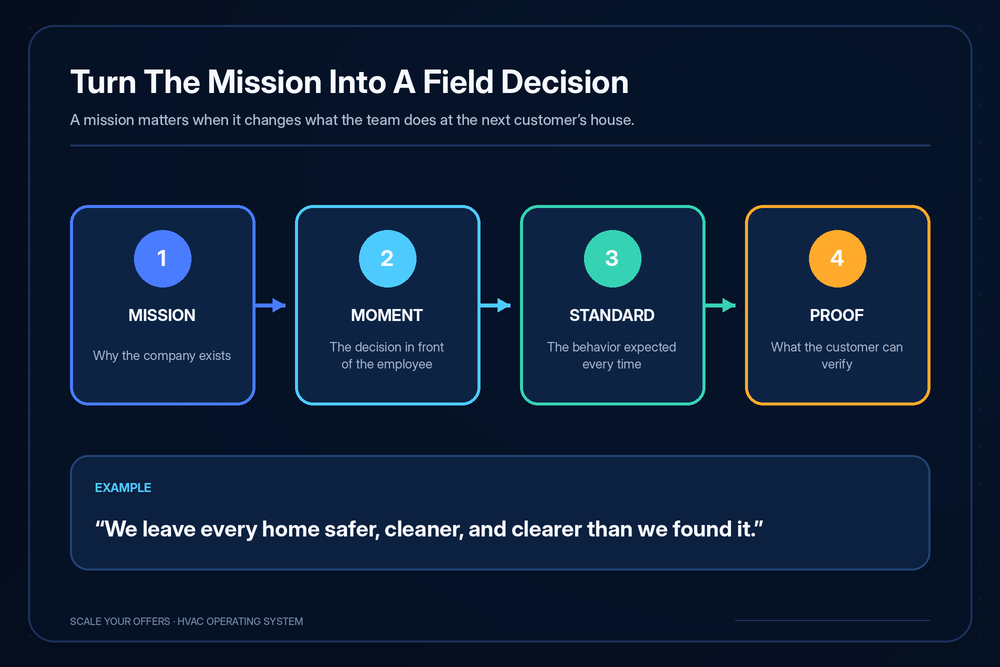
We leave every home safer, cleaner, and clearer than we found it.
That sentence can affect behavior:
- Safer means the technician documents hazards, follows the approved procedure, and refuses a shortcut that creates risk.
- Cleaner means the team protects the home, controls the work area, and completes a final cleanup.
- Clearer means the homeowner understands the diagnosis, the available paths, the price, and the next step.
The sentence is still compact. The standards underneath it make it operational.
Build the mission from four pieces
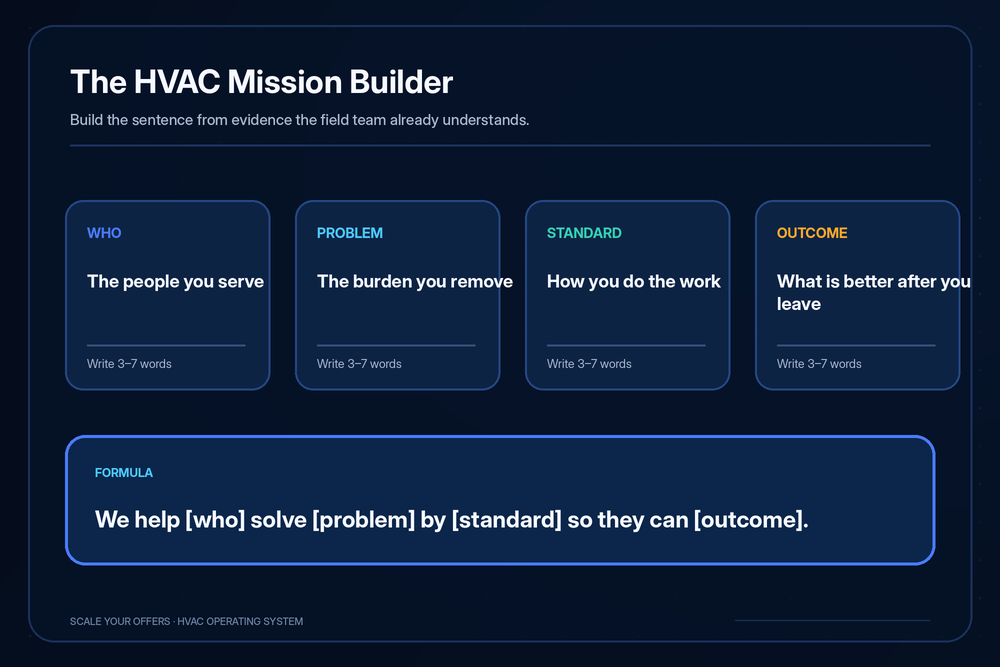
Start with the work your company actually wants to be known for. Use four components.
1. Who you serve
Name the real customer without making the sentence clumsy. “Homeowners and property managers in our community” may be accurate. “The families and businesses who depend on their building” may carry more meaning.
The right wording depends on your mix of residential, light commercial, and larger commercial work. Write for the company you run, not the category in general.
2. The burden you remove
HVAC work solves more than temperature. It can remove uncertainty, disruption, risk, wasted energy, repeated breakdowns, poor communication, and the stress of a major purchase made under pressure.
Choose the burden your best customers thank you for removing. Review recent reviews, callback notes, replacement consultations, and service-call recordings. The useful language already exists in those records.
3. The standard you hold
This is the operating promise inside the mission. Examples include:
- Diagnose before recommending.
- Explain before asking for a decision.
- Protect the home as carefully as the equipment.
- Do the documented work, even when the shortcut is faster.
- Tell the truth about repair and replacement.
Do not choose six. Pick the standard that organizes the others.
4. The outcome after you leave
Describe the customer's changed condition in plain language. They feel prepared. The home is comfortable. The building can operate. The customer understands the system. The family has a safe plan before extreme weather arrives.
A practical HVAC mission statement formula
Use this as a drafting tool:
We help [who] solve [burden] by [standard] so they can [outcome].
Examples below are starting points, not finished brand language.
Residential service company
We help local families protect the comfort of their homes by diagnosing carefully, explaining clearly, and doing the work we would want done for our own family.
Residential replacement company
We help homeowners make confident comfort decisions before an emergency makes the decision for them.
Commercial HVAC company
We help building teams keep people comfortable and operations moving through documented work, direct communication, and dependable response.
Company that wants to lead with craftsmanship
We build comfort systems that perform the way they were designed, and we leave the customer with proof of the work.
Company that wants to lead with trust
We give every customer an honest diagnosis, understandable choices, and a clean path forward.
Notice what the examples avoid. They do not claim to be “the best,” “the most trusted,” or “number one.” Those claims require proof and rarely help an employee make a decision.
Pull language from evidence, not a conference room
A leadership team can write a polished mission statement that sounds nothing like the company. Prevent that by gathering evidence first.
Review these five sources:
- Twenty recent five-star reviews.
- Ten complaints, callbacks, or lost-customer notes.
- Five stories employees tell with pride.
- Five situations where the company lost money to do the right thing.
- The reasons your best employees say they stay.
Create three columns: phrases customers use, behaviors employees respect, and failures the company refuses to repeat.
You are looking for patterns. Customers may repeatedly mention that the technician explained everything, protected the floor, arrived when promised, found an issue others missed, or gave them options without pressure. Those patterns are stronger material than a generic list of admired words.
Gallup argues that lived stories provide some of the clearest evidence that a company embodies its values.[4] The same principle applies to mission. A sentence gains credibility when the team can immediately attach a true story to it.
Write the standards under the sentence
The public mission may be one sentence. The internal operating definition should be one page.
Use a table like this:
| Mission phrase | What it means in the field | Proof we expect |
|---|---|---|
| Safer | Identify hazards and follow the approved safety procedure | Photos, readings, completed checklist, escalation note |
| Cleaner | Protect the customer's property and complete a final walkthrough | Arrival photo, protection used, final photo |
| Clearer | Explain findings, choices, pricing, and next step in plain language | Documented diagnosis and option recap |
OSHA's management-leadership guidance recommends written policies, clear goals, resources, visible leadership, and defined responsibilities for safety programs.[5] That is a useful model for any mission promise: define it, resource it, assign it, and inspect it.
Test the statement against five hard moments
A mission should survive pressure. Run each draft through these scenarios.
The expensive callback
A manager can hide the error, argue with the customer, or own the repair. What does the mission require?
The fourteen-year-old system
A repair may be reasonable. Replacement may also be reasonable. What does the mission require the technician to explain?
The overbooked Friday afternoon
The office can promise an arrival it cannot keep or tell the truth and offer the best available path. Which choice fits?
The productive technician who ignores the standard
The employee produces revenue and creates customer or safety risk. Will the mission influence coaching, compensation, and continued employment?
The job you should decline
A customer asks for work outside your capability, license, service area, or ethical standard. Does the mission give the team permission to walk away?
A mission that never costs time, money, or convenience is probably promotional copy. Real standards create tradeoffs.
Roll it out through the operating system
Do not reveal the mission at an annual meeting and assume the work is complete. Install it into the places where decisions happen.
Hiring
Ask candidates for a story that shows the behavior. If “explain clearly” matters, ask them to teach a technical idea to a nontechnical person during the interview.
Onboarding
Teach one true customer story for each phrase. Explain the standard, the proof, and the escalation path.
Daily huddles
Use one minute to recognize a field example or discuss a decision that tests the mission.
Call reviews
Score whether the CSR or technician made the mission visible. A vague “good call” does not teach a standard.
Compensation and promotion
Do not promote a person who repeatedly violates the mission because the revenue looks good. The team learns what leadership truly values from that decision.
Marketing
Turn the mission into proof-based claims. “We document the diagnosis with five photos and three readings” is stronger than “We care about quality.” Only publish standards your operation consistently performs.
A 30-day mission installation plan
| Week | Work | Finished outcome |
|---|---|---|
| 1 | Gather customer language, employee stories, complaints, and costly right decisions | Evidence bank |
| 2 | Draft three options and test them against hard moments | One approved mission sentence |
| 3 | Define field behavior and proof for each phrase | One-page operating definition |
| 4 | Add the mission to hiring, onboarding, huddles, call scoring, and recognition | Mission appears in the operating cadence |
At the end of 30 days, ask ten employees to explain the mission without reading it. Then ask for a recent example. Memorization without an example means the sentence has not reached the work yet.
HVAC mission statement checklist
Use this before you publish:
- A twelve-year-old can understand it.
- It names who benefits from the company's work.
- It describes a meaningful burden or outcome.
- It contains an operating standard.
- It does not rely on unprovable superlatives.
- A field employee can apply it to a real decision.
- Leadership can name a cost the company accepts to uphold it.
- Each phrase has visible proof.
- The team can tell true stories that demonstrate it.
- Hiring, coaching, recognition, and marketing all use it.
FAQ
What is a good mission statement for an HVAC company?
A good HVAC mission statement explains why the company exists for its customers and names a standard employees can apply. It should be specific enough to influence diagnosis, communication, property protection, safety, and customer choices.
How long should an HVAC mission statement be?
One sentence is usually enough for the public statement. Keep a separate one-page operating definition that explains the behavior and proof underneath each phrase.
Should the mission mention profit or growth?
Profit and growth belong in the vision and annual plan. The mission should explain the enduring value the company creates. A healthy business needs profit to continue serving, but profit alone gives the team little guidance in a customer moment.
How often should a mission statement change?
The wording can improve as the company matures, but the core purpose should remain durable. Review it during an annual or three-year planning cycle and revise only when the company, customer, or strategic direction has genuinely changed.
How do I make employees care about the mission?
Connect it to real decisions, true stories, recognition, coaching, and promotions. Employees will believe what leadership rewards, tolerates, and funds.
Put the mission inside the machine
A mission becomes useful when it reaches the phone, the truck, the proposal, the install, the callback, and the Monday scorecard. It gives leadership a consistent answer to the question, “How do we do business here?”
The next step is to find the earliest place your current growth system breaks. Take the free A.C.E. Assessment. It scores Attract, Convert, and Expand, then shows you which stage deserves attention first.
References
- Scale Your Offers, The Booked-Out Business Playbook: HVAC Edition, C.O.R.E. Culture section.
- Gallup, Employee Engagement Indicator
- Gallup, Purposeful Work Boosts Engagement, but Few Experience It
- Gallup, Are Your Company Values More Than Just Words?
- OSHA, Safety Management: Management Leadership