
The HVAC Leadership Meeting Cadence: Four Meetings That Replace Hallway Management
An HVAC company without a meeting cadence still has meetings.
They happen in the parking lot, through text messages, beside the dispatch board, during a customer's call, and five minutes before the truck leaves. The same issue gets discussed by different people, decisions disappear, and the owner becomes the routing system for the entire company.
A useful meeting cadence does not add bureaucracy. It collects the conversations that already happen, gives them an order, and turns them into decisions with owners and dates.
The Scale Your Offers C.O.R.E. framework uses four recurring meetings: a daily huddle, weekly scorecard, monthly review, and quarterly reset.[1] Together, they take less time than unmanaged interruptions and give each level of the company a clear job.
The four-meeting operating rhythm
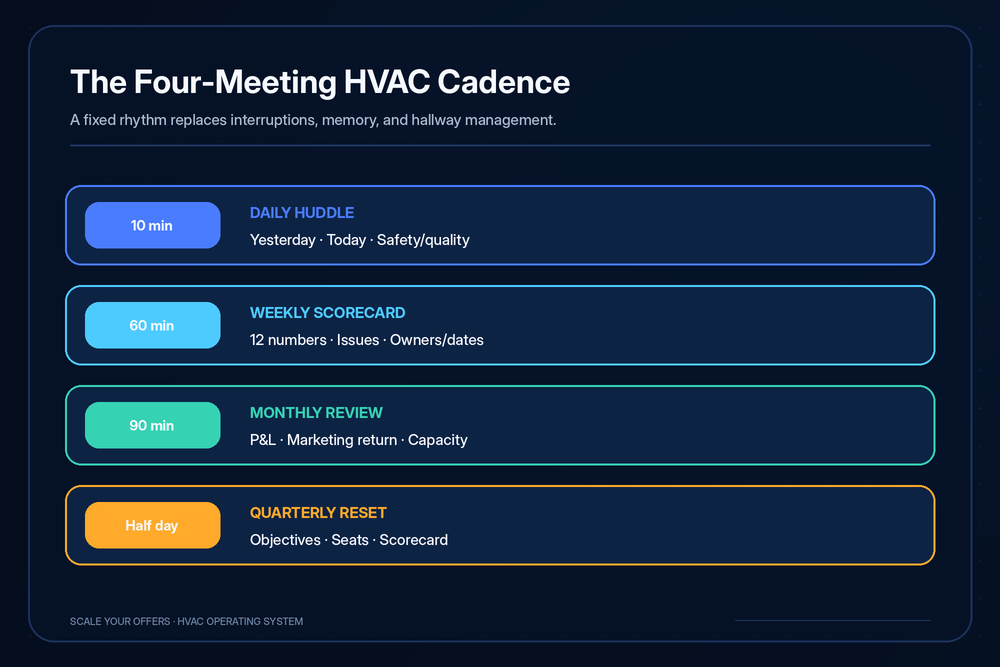
| Meeting | When | Length | Primary job |
|---|---|---|---|
| Daily huddle | Before trucks roll | 10 minutes | Align today's board, risks, and priorities |
| Weekly scorecard | Monday morning | 60 minutes | Read numbers, solve issues, assign owners and dates |
| Monthly review | First week of month | 90 minutes | Review P&L, marketing return, capacity, people, and trends |
| Quarterly reset | First week of quarter | Half day | Set priorities, review seats, rebuild targets, and allocate resources |
The meetings should connect. The daily huddle operates the day. The weekly scorecard operates the system. The monthly review checks economics and capacity. The quarterly reset chooses what the company will change.
Meeting 1: the 10-minute daily huddle
The huddle is not a morning speech and not a full dispatch meeting. It answers five questions:
- What happened yesterday that the team needs to know?
- What does today's board require?
- Where is capacity tight or exposed?
- Which customer, safety, quality, or material issue needs attention?
- What single commitment must be clear before people leave?
A practical agenda:
| Minute | Topic |
|---|---|
| 0–2 | Yesterday's wins and misses |
| 2–5 | Today's call board, installs, and capacity |
| 5–7 | Parts, permits, equipment, or customer risks |
| 7–9 | One safety or quality standard |
| 9–10 | Commitments and escalations |
The huddle should be visual. Use the dispatch board or a one-page view. Do not read every appointment aloud. Focus on exceptions, constraints, and handoffs.
The person closest to the day should run it. In many companies, that is the service manager, dispatcher, or operations manager rather than the owner.
Meeting 2: the 60-minute weekly scorecard
This is the operating center of the company.
The meeting reads the numbers in the same order every week, marks what is off target, solves the few issues that matter most, and sends every decision out with one accountable person and a date.
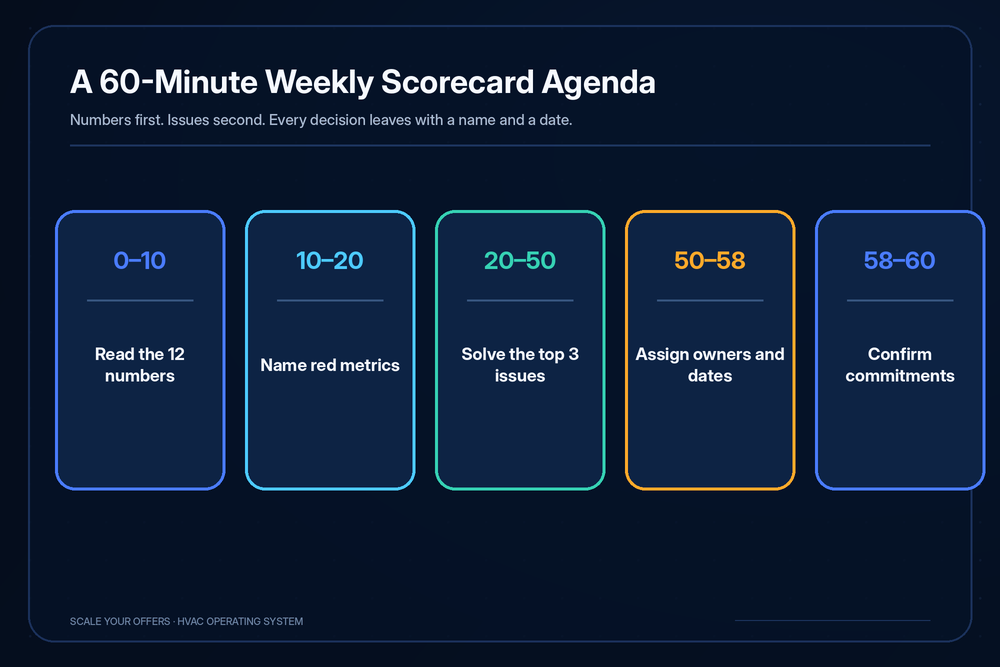
A strong agenda:
Minutes 0–10: read the numbers
Read the scorecard without a long explanation. The owner of each number states actual, target, and status.
Minutes 10–20: name the red metrics
Ask what changed, what the team knows, and what evidence is still missing. Avoid turning every red number into a defense.
Minutes 20–50: solve the top three issues
Choose the issues that sit earliest in the customer or operational journey. Solve fewer issues completely instead of discussing ten.
Minutes 50–58: assign owners and dates
Every decision becomes a task, policy change, test, or investigation with one name and one due date.
Minutes 58–60: confirm commitments
Read the commitments aloud. Record what remains unresolved.
The meeting ends on time. Unsolved issues stay on the list. They do not disappear into another conversation.
The 12 numbers to review weekly
A growing HVAC company can track hundreds of metrics. The weekly meeting needs the few that show whether the customer journey and operating capacity are healthy.
A practical starting set:
- Booked calls this week.
- Booking rate on answered qualified calls.
- Cost per booked call or job by primary channel.
- Calls run per technician per day.
- Average service ticket, read with call mix.
- Replacement opportunities generated.
- Replacement close rate.
- Average replacement ticket.
- New maintenance agreements.
- Reviews collected.
- Install backlog in days.
- Marketing spend and attributed sold revenue.
These are drawn from the Scale Your Offers operating scorecard.[1] Set targets from your economics, capacity, quality standards, and baseline. Do not copy another company's number without understanding the model underneath it.
Meeting 3: the 90-minute monthly review
The weekly meeting catches movement. The monthly review checks whether the movement creates a healthy business.
Use five sections.
Financial truth
Review revenue, gross margin, overhead, net profit, cash, receivables, financing fees, callback expense, and budget variance. The monthly review should connect the operating scorecard to the financial statements.
Marketing return
Review spend, qualified demand, booked calls, sold work, collected revenue, source mix, and campaign capacity. Separate lead volume from booked and sold outcomes.
Sales quality
Review opportunity volume, close rate, average ticket, option use, financing presentation, lost reasons, and open estimates without a next action.
Capacity and delivery
Review service productivity, install backlog, overtime, schedule density, callback rate, parts and equipment constraints, and upcoming seasonal demand.
People and priorities
Review open seats, hiring pipeline, manager capacity, training, performance patterns, and quarterly priorities.
The monthly review is where leadership sees tradeoffs. A strong close rate can create an install backlog. Higher lead volume can expose a booking problem. Fast revenue growth can hide declining margin.
Meeting 4: the quarterly reset
The quarterly reset works on the company rather than the week.
Use the half day to:
- Review the three-year vision and one-year outcomes.
- Compare quarter results with targets.
- Identify the earliest weak stage.
- Choose three to five company priorities.
- Review the accountability chart and manager capacity.
- Set or revise scorecard targets.
- Allocate budget and people.
- Decide what the company will stop doing.
- Communicate the quarter to the team.
OSHA recommends that safety and health programs be evaluated initially and periodically, at least annually, with workers involved in reviewing information, performance indicators, and improvement opportunities.[2] Safety needs its own qualified program and compliance review. The broader operating lesson is useful: standards require scheduled evaluation, employee input, and corrective action.
The issues-list rule
Anything raised in the weekly meeting gets a name and a date before the meeting ends.
Discussion without ownership creates temporary relief and no operating change.
A useful issues record includes:
| Field | Purpose |
|---|---|
| Issue | One sentence describing the gap |
| Evidence | Number, call, job, customer, or observation |
| Root cause | The current best explanation, marked as hypothesis when unproven |
| Decision | What the company will do |
| Owner | One accountable person |
| Due date | When the result returns to the meeting |
| Proof | What will show the issue is resolved |
Keep the list visible. A spreadsheet, project tool, or CRM task can work. The tool matters less than consistent use.
Separate reporting, solving, and coaching
Many meetings fail because three different jobs are mixed together.
Reporting
What happened? What is the number? What evidence exists?
Solving
What caused the gap? What decision or test should happen?
Coaching
What does one employee need to learn, practice, or change?
A scorecard meeting can identify a coaching need. Detailed individual feedback usually belongs in a one-on-one, ride-along, call review, or training session rather than a public debate.
Gallup reports that meaningful weekly feedback can nearly triple the share of engaged employees and that 15 to 30 minutes of consistent conversation can be enough.[3] Protect manager one-on-one time outside the scorecard meeting.
Rules that keep meetings useful
Use the same agenda
A predictable structure lowers preparation time and prevents the loudest issue from taking over every week.
Start with numbers
Numbers do not explain themselves, but they help the team choose where to investigate.
Mark assumptions
Say “we think” when the cause is not known. Assign someone to gather evidence.
Keep one owner per issue
Several people may contribute. One person returns with the result.
Write decisions while people are present
Do not rely on memory or a follow-up summary that may never arrive.
End on time
A meeting that regularly overruns teaches people to arrive unprepared and postpone decisions.
Recognize specific performance
Name the behavior, standard, and effect. Gallup and Workhuman research found 61% engagement among employees receiving weekly feedback and recognition, compared with 38% among those getting weekly feedback but less frequent recognition.[4]
Do not use the meeting to surprise people
Performance concerns should be addressed directly and promptly. The scorecard can show the pattern; respectful coaching belongs in the proper setting.
An illustrative weekly scorecard
| Number | Target | Actual | Owner | Status | Next action |
|---|---|---|---|---|---|
| Booked calls | 110 | 96 | CSR manager | Red | Review source mix and 10 missed calls |
| Booking rate | 68% | 54% | CSR manager | Red | Score 15 calls; retrain ask for booking |
| Replacement close rate | 50% | 52% | Sales manager | Green | Continue proposal audit |
| Install backlog | 7 days | 14 days | Ops manager | Red | Rebalance marketing and crew capacity |
| Reviews collected | 18 | 9 | Service manager | Red | Add driveway ask to completion checklist |
The table shows why the earliest-stage rule matters. When booking rate is weak and install backlog is already high, leadership may need two different decisions: repair the phone process and avoid increasing demand until capacity stabilizes.
A 30-day meeting-cadence installation
Week 1: build the scorecard
Choose the numbers, define each formula, assign owners, set initial targets, and establish the data source.
Week 2: launch the daily huddle and weekly meeting
Use the agenda exactly as written. Track confusion as an issue rather than redesigning everything mid-meeting.
Week 3: train issue solving and one-on-ones
Teach managers to separate evidence, cause, decision, and coaching. Schedule weekly feedback conversations.
Week 4: run the first monthly review
Connect scorecard movement to financial performance, capacity, and people. Choose improvements for the next 30 days.
Schedule the quarterly reset before the month ends.
Meeting-cadence checklist
- Four meetings have fixed days, lengths, and owners.
- The daily huddle runs before trucks roll.
- The weekly scorecard uses the same 12 or fewer numbers.
- Every number has one owner and one data source.
- Red metrics become issues rather than explanations.
- The meeting solves the highest-priority issues first.
- Every decision leaves with a name and date.
- Individual coaching happens outside the public scorecard review.
- Recognition names a specific behavior and standard.
- The monthly review connects operations to the P&L.
- The quarterly reset sets three to five priorities.
- Meetings end on time.
FAQ
How often should an HVAC team meet?
Use a short daily huddle for today's work, a weekly scorecard for operating performance, a monthly review for economics and capacity, and a quarterly reset for strategic priorities. Individual coaching should happen on a separate weekly or biweekly rhythm based on the role.
What should be on an HVAC weekly meeting agenda?
Read the scorecard, identify off-target metrics, solve the top issues, assign owners and dates, and confirm commitments. Avoid long status updates that could be read beforehand.
How long should an HVAC daily huddle be?
About 10 minutes is enough when the team uses a visual board and discusses exceptions, risks, and handoffs rather than every appointment.
Who should run the weekly leadership meeting?
The accountable operating leader should run it. In an owner-led company that may be the owner initially. As the structure matures, a general manager or operations leader may run the meeting while the owner participates in the areas the owner still owns.
What if our data is not reliable?
Start with the best available numbers, mark data-quality issues, and assign fixes. Waiting for perfect data preserves the current blind spot.
Give every issue a home
A cadence turns scattered conversations into a system. The next step is identifying which customer-growth stage deserves the team's attention first.
Take the free A.C.E. Assessment to score Attract, Convert, and Expand and get the first three moves for the weak stage.
References
- Scale Your Offers, The Booked-Out Business Playbook: HVAC Edition, C.O.R.E. Execution section.
- OSHA, Safety Management: Program Evaluation and Improvement
- Gallup, Span of Control: What Is the Optimal Team Size for Managers?
- Gallup, Organizations Can Redefine Feedback by Including Recognition