Build the Seats Before You Hire the People: An HVAC Accountability Chart by Revenue Stage
HVAC companies often build job descriptions around whoever happened to be available.
A dependable technician becomes the service manager and keeps a full route. A strong CSR becomes the office manager and still answers most calls. The owner gives marketing to a family member, dispatch to the CSR, purchasing to the install lead, and sales management to nobody in particular.
The people may be capable. The structure is still unclear.
An HVAC organizational chart becomes useful when it functions as an accountability chart. It defines the work the company needs, the number each seat owns, the authority attached to the seat, and the person currently filling it.
The order matters: build the seats before you hire the people.
Org chart versus accountability chart
A traditional org chart shows reporting lines. An accountability chart adds operating clarity.
Every seat answers five questions:
- What outcome does this seat own?
- What recurring work produces the outcome?
- What three to five numbers show performance?
- What decisions can the seat make?
- Who does the seat report to?
The Scale Your Offers C.O.R.E. framework uses a simple rule: one number has one owner. When two people “share” accountability for booking rate, close rate, callback rate, or install backlog, the number usually belongs to nobody.[1]
Build the chart around functions
Start with the functions that must exist in every HVAC company, even when one person fills several.
Leadership and finance
Vision, strategy, capital, financial review, risk, key hires, and culture.
Marketing and demand
Offers, paid media, search visibility, content, database reactivation, lead-source tracking, and marketing calendar.
Customer service and booking
Inbound calls, qualification, scheduling, confirmations, missed calls, customer updates, and follow-up.
Service operations
Technician performance, technical standards, training, callbacks, maintenance production, and field support.
Replacement sales
Opportunity management, diagnosis-to-proposal handoff, presentation, financing, follow-up, close rate, and average ticket.
Installation
Job readiness, equipment and material, permits, crew assignment, quality, commissioning, documentation, and customer handoff.
Dispatch and capacity
Schedule design, routing, emergency capacity, arrival standards, workload balance, and backlog.
Administration
Accounts receivable, accounts payable, payroll inputs, purchasing support, warranty registration, permits, and records.
At a small company, the owner may fill five of these functions. Writing the seats still matters because it shows which seat must separate next.
A revenue-stage HVAC accountability chart
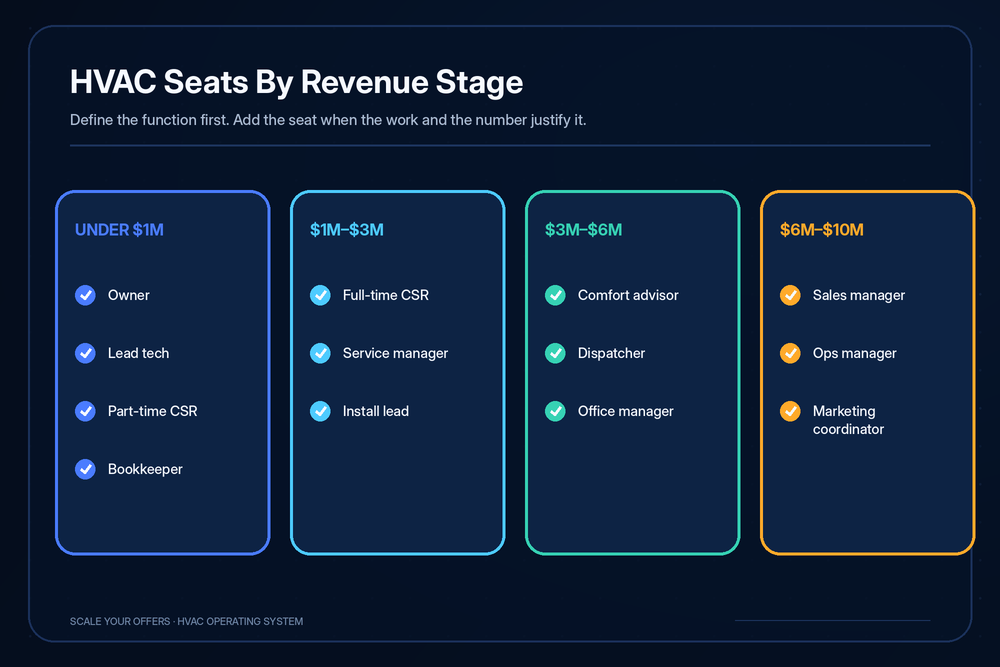
Company revenue is only a rough signal. Geography, service mix, commercial work, average ticket, subcontracting, and productivity change the right structure. Use the ranges below as a planning model, then adjust with your numbers.
Under $1 million
Seats that must exist:
- Owner/general manager.
- Lead technician.
- Part-time or shared CSR/dispatcher.
- Bookkeeper or outsourced accounting support.
The owner usually retains sales, dispatch decisions, marketing, purchasing, hiring, and major customer escalations.
The structural goal at this stage is clarity. Write the seats even when names repeat across the chart.
$1 million to $3 million
Add or separate:
- Full-time CSR.
- Service manager or field lead.
- Install lead.
- Clear dispatch ownership.
The owner often retains replacement sales and marketing decisions. The first major leadership challenge is preventing the service manager from becoming only the most experienced technician with a title.
$3 million to $6 million
Add or separate:
- Dedicated comfort advisor or replacement salesperson.
- Dispatcher.
- Office manager or customer-experience leader.
- More formal service-manager capacity.
The owner should move toward strategy, manager development, pricing, key hires, and capital. Marketing may still report to the owner while execution moves to an internal coordinator or outside partner.
$6 million to $10 million
Add or separate:
- Sales manager.
- Operations manager or general manager, depending on design.
- Marketing coordinator or marketing leader.
- Department scorecards and manager one-on-ones.
- Stronger finance/controller capability.
The owner's work should concentrate on vision, capital, key people, major relationships, and the operating review.
These stages mirror the role progression in the Scale Your Offers C.O.R.E. material.[1] They are planning guidance, not a mandate to add payroll before the economics support it.
Define a seat with one page
Use this template for every seat.
Seat name
Use a functional title: CSR, dispatcher, service manager, sales manager, install manager, operations manager.
Purpose
One sentence that describes why the seat exists.
The CSR seat turns qualified inbound demand into confirmed appointments with accurate expectations.
Five responsibilities
Keep the list focused on recurring outcomes, not every possible task.
Scorecard
Three to five numbers the seat owns.
Decision rights
What the person can decide without permission, within what limits.
Escalation rules
The conditions that require the next leader.
Reporting line
One accountable manager.
Required capabilities
Technical, leadership, communication, software, licensing, or experience requirements.
One seat, one number, one owner
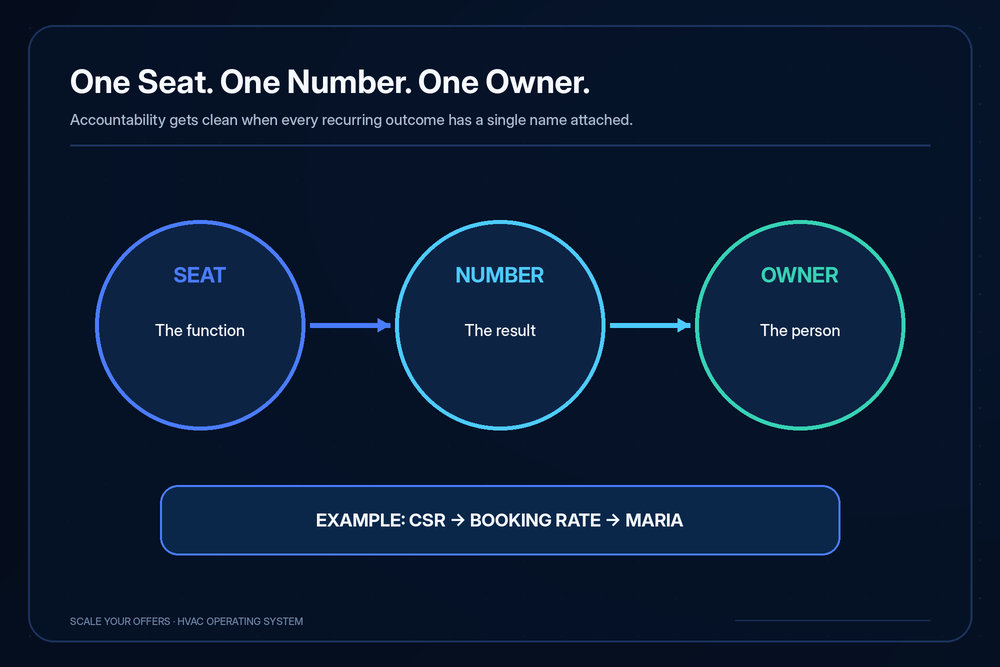
Examples:
| Seat | Primary number | Supporting numbers |
|---|---|---|
| CSR | Booking rate | Answer rate, speed to lead, abandoned calls, confirmations |
| Dispatcher | Schedule integrity | Drive time, on-time arrival, capacity reserved, reschedules |
| Service manager | Field performance | Average ticket, callback rate, maintenance conversion, training completion |
| Sales manager | Replacement revenue quality | Close rate, average ticket, financing presentation, open estimates |
| Install manager | Quality and throughput | Install backlog, gross margin, rework, commissioning completion |
| Marketing owner | Cost per booked job | Qualified leads, source mix, spend, sold revenue by source |
Several seats can influence a number. Only one seat should be accountable for bringing it to the weekly meeting, explaining movement, and leading the response.
Do not confuse activity with ownership
A marketing coordinator may post content and manage vendors. The seat should own a business outcome such as qualified demand, campaign deadlines, source reporting, or cost per booked job.
A service manager may ride with technicians and answer questions. The seat should own technician performance, callback learning, training cadence, and field standards.
An office manager may “help everybody.” The seat should own a defined set of customer, people, and workflow outcomes.
When the purpose ends with “assist,” “support,” or “help,” ask what finished result the seat is accountable for.
Set manager capacity intentionally
Gallup's span-of-control research says the median manager has six direct reports, while also cautioning that the right span depends on manager talent, individual-contributor workload, work complexity, and the support available.[2]
That nuance matters in HVAC.
A service manager with eight technicians, a full service route, constant field escalations, training responsibility, and callback ownership may have a title without management capacity. A dispatcher managing a stable zoned schedule may support a different number of people than a manager coaching new technicians through complex diagnostic work.
Ask:
- How much of this person's week remains individual-contributor work?
- How much coaching does the team require?
- How variable and risky are the decisions?
- Are SOPs, data, and support systems mature?
- Can the manager provide meaningful weekly feedback?
Gallup reports that weekly meaningful feedback can nearly triple the share of engaged employees and that 15 to 30 minutes of consistent conversation can be enough.[2] Protect the manager time required to do the job.
Decide when a seat becomes a hire
Do not hire from frustration alone. Use four triggers.
Volume trigger
The work consistently requires enough capacity for the seat.
Economic trigger
The added gross profit, recovered owner time, protected revenue, or reduced cost can support the compensation and tools.
Risk trigger
The current structure creates unacceptable customer, safety, financial, or compliance risk.
Leadership trigger
The missing seat prevents other people from owning outcomes or developing.
Use trailing data. One chaotic week does not always justify a permanent hire. A recurring pattern across a season usually deserves a structural answer.
An illustrative seat-economics calculation
Assume an owner spends 20 hours per week on dispatch, routine customer escalations, and schedule rebuilding. A dispatcher/office leader could take 15 of those hours while also improving booking follow-through and arrival communication.
If the role costs $70,000 in total annual employment expense, leadership should identify the operating value required:
- Owner capacity released.
- Fewer missed or mishandled calls.
- Better schedule density.
- Lower overtime or drive time.
- Fewer preventable customer complaints.
- More consistent follow-up.
Do not invent savings to justify the hire. Set a 90-day scorecard and compare the baseline.
Write decision rights beside the chart
Reporting lines alone do not create authority.
For each manager, define limits for:
- Customer credits.
- Overtime.
- Discounts.
- Purchase orders.
- Schedule changes.
- Hiring steps.
- Corrective action.
- Warranty and callback responses.
- Vendor decisions.
The employee should know which decisions belong to the seat and which require escalation. The owner should follow the same boundary.
Prevent the two-boss problem
An employee who receives conflicting priorities from the owner and a manager has two bosses. The manager loses accountability because authority can be bypassed.
Use one reporting line for normal work. Cross-functional requests should route through the accountable managers or the shared operating meeting.
The owner can inspect anything. Inspection is different from changing priorities directly with an employee and leaving the manager to discover it later.
Build the chart in the right order
- List the functions the company needs today and within three years.
- Create seats around outcomes.
- Assign one primary number to each seat.
- Write responsibilities, decision rights, and escalation rules.
- Draw reporting lines.
- Place current people into seats.
- Mark seats that are combined, empty, or overloaded.
- Choose the first separation based on the earliest operating constraint.
- Build the 90-day scorecard before hiring.
- Review the chart quarterly.
The Bureau of Labor Statistics projects about 40,600 HVAC openings per year on average from 2025 to 2035.[3] A competitive labor market makes role clarity more important. A strong candidate needs to understand the job, authority, manager, and success measures before accepting it.
Sample HVAC accountability-chart scorecards
CSR
- Booking rate on answered qualified calls.
- Speed to first response.
- Abandoned or missed calls recovered.
- Appointment confirmation rate.
- Data-completeness rate.
Service manager
- Callback rate.
- Average service ticket, read with call mix.
- Maintenance-agreement conversion.
- Required documentation completion.
- Weekly coaching completed.
Sales manager
- Replacement close rate.
- Average replacement ticket.
- Proposal-option use.
- Financing presentation rate.
- Open estimates with a dated next action.
Install manager
- Install backlog in days.
- Gross margin by job.
- Rework and callback rate.
- Commissioning/documentation completion.
- Jobs starting with complete material and permit readiness.
Targets should be set from company economics, baseline performance, market, and quality standards. A scorecard should create focus, not encourage gaming.
30-day accountability-chart build
| Week | Work | Outcome |
|---|---|---|
| 1 | List functions, recurring decisions, owner work, and current numbers | Current-state map |
| 2 | Define seats, purposes, responsibilities, scorecards, and reporting lines | Draft accountability chart |
| 3 | Add names, decision rights, escalation rules, and combined-seat warnings | Live chart |
| 4 | Start manager one-on-ones and weekly scorecard; choose first structural change | Operating cadence |
Accountability-chart checklist
- Every necessary function appears.
- Seats are built around outcomes.
- Each seat has one primary accountable number.
- Supporting metrics are limited and relevant.
- Every seat has one reporting line.
- Decision rights are written.
- Escalation limits protect risk.
- Combined seats are visible.
- Empty future seats are visible.
- Managers have time to manage.
- Hiring begins with a seat scorecard.
- The chart is reviewed quarterly.
FAQ
What roles does an HVAC company need?
Every HVAC company needs leadership/finance, marketing, customer service and booking, dispatch, service operations, replacement sales, installation, and administration functions. One person may fill several seats in a smaller company.
When should an HVAC company hire a service manager?
Hire or formally separate the seat when field volume, training, callbacks, technician support, and owner time create enough recurring work and economic value. Define the scorecard and authority before choosing the person.
Is an org chart useful for a small HVAC company?
Yes. It shows which functions the owner currently carries and which seat should separate next. Use multiple seat labels under one person's name rather than pretending the functions do not exist.
How many numbers should each seat own?
Three to five supporting metrics are usually enough, with one primary number that makes accountability clear. The exact set depends on the role and company model.
Can two people own the same KPI?
Several people can influence a KPI. Give one seat accountability for reporting it, understanding movement, and leading the response.
Put the right work in the right seat
A clean accountability chart reduces owner dependency, clarifies hiring, and gives every weekly number a home. The next step is deciding which stage should receive attention first.
Take the free A.C.E. Assessment to score Attract, Convert, and Expand and identify the earliest constraint in the customer-growth system.
References
- Scale Your Offers, The Booked-Out Business Playbook: HVAC Edition, C.O.R.E. Roles section.
- Gallup, Span of Control: What Is the Optimal Team Size for Managers?
- U.S. Bureau of Labor Statistics, Heating, Air Conditioning, and Refrigeration Mechanics and Installers