
Dec 21, 2025
How to Write a 15-Minute VSL with AI in One Prompt
Writing a video sales letter used to take days. Sometimes weeks. You'd stare at a blank page, struggle with the hook, second-guess your story, and wonder if any of it would actually convert.
AI has changed that timeline dramatically.
Over the past six to eight months, we've refined a process for writing VSLs with AI that cuts production time by 40-50%. The real benefit goes beyond speed. When you can write faster, you can test more. And in marketing, the more variations you test, the higher your chances of finding a winner.
Here's the complete process for writing a 15-minute video sales letter using AI in a single prompt session.
The Foundation: What the AI Needs to Know
Before you write a single word of your VSL, you need to feed your AI the right context. The quality of your output depends entirely on the quality of your input.
Your prompt should establish these parameters upfront:
Word count target: A 15-minute VSL runs approximately 2,250 words at 150 words per spoken minute. Tell the AI this constraint before you begin.
Reading level: Keep everything at an eighth-grade reading level maximum. Simpler language converts better. If something sounds too sophisticated, it probably is.
Writing style: The copy must be conversational because it will be read word-for-word. Anything that sounds written will sound awkward when spoken aloud.
Psychological depth: Direct the AI to speak to layer three psychology. Surface-level pains and desires create surface-level connections. You want the VSL to touch on the deepest fears, aspirations, and emotional triggers your audience carries.
Dimensional language: Request vivid imagery that paints pictures in the mind of your viewer. Abstract concepts don't convert. Concrete images do.
The 12-Step VSL Framework
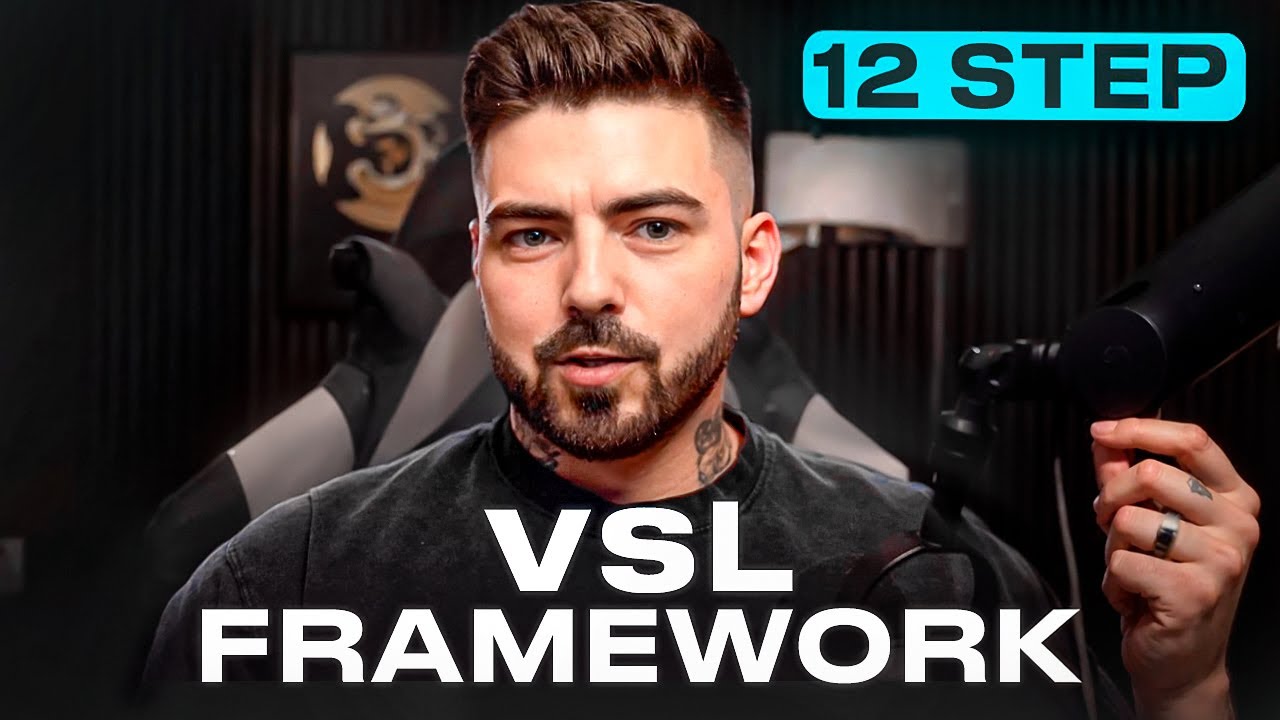
The structure we use comes from Digital Marketer's proven 12-step video sales letter framework. Each section serves a specific purpose in the conversion sequence.
The framework moves through these phases: hook, problem agitation, story introduction, authority establishment, mechanism explanation, social proof, offer presentation, objection handling, future pacing, risk reversal, scarcity, and call to action.
When you feed this framework to Claude, paste the entire structure along with your context. The AI needs to understand how each piece connects to the next.
One modification we make consistently: we place the social proof section after explaining how the mechanism works. This sequencing creates logical flow. You explain what you do, then prove that it actually works.
Crafting the Hook
The hook determines whether anyone watches the rest of your VSL. Most AI-generated hooks fall flat because they're too generic or too clever.
A strong hook meets the viewer exactly where they are emotionally. It describes a moment they recognize from their own life.
Here's an example from a marriage coaching VSL:
"You know that moment. The one where you're lying next to your spouse but you might as well be sleeping next to a stranger. Maybe you just tried to reach out to touch their hand or snuggle closer, but they rolled away. Again.
And in the silent darkness, your mind starts racing. Wondering how you got here. Wondering what happened to the person who used to light up when you walked into the room.
The one who couldn't wait to share their day with you. Who used to look at you like you were their whole world."
This hook works because it describes a specific physical and emotional experience. The viewer immediately recognizes themselves in it.
When your AI produces a hook that feels too broad or too polished, send it back. Request something more conversational, more dimensional, more rooted in layer three psychology.
Building the Body
The body of your VSL follows a predictable arc: present problem, aggravate problem, introduce solution, prove it works, make the offer.
Within the problem section, paint the picture of consequences. What happens if they don't solve this? Where does this road lead? The AI should future-pace the negative outcome before introducing any hope.
The story section establishes credibility through lived experience. Your presenter has faced the same struggle.
They tried all the common solutions. Nothing worked until they discovered the mechanism you're about to reveal.
When writing this section, feed the AI specific details from your client's actual story. Generic transformation narratives feel manufactured. Real details create real connection.
Weaving in Social Proof
Standard practice puts all testimonials in one block. We take a different approach.
Thread social proof throughout the VSL at moments of maximum relevance. When you describe a pain point in the hook, cut to a testimonial of someone experiencing that exact pain. When you describe the transformation, show someone who achieved that specific result.
This technique requires more editing in post-production, but it creates a more compelling narrative flow. The viewer sees themselves in multiple people throughout the presentation.
The Editing Process
AI gives you a foundation. It does not give you a finished product.
After generating your VSL, read the entire script out loud. Every single word. If you stumble on a phrase, your presenter will stumble on it too. If something sounds awkward in your mouth, it sounds awkward in their ears.
Change anything that doesn't flow naturally. Simplify sentences that run too long. Break up paragraphs that feel dense.
This editing process is where dyslexia becomes an advantage. When reading is already challenging, you notice friction points that others miss. If it's hard for you to read, it's probably hard for someone to listen to.
Common Mistakes to Avoid
Letting the AI finish too soon: Claude sometimes stops mid-VSL and asks if you want it to continue. Keep prompting until you have the complete script. This burns through credits faster, but incomplete scripts waste more time than credits ever could.
Accepting the first hook: The initial hook rarely hits hard enough. Send it back two or three times before moving forward with the body.
Ignoring flow: AI tends to write in choppy fragments that look good on screen but sound robotic when spoken. Every sentence needs to connect naturally to the next.
Skipping the read-aloud test: This is where most people cut corners. Reading silently and reading aloud reveal completely different problems.
The Complete Prompt Structure
Here's how to structure your single prompt for maximum output quality:
Start with context. Tell the AI exactly what you're creating and why. Specify the word count, reading level, and psychological depth you need.
Provide your framework. Paste the full 12-step structure so the AI understands the required sections and their sequence.
Include your avatar details. The more specific you are about who you're speaking to, the more specific the AI can be in its language.
Add your story elements. Give the AI the transformation story it needs to tell. Real details make real copy.
Specify your offer and call to action. What are you asking them to do at the end?
End with quality parameters. Request conversational language, vivid imagery, and layer three psychological connection.
Why This Process Works
The AI handles the structural heavy lifting. It understands frameworks. It can produce volume quickly. It doesn't experience writer's block.
You handle the refinement. You know your audience. You can hear when something sounds wrong. You understand the difference between copy that looks good and copy that converts.
This division of labor produces better VSLs in less time. You're not starting from nothing. You're starting from something you can shape.
The math is straightforward. If you can write VSLs 40-50% faster, you can test 40-50% more variations. More variations mean more data. More data means faster optimization. Faster optimization means higher conversion rates.
Frequently Asked Questions
How long should a video sales letter be?
Most high-converting VSLs run between 10 and 20 minutes. A 15-minute VSL translates to approximately 2,250 words at a speaking pace of 150 words per minute. The optimal length depends on offer complexity and price point. Higher ticket offers typically require longer VSLs to build sufficient trust and handle more objections.
Can AI write a complete VSL without human editing?
AI produces a solid first draft, but human editing remains essential. The AI doesn't know how your specific audience speaks, what details ring true, or where the script flows poorly when read aloud. Plan to edit every AI-generated VSL line by line before production.
What reading level should a VSL be written at?
Keep your VSL at an eighth-grade reading level or below. Simpler language creates broader appeal and easier comprehension. When viewers have to work to understand your message, they stop watching. Run your script through a readability checker before recording.
What is layer three psychology in copywriting?
Layer three psychology addresses the deepest emotional drivers behind purchasing decisions. Layer one covers surface-level wants. Layer two addresses stated problems. Layer three reaches the fears, insecurities, and aspirations that people rarely articulate openly. VSLs that connect at layer three create stronger emotional responses and higher conversion rates.
How do I make AI-generated copy sound more natural?
Read the script aloud immediately after generation. Anything that sounds written rather than spoken needs revision. Request conversational language in your prompt. Ask the AI to write as if someone is speaking directly to a friend. Then edit aggressively for flow and authenticity.
What VSL framework converts best?
The 12-step framework from Digital Marketer provides a proven structure that guides viewers from attention through action. The sequence matters: hook, problem, story, authority, mechanism, proof, offer, objections, future pacing, guarantee, urgency, and call to action. Modify the sequence based on your specific offer and audience.
How many VSL variations should I test?
Test as many variations as your budget and timeline allow. At minimum, test different hooks against each other. The hook determines whether anyone watches the rest. Beyond hooks, test different story angles, proof points, and calls to action. More tests generate more data for optimization.
Ready to Scale Your VSLs?
At Scale Your Offers, we don't just write VSLs. We go line by line to make sure everything flows, everything hits, and everything converts. Our core metric is client revenue. If we're not generating results, we're not doing our job.




1722 Diane St. Spring Hill, FL 34609
2026 © Ads and Funnels LLC, All Right Reserved
1722 Diane St. Spring Hill, FL 34609
2026 © Ads and Funnels LLC, All Right Reserved
1722 Diane St. Spring Hill, FL 34609
2026 © Ads and Funnels LLC, All Right Reserved
Dec 21, 2025
How to Write a 15-Minute VSL with AI in One Prompt
Writing a video sales letter used to take days. Sometimes weeks. You'd stare at a blank page, struggle with the hook, second-guess your story, and wonder if any of it would actually convert.
AI has changed that timeline dramatically.
Over the past six to eight months, we've refined a process for writing VSLs with AI that cuts production time by 40-50%. The real benefit goes beyond speed. When you can write faster, you can test more. And in marketing, the more variations you test, the higher your chances of finding a winner.
Here's the complete process for writing a 15-minute video sales letter using AI in a single prompt session.
The Foundation: What the AI Needs to Know
Before you write a single word of your VSL, you need to feed your AI the right context. The quality of your output depends entirely on the quality of your input.
Your prompt should establish these parameters upfront:
Word count target: A 15-minute VSL runs approximately 2,250 words at 150 words per spoken minute. Tell the AI this constraint before you begin.
Reading level: Keep everything at an eighth-grade reading level maximum. Simpler language converts better. If something sounds too sophisticated, it probably is.
Writing style: The copy must be conversational because it will be read word-for-word. Anything that sounds written will sound awkward when spoken aloud.
Psychological depth: Direct the AI to speak to layer three psychology. Surface-level pains and desires create surface-level connections. You want the VSL to touch on the deepest fears, aspirations, and emotional triggers your audience carries.
Dimensional language: Request vivid imagery that paints pictures in the mind of your viewer. Abstract concepts don't convert. Concrete images do.
The 12-Step VSL Framework
The structure we use comes from Digital Marketer's proven 12-step video sales letter framework. Each section serves a specific purpose in the conversion sequence.
The framework moves through these phases: hook, problem agitation, story introduction, authority establishment, mechanism explanation, social proof, offer presentation, objection handling, future pacing, risk reversal, scarcity, and call to action.
When you feed this framework to Claude, paste the entire structure along with your context. The AI needs to understand how each piece connects to the next.
One modification we make consistently: we place the social proof section after explaining how the mechanism works. This sequencing creates logical flow. You explain what you do, then prove that it actually works.
Crafting the Hook
The hook determines whether anyone watches the rest of your VSL. Most AI-generated hooks fall flat because they're too generic or too clever.
A strong hook meets the viewer exactly where they are emotionally. It describes a moment they recognize from their own life.
Here's an example from a marriage coaching VSL:
"You know that moment. The one where you're lying next to your spouse but you might as well be sleeping next to a stranger. Maybe you just tried to reach out to touch their hand or snuggle closer, but they rolled away. Again.
And in the silent darkness, your mind starts racing. Wondering how you got here. Wondering what happened to the person who used to light up when you walked into the room.
The one who couldn't wait to share their day with you. Who used to look at you like you were their whole world."
This hook works because it describes a specific physical and emotional experience. The viewer immediately recognizes themselves in it.
When your AI produces a hook that feels too broad or too polished, send it back. Request something more conversational, more dimensional, more rooted in layer three psychology.
Building the Body
The body of your VSL follows a predictable arc: present problem, aggravate problem, introduce solution, prove it works, make the offer.
Within the problem section, paint the picture of consequences. What happens if they don't solve this? Where does this road lead? The AI should future-pace the negative outcome before introducing any hope.
The story section establishes credibility through lived experience. Your presenter has faced the same struggle.
They tried all the common solutions. Nothing worked until they discovered the mechanism you're about to reveal.
When writing this section, feed the AI specific details from your client's actual story. Generic transformation narratives feel manufactured. Real details create real connection.
Weaving in Social Proof
Standard practice puts all testimonials in one block. We take a different approach.
Thread social proof throughout the VSL at moments of maximum relevance. When you describe a pain point in the hook, cut to a testimonial of someone experiencing that exact pain. When you describe the transformation, show someone who achieved that specific result.
This technique requires more editing in post-production, but it creates a more compelling narrative flow. The viewer sees themselves in multiple people throughout the presentation.
The Editing Process
AI gives you a foundation. It does not give you a finished product.
After generating your VSL, read the entire script out loud. Every single word. If you stumble on a phrase, your presenter will stumble on it too. If something sounds awkward in your mouth, it sounds awkward in their ears.
Change anything that doesn't flow naturally. Simplify sentences that run too long. Break up paragraphs that feel dense.
This editing process is where dyslexia becomes an advantage. When reading is already challenging, you notice friction points that others miss. If it's hard for you to read, it's probably hard for someone to listen to.
Common Mistakes to Avoid
Letting the AI finish too soon: Claude sometimes stops mid-VSL and asks if you want it to continue. Keep prompting until you have the complete script. This burns through credits faster, but incomplete scripts waste more time than credits ever could.
Accepting the first hook: The initial hook rarely hits hard enough. Send it back two or three times before moving forward with the body.
Ignoring flow: AI tends to write in choppy fragments that look good on screen but sound robotic when spoken. Every sentence needs to connect naturally to the next.
Skipping the read-aloud test: This is where most people cut corners. Reading silently and reading aloud reveal completely different problems.
The Complete Prompt Structure
Here's how to structure your single prompt for maximum output quality:
Start with context. Tell the AI exactly what you're creating and why. Specify the word count, reading level, and psychological depth you need.
Provide your framework. Paste the full 12-step structure so the AI understands the required sections and their sequence.
Include your avatar details. The more specific you are about who you're speaking to, the more specific the AI can be in its language.
Add your story elements. Give the AI the transformation story it needs to tell. Real details make real copy.
Specify your offer and call to action. What are you asking them to do at the end?
End with quality parameters. Request conversational language, vivid imagery, and layer three psychological connection.
Why This Process Works
The AI handles the structural heavy lifting. It understands frameworks. It can produce volume quickly. It doesn't experience writer's block.
You handle the refinement. You know your audience. You can hear when something sounds wrong. You understand the difference between copy that looks good and copy that converts.
This division of labor produces better VSLs in less time. You're not starting from nothing. You're starting from something you can shape.
The math is straightforward. If you can write VSLs 40-50% faster, you can test 40-50% more variations. More variations mean more data. More data means faster optimization. Faster optimization means higher conversion rates.
Frequently Asked Questions
How long should a video sales letter be?
Most high-converting VSLs run between 10 and 20 minutes. A 15-minute VSL translates to approximately 2,250 words at a speaking pace of 150 words per minute. The optimal length depends on offer complexity and price point. Higher ticket offers typically require longer VSLs to build sufficient trust and handle more objections.
Can AI write a complete VSL without human editing?
AI produces a solid first draft, but human editing remains essential. The AI doesn't know how your specific audience speaks, what details ring true, or where the script flows poorly when read aloud. Plan to edit every AI-generated VSL line by line before production.
What reading level should a VSL be written at?
Keep your VSL at an eighth-grade reading level or below. Simpler language creates broader appeal and easier comprehension. When viewers have to work to understand your message, they stop watching. Run your script through a readability checker before recording.
What is layer three psychology in copywriting?
Layer three psychology addresses the deepest emotional drivers behind purchasing decisions. Layer one covers surface-level wants. Layer two addresses stated problems. Layer three reaches the fears, insecurities, and aspirations that people rarely articulate openly. VSLs that connect at layer three create stronger emotional responses and higher conversion rates.
How do I make AI-generated copy sound more natural?
Read the script aloud immediately after generation. Anything that sounds written rather than spoken needs revision. Request conversational language in your prompt. Ask the AI to write as if someone is speaking directly to a friend. Then edit aggressively for flow and authenticity.
What VSL framework converts best?
The 12-step framework from Digital Marketer provides a proven structure that guides viewers from attention through action. The sequence matters: hook, problem, story, authority, mechanism, proof, offer, objections, future pacing, guarantee, urgency, and call to action. Modify the sequence based on your specific offer and audience.
How many VSL variations should I test?
Test as many variations as your budget and timeline allow. At minimum, test different hooks against each other. The hook determines whether anyone watches the rest. Beyond hooks, test different story angles, proof points, and calls to action. More tests generate more data for optimization.
Ready to Scale Your VSLs?
At Scale Your Offers, we don't just write VSLs. We go line by line to make sure everything flows, everything hits, and everything converts. Our core metric is client revenue. If we're not generating results, we're not doing our job.
1722 Diane St. Spring Hill, FL 34609
2026 © Ads and Funnels LLC, All Right Reserved